From First Principles
Podcast Description
We break down the week’s biggest science headlines from first principles—because understanding the world shouldn’t require a PhD.
Podcast Insights
Content Themes
The show focuses on breaking down complex scientific topics from first principles, with episodes covering themes such as cosmic discoveries, advancements in biotechnology, and notable astronomical events. Recent episodes have explored subjects like the characteristics of the interstellar visitor 3I ATLAS, the capabilities of the Vera Rubin Observatory, and the implications of CRISPR advancements.
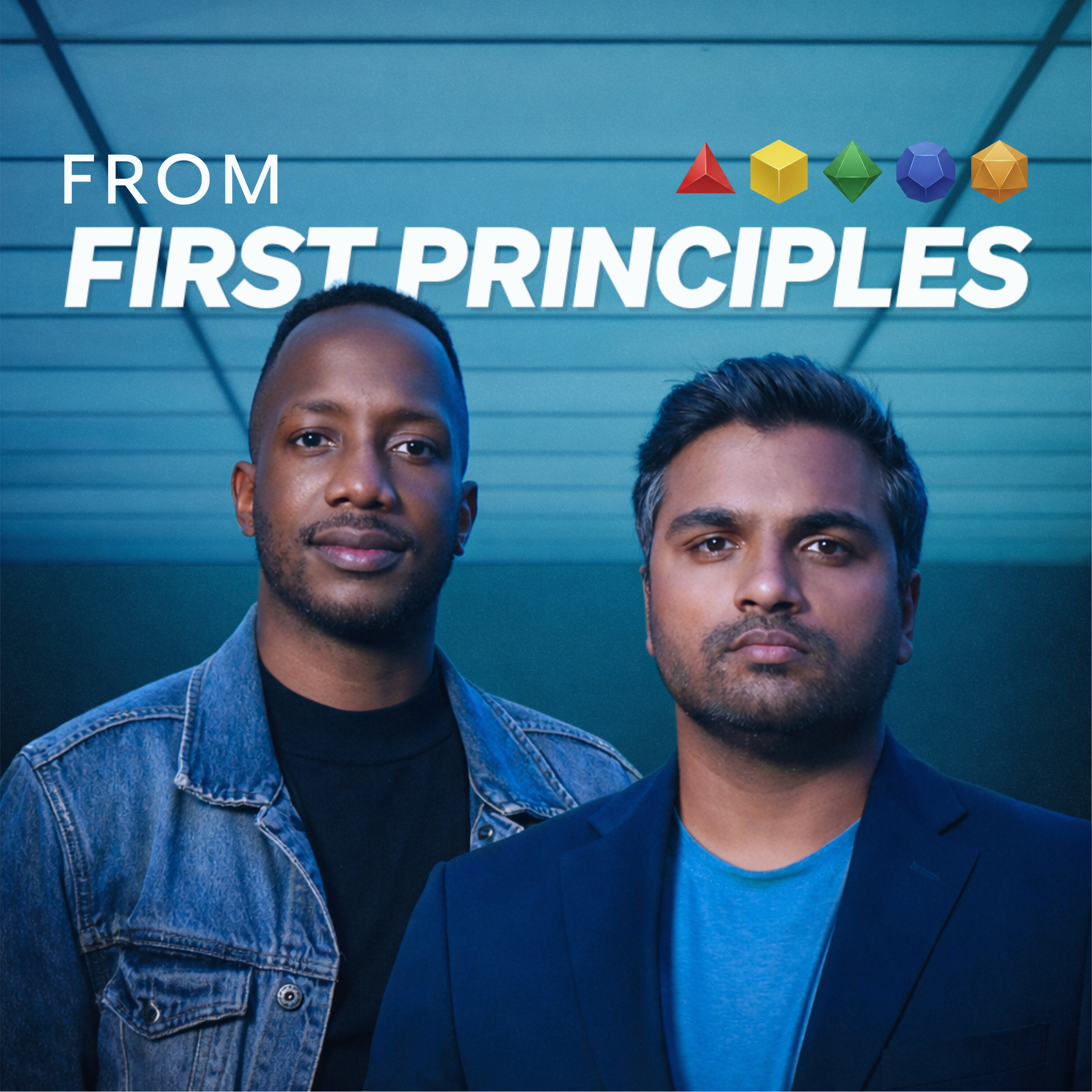
From First Principles is a fast, funny, and rigorous breakdown of the biggest science stories of the week, hosted by Lester Nare and physicist Krishna Choudhary, PhD. We go past headlines into the actual mechanics: what happened, why it matters, and what everyone’s missing.
Expect physics, space, AI, energy, biotech, and the occasional “wait… is that real?” story. If you’re curious, skeptical, and you like learning in public — you’re in the right place.
Why build a telescope inside a billion tons of Antarctic ice? The 2026 Nobel Prize in Physics recognizes Francis Halzen’s work on IceCube and the discovery of high-energy neutrinos from the cosmos.
In Episode 62 of From First Principles, Lester Nare and Krishna Choudhary explain neutrinos from the ground up: why these elusive particles make powerful cosmic messengers, how faint flashes of Cherenkov light reveal their interactions, and why detecting them requires an observatory buried deep beneath the South Pole.
We follow the path from beta decay and the first neutrino experiments to AMANDA, IceCube’s construction, the 2013 astrophysical breakthrough, a distant blazar, and a neutrino map of the Milky Way. Along the way: cosmic rays, the Oh-My-God particle, tracks versus cascades, and the international collaboration behind the discovery.
CHAPTERS
00:00 Hunting ghost particles beneath Antarctica
01:16 Hello Internet and Nobel Prize
05:30 What are neutrinos?
10:00 Neutrinos as cosmic messengers
15:02 The Oh-My-God particle
16:21 Cosmic-ray energies
19:07 Cosmic particle accelerators
22:28 Why look for neutrinos?
25:52 How to detect a neutrino
29:23 Cherenkov light
33:13 Building a neutrino observatory
37:17 From Antarctic ice to AMANDA
42:21 Building IceCube
44:59 Reading tracks and cascades
49:30 Backgrounds and the 2013 discovery
52:46 Tracing cosmic neutrino sources
54:16 Mapping the Milky Way
58:23 IceCube collaboration and Gen2
1:01:05 Closing and Nobel week
RESEARCH & FURTHER READING
AMANDA in Antarctic ice (2001): https://doi.org/10.1038/35068509
IceCube detector and instrumentation (2017): https://doi.org/10.1088/1748-0221/12/03/P03012
First PeV neutrinos (2013): https://doi.org/10.1103/PhysRevLett.111.021103
Astrophysical neutrino evidence (2013): https://doi.org/10.1126/science.1242856
Blazar TXS 0506+056 (2018): https://doi.org/10.1126/science.aat1378
Archival blazar neutrino emission (2018): https://doi.org/10.1126/science.aat2890
Milky Way neutrino map (2023): https://doi.org/10.1126/science.adc9818
Gamma-ray burst constraints (2012): https://doi.org/10.1038/nature11068
IceCube overview: https://icecube.wisc.edu/science/icecube/
EDITORIAL NOTES
Intro: the 2013 breakthrough was high-energy astrophysical neutrinos. Lower-energy supernova neutrinos were detected in 1987.
On-screen clarifications:
06:45 Beta-minus decay produces a proton, electron and electron antineutrino.
11:10 Davis studied solar neutrinos; Koshiba’s team detected SN 1987A neutrinos.
17:50 The cosmic-ray knee and ankle are not fixed distance boundaries.
19:38 Required accelerator size depends on magnetic-field strength.
24:18 Ground-based telescopes also detect gamma rays through air showers.
27:48 W interactions produce charged leptons; Z scattering preserves neutrino flavor.
34:06 The underwater concept dates to 1960; DUMAND developed in the 1970s.
36:09 Baikal holds about one-fifth of unfrozen surface freshwater.
38:53 Earth filters muons but also absorbs many very-high-energy neutrinos.
41:26 Pressure converts air bubbles into clathrates, reducing light scattering.
42:28 Construction finished in December 2010; full operations began in May 2011.
44:27 Sensors are DOMs; DeepCore is a densely instrumented detector region.
45:47 Timing gives direction; light yield and pattern help estimate energy.
49:44 Upgoing events can still be atmospheric neutrinos.
53:12 TXS 0506+056 is about 3.7 billion light-years away.
56:38 Long GRBs often involve collapsing stars; short GRBs often involve mergers.
WATCH & FOLLOW
Full video: https://youtu.be/eMahxeBj5k0
Episode notes: https://ffppod.com/episodes/ep62
Medicine Nobel explained: https://youtu.be/PKAYqhy8xf8
Follow @FFPPod on Instagram, TikTok, X and Facebook.
From First Principles: Breaking down science news so it makes sense to curious people everywhere.
Disclaimer
This podcast’s information is provided for general reference and was obtained from publicly accessible sources. The Podcast Collaborative neither produces nor verifies the content, accuracy, or suitability of this podcast. Views and opinions belong solely to the podcast creators and guests.
For a complete disclaimer, please see our Full Disclaimer on the archive page. The Podcast Collaborative bears no responsibility for the podcast’s themes, language, or overall content. Listener discretion is advised. Read our Terms of Use and Privacy Policy for more details.