CMOs Without Borders
CMOs Without Borders
Podcast Description
Welcome to CMOs Without Borders — the podcast where two seasoned marketing leaders with decades of experience from opposite sides of the border cut through the noise and get real about what actually drives growth in financial services.
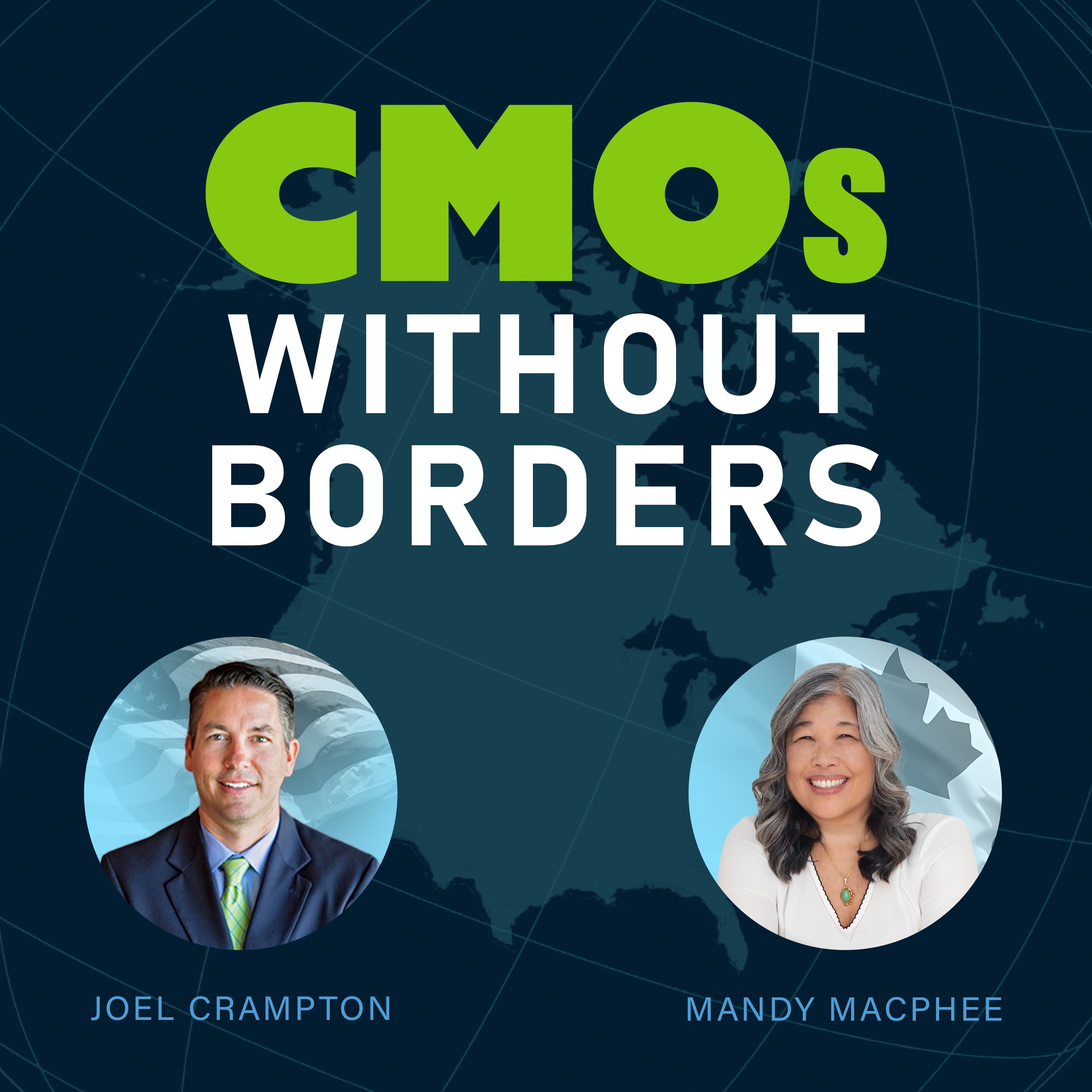
Hosted by fractional CMOs Joel Crampton, founder of CMO/Alpha (U.S.), and Mandy MacPhee, founder of illumination (Canada), this show explores the strategic marketing moves that help RIAs, fintechs, credit unions, and financial brands thrive — regardless of size, structure, or postal code.
We bring different lenses to the mic: U.S. vs. Canada, Fintech vs. Institutional, Independent firms vs. Enterprise marketing
But we’re united by one mission: helping you build a smarter, more strategic marketing function that actually drives results — not just more activity.
Each episode delivers candid conversations, real-world examples, and field-tested insights to help you:
- Align your marketing with business goals
- Outperform the competition without wasting time or budget
- Gain the clarity and confidence to lead — or delegate — marketing that works
If you’re a financial advisor, fintech founder, credit union exec, or marketing leader in the financial space, this is your “no-fluff, behind-the-scenes look” at what works — and what doesn’t.
Podcast Insights
Content Themes
The show focuses on driving growth in financial services, covering topics such as strategic marketing alignment, competition analysis, and marketing plan failures. Episodes include deep dives into real-world case studies, such as the analysis of why most financial services marketing plans fail and actionable frameworks like the 'Three C’s' for resilient marketing.
Welcome to CMOs Without Borders — the podcast where two seasoned marketing leaders with decades of experience from opposite sides of the border cut through the noise and get real about what actually drives growth in financial services.
Hosted by fractional CMOs Joel Crampton, founder of CMO/Alpha (U.S.), and Mandy MacPhee, founder of illumination (Canada), this show explores the strategic marketing moves that help RIAs, fintechs, credit unions, and financial brands thrive — regardless of size, structure, or postal code.
We bring different lenses to the mic: U.S. vs. Canada, Fintech vs. Institutional, Independent firms vs. Enterprise marketing
But we’re united by one mission: helping you build a smarter, more strategic marketing function that actually drives results — not just more activity.
Each episode delivers candid conversations, real-world examples, and field-tested insights to help you:
– Align your marketing with business goals
– Outperform the competition without wasting time or budget
– Gain the clarity and confidence to lead — or delegate — marketing that works
If you’re a financial advisor, fintech founder, credit union exec, or marketing leader in the financial space, this is your “no-fluff, behind-the-scenes look” at what works — and what doesn’t.
An AI can generate a thousand versions of anything. It still takes a human to know which one is right.
In this episode, Joel Crampton and Mandy MacPhee sit down with Ben Finklea, a fellow fractional CMO and the founder of Armbrain, an AI tool built for fractional CMOs.
Ben was the one who convinced Mandy to go all in on Claude nine months ago, and this conversation covers what he’s learned since, what AI is genuinely good at, where it falls apart, and how a bad morning with seven unfinished tasks turned into a product other fractionals now depend on.
His message is clear. AI is only as useful as the judgment behind it. Without a human in the loop, even the most powerful model can confidently produce the wrong answer.
Key Takeaways
Judgment is the thing AI still can’t fake.
Taste, discernment, and experience only exist after a human has lived through something. AI can produce a thousand options. Only a human with real experience can tell you which one is right.
AI is stuck the day its training stops.
A model is already months behind the moment you’re using it, and it won’t get smarter until the next version ships. Catching when something is off still falls on the person using it.
Automation and strategy are not the same job.
If you already know the answer, AI can automate getting there. Strategy plays out over months and years, and no AI can tell you whether it actually got there.
Executive function, not information, is the real bottleneck.
Ben built Armbrain after a morning with seven important tasks and nothing finished, because he couldn’t decide what mattered most. That struggle led to a tool that helps fractional CMOs figure out what to focus on first.
Context makes AI dramatically faster.
Mandy’s own story: a client plan that used to take a full day took her under an hour once Armbrain had enough context on that client. The tool didn’t do the thinking for her. It just meant she wasn’t starting from zero.
Niching down is what let Ben build something sustainable.
Ben built Armbrain for himself, then for friends who asked for it. That’s the right way to compete against tools like Claude and ChatGPT: pick a niche narrow enough that you’re not fighting companies with far more money and reach.
Networking has to happen before you need it.
Staying visible while current clients take priority is the hardest part of running a fractional practice. Business development is important but rarely urgent, so it’s the first thing pushed aside.
For Fractional CMOs and Founders Running Lean Teams
The best tools usually start as a fix for your own problem, not a market opportunity. If you’re bouncing between priorities without finishing any of them, the fix isn’t a longer to do list. It’s a system that already knows what matters.
Connect with Ben Finklea
Armbrain
linkedin.com/in/benfinklea
armbrain.io
Connect with the Hosts
Joel Crampton — Fractional CMO for RIAs and Wealth Managers
linkedin.com/in/joelcrampton
cmoalpha.com
Mandy MacPhee — Fractional CMO for Founder-Led Companies
linkedin.com/in/mandymacphee
illuminationcmo.com
Disclaimer
This podcast’s information is provided for general reference and was obtained from publicly accessible sources. The Podcast Collaborative neither produces nor verifies the content, accuracy, or suitability of this podcast. Views and opinions belong solely to the podcast creators and guests.
For a complete disclaimer, please see our Full Disclaimer on the archive page. The Podcast Collaborative bears no responsibility for the podcast’s themes, language, or overall content. Listener discretion is advised. Read our Terms of Use and Privacy Policy for more details.