BIG IDEAS BY NEW ECONOMIES
BIG IDEAS BY NEW ECONOMIES
Podcast Description
Welcome to BIG IDEAS by NEW ECONOMIES - a show where we learn how the most iconic founders have turned crucible moments into global companies. www.neweconomies.co
Podcast Insights
Content Themes
The show covers a variety of themes around entrepreneurship, innovation, and technology. Specific episodes discuss topics such as building AI applications, the rise of 'vibe coding', and social innovation through dinner hosting. There is a strong focus on trends in technology and business models, with insights on market dynamics and consumer behavior.
Welcome to BIG IDEAS by NEW ECONOMIES – a show where we learn how the most iconic founders have turned crucible moments into global companies.
Subscribe to stay ahead of technology trends.Never miss future editions.
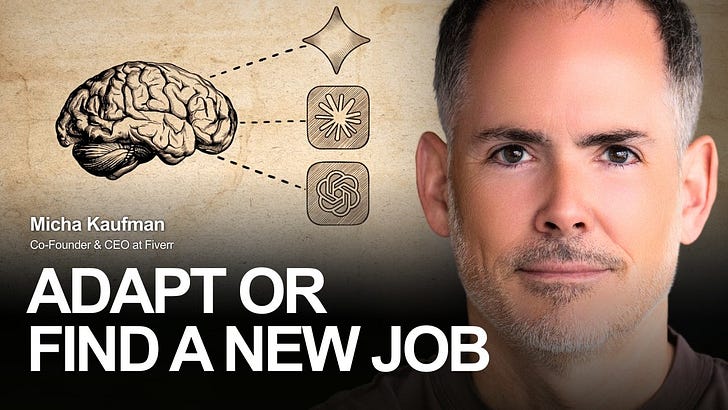
Micha Kaufman, co-founder and CEO of Fiverr, joins us to explain why anyone who has worked in their profession for more than five years is now “a dinosaur.”
He has spent 17 years building Fiverr into a global marketplace connecting millions of freelancers with businesses, and took it public on the New York Stock Exchange in 2019. His internal memo warning staff about AI went viral a year ago, and he says the employees who embraced it are now doing two to three times more than before.
Micha also shares why AI has flipped the 80/20 split between human and software work, why an AI that knows everybody “just makes everybody more average,” and why human judgment and accountability will be the biggest moat any professional can have.
In our in-depth episode, we discuss:
* The asteroid analogy behind Micha’s viral AI memo, and what changed inside Fiverr in the 12 months after he sent it
* Why the 20% of work AI can’t do is “infinitely important,” and the risk of outsourcing judgment to machines
* Why most AI-generated code is built on poor-quality open source, and what that means for developers whose job was 60–70% copy-pasting
* Why Micha wants to stop calling freelancers “freelancers,” and why he believes getting better is each person’s own responsibility
* How Micha runs a public company through a period of uncertainty by encouraging impatience, and whether half of Fiverr’s clients could soon be AI agents
Watch or listen now across YouTube, Apple Podcasts, Spotify, and X
Download the transcript 👇
Timestamps
(00:00) Meet Micha Kaufman (02:17) Is the 9-to-5 dead?(05:20) The viral AI memo(05:50) The dinosaur and the asteroid(12:25) Using AI vs really using AI(14:33) The one thing AI lacks: accountability(18:55) Has AI made us lazy?(19:33) How AI flipped the 80/20 of work(21:02) Why AI is a nightmare for designers(23:23) What happens to freelancers doing basic work?(27:32) Why “freelancer” is the wrong word(28:38) Whose job is it to get better?(32:04) Why most AI-generated code is bad(38:32) Why adaptability wins(41:10) Running a public company in uncertain times(43:06) Why Micha encourages impatience(44:02) The hard part of deploying AI(45:19) Fiverr’s next 12 months
Lessons from this episode with Micha
1. Why every experienced professional is now a dinosaurMicha’s viral memo started with one analogy. He explains why anyone with more than five years in their profession is living through an extinction event, and why the outcome is transformation, not the end.
* “If you’ve been doing something as a professional for more than five years, you are a dinosaur. And you are a dinosaur at the moment an asteroid makes impact.”
* The crater is only the start. The debris, the darkness, the ice age and the food scarcity that follow are what decide which species survive.
* Survival is not about evolution, which takes millions of years. It is about morphing into something new, and some species flourish while others go extinct.
[0:05:57 – 0:07:20]
2. The one thing AI will never haveMicha argues that the real line between humans and machines is not intelligence. It is accountability, and he traces the reason back to our mortality.
* When ChatGPT gives harmful advice, the chat window still says, “I’m AI and I make many mistakes.” That line sums up AI’s lack of accountability.
* Humans are accountable because we are mortal. Reputation is our most precious asset, and keeping it requires accountability.
* “Human in the loop” is a buzzword. What it really comes down to is judgment and accountability, and the risk is that people start outsourcing both to software.
[0:14:33 – 0:15:57]
3. How AI flipped the 80/20 of workBefore AI, humans did most of the work and software did the rest. Micha explains why that ratio has reversed, and why the part left to humans matters more than ever.
* Up until AI, humans did about 80% of the work and software did about 20%. Now it has flipped.
* The 80% that AI handles “doesn’t get you anywhere. It just gets you faster.”
* The 20% left to humans “is not 20% important. It’s infinitely important.” The danger is starting to outsource that 20% as well.
[0:19:36 – 0:21:02]
4. The X factor: why the same AI gives different resultsIf everyone has the same AI tools, where does the advantage come from? Micha argues it comes from the person using them.
* Whatever AI produces is the average, because everybody has access to it. Something looking slick doesn’t mean it will work.
* “If I prompt Claude Design and you prompt Claude Design, we’re not going to get the same results.”
* The difference is design taste and knowing what works. “It’s not Claude Design. It’s me. This is the X factor.”
[0:26:10 – 0:27:32]
5. It’s not your CEO’s job to make you betterMicha shares the message he gave his own team, one he admits he might get criticized for.
* “Look, it’s not my job to make you better. Not better human beings, not better professionals, not better husbands and wives, not better parents. It’s your job.”
* He holds himself to the same rule: it’s not the board’s job or the market’s job to make him better. It’s his own.
* Fiverr’s role is to help those who help themselves. “I would do anything to help those who help themselves.”
[0:29:05 – 0:30:22]
6. Why most AI-generated code is badCode is being written at blazing speed, but Micha says most of it is poor quality. The reason is built into how AI models learn.
* AI is a statistical model. It answers a request from wherever it has the most data, and for code, that is open source.
* “The vast majority of open source is terrible.” Repurposing it means code that is insecure, inefficient, full of bugs and weak on edge cases.
* Five years ago, about 60 to 70% of a developer’s job was already copy-pasting from open source. AI now does that part.
[0:32:35 – 0:34:05]
7. Why Micha encourages impatience with the CEORunning a public company takes long-term patience, but Micha pushes his team to be impatient, including with him.
* The framework starts with being impatient with yourself. Only then can you demand the same of others.
* If Micha says, “Okay, I’ll think about it,” that’s not a good answer. If he says a week, his team should ask: why not tomorrow? Can we talk about this tonight?
* The balance: push hard on what can move fast, but “you can’t define 100 years in a day. It takes time.”
[0:42:50 – 0:44:02]
Where to connect with us
Follow Ollie on X: https://x.com/ollieforsythFollow Micha on X: https://x.com/michakaufmanVisit Fiverr: http://fiverr.comOur partner for today’s episode is Harmonic, your go-to startup database: https://harmonic.ai
Previous episodes include
See all previous episodes here 👉
Get full access to NEW ECONOMIES at www.neweconomies.co/subscribe
Disclaimer
This podcast’s information is provided for general reference and was obtained from publicly accessible sources. The Podcast Collaborative neither produces nor verifies the content, accuracy, or suitability of this podcast. Views and opinions belong solely to the podcast creators and guests.
For a complete disclaimer, please see our Full Disclaimer on the archive page. The Podcast Collaborative bears no responsibility for the podcast’s themes, language, or overall content. Listener discretion is advised. Read our Terms of Use and Privacy Policy for more details.