The NeuroLeadership Edge

The NeuroLeadership Edge
Podcast Description
The NeuroLeadership Edge turns cutting-edge brain science into crisp, actionable leadership moves. Host Claire Hayek——engineer, songwriter & neuroscience coach—reveals how bold leaders convert pressure into performance while keeping their teams healthy.
Each week you’ll hear story-driven conversations with c-suite, execs, founders, and soft-skills experts who have led through crisis, hyper-growth, and high-stakes pivots, plus quick “Edge Shot” solo segments where Claire hands you one research-backed tactic you can use in your very next meeting.
If you want practical tools to think clearer, speak with conviction, and guide people through uncertainty, hit follow and train your brain into your greatest competitive edge.
Podcast Insights
Content Themes
The podcast covers themes such as leadership performance under pressure, team dynamics, and mental fitness. Episodes include discussions on building high-trust teams, understanding neuroscience in leadership, and practical tools like the 'Critic to Coach' technique for overcoming self-sabotage, providing listeners with methods they can apply immediately.

The NeuroLeadership Edge is a leadership podcast for executives, founders, and senior leaders who carry real responsibility and make decisions under constant pressure.
Hosted by neuroscience-based leadership expert Claire Hayek, the show examines what actually happens when leaders are under stress, managing uncertainty, and navigating high-stakes moments that shape teams, culture, and results.
Through a mix of solo episodes and candid conversations with experienced leaders, you’ll hear how decisions are made when the pressure is real, how emotional load impacts performance, and what it takes to lead with clarity, authority, and resilience over time.
If you’re a leader navigating change, pressure, or reinvention, and you want an edge that actually translates into action, this podcast is for you.
One CEO walked onto an open office floor, raised his voice about a missed deadline, and changed the working conditions for every person in the room before his sentence ended. Hands stopped on keyboards. Conversations paused mid-sentence. The project leader stayed still. Claire was an engineer on that floor, and her body recognized the signal immediately. She grew up in Lebanon during the war, and her nervous system learned long ago what a tightening chest and a hunch in the shoulders mean.
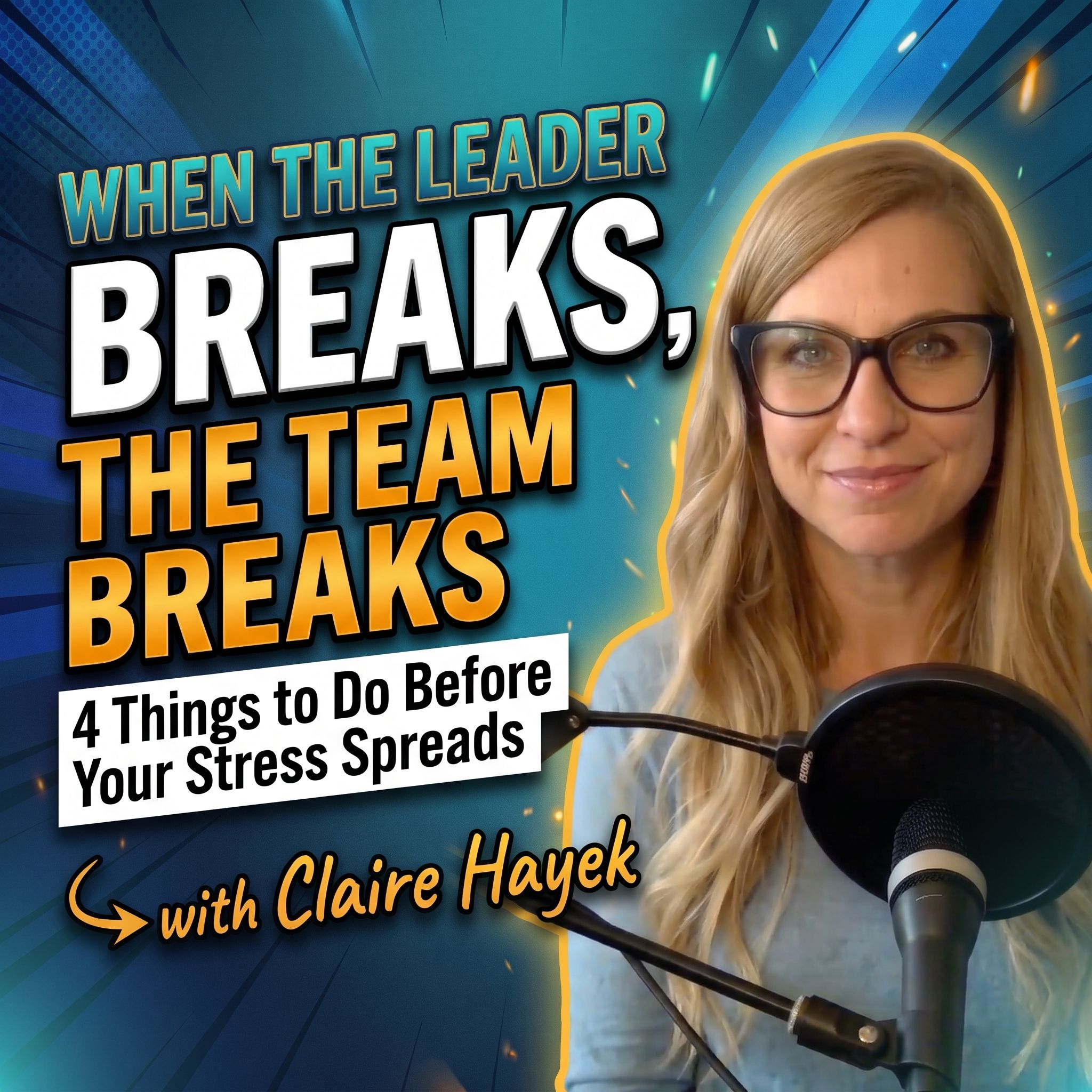
This episode starts with what happened in that room and the science behind it. The nervous system reads faces, posture, and tone in a fraction of a second, reacts first, and analyzes later. It treats a shouting client and shelling outside a building as the same signal. That is how much influence one person’s energy has on a whole room.
From there, Claire gives you four instructions you can use this week.
One: take 60 seconds before your next meeting. Slow your breathing, bring your attention to one true thing about the people waiting for you, set your intention, then walk in. Two leaders arrive at the same meeting with the same agenda and the same slides. The one who settled first gets people speaking sooner and offering the harder information.
Two: say your calm out loud. A senior executive held a steady voice and a calm face through every crisis. His supervisors read composure. His direct reports read indifference. Your calm protects you. Your calm named out loud protects your team. Claire gives you the exact words to use in your next tense meeting.
Three: build the structure before the crisis arrives. A senior leader running events across the Middle East opens a situation room at seven in the morning and again at four in the afternoon, with the same protocol every time: updates, synchronization, next steps. Put two fixed check-ins on your team’s calendar this week, three items each, and run them while things are calm.
Four: run the ordinary week test. Watch your team during a normal week and track three things: who goes quiet, who stops sharing information that makes them look less impressive, and who stops showing up for anyone outside their own department. Write it on one page and compare it to your last crisis. Your team will behave on the hard day the way it behaved the week before.
Claire closes with a challenge: pick one of the four, do it this week, and comment on the episode with what changed in your team.
TOPICS COVERED
- How a leader’s nervous system state spreads across a team
- Threat detection: why the body reacts to tone and posture before the mind analyzes
- The 60-second reset before high-stakes meetings
- Why calm can read as indifference, and how to prevent it
- Scripting a vulnerable, steady opening for tense meetings
- Fixed check-in rhythms that hold a team together before a crisis
- The “situation room” model for communication under pressure
- The ordinary week test: reading your real team when nothing is on fire
- Leadership under pressure, managing uncertainty, and clarity for teams
- Book chapter nine, “The Team Level,” and the French edition
WHAT YOU’LL LEARN
- Why your team feels your state before you say one word
- A one-minute move that settles you before every meeting
- The exact words to say out loud so your calm reads as care
- A simple two-check-in structure that holds your team together when pressure peaks
- Three signals to watch in an ordinary week that reveal how your team behaves under real pressure
- How to run the ordinary week test and compare it to your last crisis
TIMESTAMPS
[00:00:00] Opening: The CEO who froze an entire office floor in one sentence
[00:01:00] Welcome: What you will walk away with by the end of this episode
[00:02:00] The story: An engineering firm where intensity felt normal
[00:03:00] Lived experience: Growing up in Lebanon and what the body recognizes instantly
[00:04:00] The science: How your nervous system reads faces, posture, and tone
[00:05:00] Instruction one: The 60-second reset before your next meeting
[00:06:00] Two leaders, one agenda: Why your team mirrors your state
[00:07:00] Instruction two: The executive whose calm was read as indifference
[00:08:00] Say it out loud: The script for your next tense meeting
[00:09:00] Instruction three: Build the structure before the crisis arrives
[00:10:00] The situation room: Why private versions of reality pull teams apart
[00:11:00] Your move this week: Two fixed check-ins, three items each
[00:12:00] Instruction four: The ordinary week test and the three things to watch
[00:13:00] The turnaround that took days, and your challenge for this week
[00:14:00] The book: Chapter nine, the French edition, and a gift idea for your team
[00:15:00] Corporate rates and closing: Lead boldly, stay human
MENTIONED IN THIS EPISODE
- Book:La compétence en leadership que personne ne vous a apprise (The Leadership Skill Nobody Taught You: Calm Under Fire in the Age of Disruption) by Claire Hayek. Chapter nine, “The Team Level,” begins on page 105. The French edition is available. https://a.co/d/0cKTUYPB
- Book hub and corporate rates:https://clairehayek.com/book
- Pressure and Performance Scorecard (free diagnostic):https://clairehayek.com/pp-scorecard
- Claire’s Substack:https://theclairehayek.substack.com
- Claire on LinkedIn:https://www.linkedin.com/in/clairehayek/
The Leadership Skill Nobody Taught You (#1 bestseller book) is out now. Order it here.
Ready to train your brain for resilience and high performance? Join Claire’s Mental Fitness Masterclass here
Use code: NLEdgePodcast for 50% OFF exclusive to my podcast listeners
For free resources, assessments, and everything else: https://clairehayek.com/book-resources
(Pressure Archetype, PP Scorecard, Reset Scripts, and more all live here)
Follow Claire Hayek on LinkedIn
Read Claire’s newsletter on Substack here
Subscribe to The NeuroLeadership Edge Podcast for brain-based strategies to lead with clarity, courage, and impact. clairehayek.com/podcast
The NeuroLeadership Edge Podcast is produced by Claire Hayek,bestselling author. All opinions are those of the host and guests. For more leadership resources, visit clairehayek.com
Disclaimer
This podcast’s information is provided for general reference and was obtained from publicly accessible sources. The Podcast Collaborative neither produces nor verifies the content, accuracy, or suitability of this podcast. Views and opinions belong solely to the podcast creators and guests.
For a complete disclaimer, please see our Full Disclaimer on the archive page. The Podcast Collaborative bears no responsibility for the podcast’s themes, language, or overall content. Listener discretion is advised. Read our Terms of Use and Privacy Policy for more details.