Natural Law Moment
Natural Law Moment
Podcast Description
The legal world is a tumultuous one, and to comprehend it, we must get to the heart of the matter. We must endeavor to understand the principles of judgment upon which the decisions that shape our personal and public lives are based.
Before we can ask "what ought to be?" we must ask "what is?"
To do this, we need the Natural Law.
Profs. Hadley Arkes & Gerry Bradley are the preeminent Natural Law scholars of our day. And with over 80 years of experience between them, not only will the Natural Law Moment podcast place you in the room with them, but it will also teach you to think like them.
Podcast Insights
Content Themes
This podcast explores crucial themes such as Natural Law, parental rights, and the Pro-Life movement, with episodes examining landmark cases like U.S. v. Skrmetti and the implications of the Dobbs decision, as well as discussions on the moral frameworks surrounding contemporary legal issues.
The legal world is a tumultuous one, and to comprehend it, we must get to the heart of the matter. We must endeavor to understand the principles of judgment upon which the decisions that shape our personal and public lives are based.
Before we can ask “what ought to be?” we must ask “what is?”
To do this, we need the Natural Law.
Profs. Hadley Arkes & Gerry Bradley are the preeminent Natural Law scholars of our day. And with over 80 years of experience between them, not only will the Natural Law Moment podcast place you in the room with them, but it will also teach you to think like them.
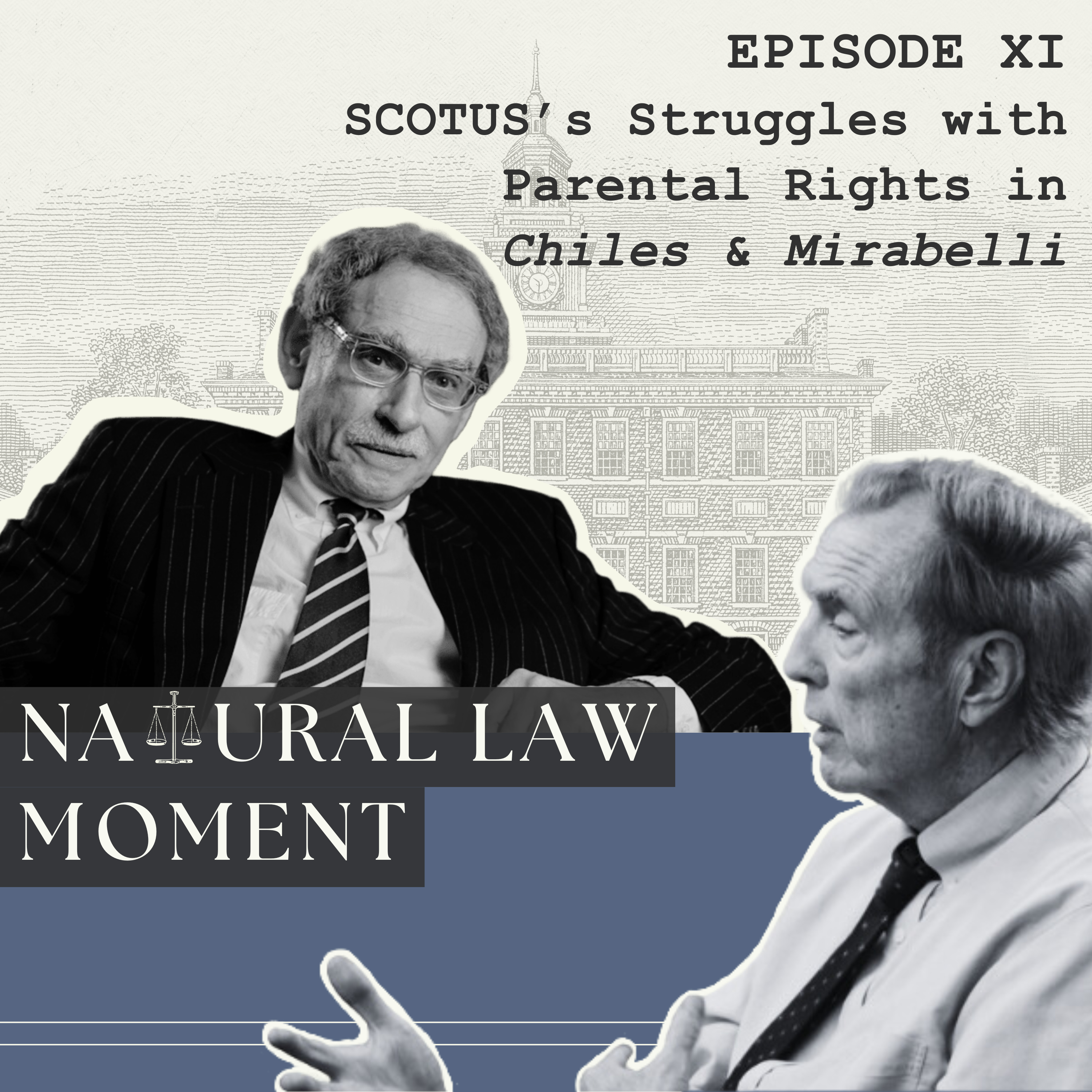
In March of this year the Supreme Court handed down two decisions that should have been seismic for the American family. Yet while most of the conservative legal world is satisfied with them as victories, and that’s whatour two cohosts Hadley Arkes and Gerry Bradley will argue is problematic for mainstream legal conservatism. Before we hear from our cohosts, a brief primer on both cases.
First, in Mirabelli v. Bonta, California required schools tohide a child’s social gender transition—new names, new pronouns, the whole identity project—from the child’s own parents unless the child consented. The Court stepped in on the emergency docket and said those policies likely violateparents’ free-exercise and substantive-due-process rights, triggering a fascinating set of dueling opinions from Justices Barrett and Kagan, the subject of our discussion. Weeks later came Chiles v. Salazar in which Colorado banned licensed counselors from any talk therapy that tries to help a minor align with biological sex or reduce same-sex attraction, while allowing the opposite. An 8–1 Court, in an opinionby Justice Gorsuch, called that move of Colorado’s viewpoint discrimination and demanded strict scrutiny. Both cases are indeed victories. But notice what they carefully avoided: any serious, substantive account of why parental authorityexists, what its natural boundaries are, and how far the state may go before it becomes a usurper. That is the central failing of modern conservative jurisprudence. We keep winning cases on process, speech, or thin historical tradition while refusing to grapple with the natural-law substance of thefamily itself.
Disclaimer
This podcast’s information is provided for general reference and was obtained from publicly accessible sources. The Podcast Collaborative neither produces nor verifies the content, accuracy, or suitability of this podcast. Views and opinions belong solely to the podcast creators and guests.
For a complete disclaimer, please see our Full Disclaimer on the archive page. The Podcast Collaborative bears no responsibility for the podcast’s themes, language, or overall content. Listener discretion is advised. Read our Terms of Use and Privacy Policy for more details.