Surgical Pioneering Podcast

Surgical Pioneering Podcast
Podcast Description
"Surgical Pioneering
Surgical Frontiers: Pioneering Tech Transforming Surgical Care"
Mission Statement:
Welcome to Surgical Frontiers, a global nexus for surgeons, researchers, engineers, and healthcare innovators dedicated to advancing surgical care through groundbreaking technology. This group is not just a platform—it’s a movement. Here, we explore, debate, and champion the innovations redefining the art and science of surgery. From AI-driven diagnostics to robotic-assisted procedures, augmented reality (AR) surgical navigation, and bioengineered implants, we are the vanguard of a new era in medicine. If you’re driven by curiosity, excellence, and the relentless pursuit of better patient outcomes, you belong here.
---
Our Core Values:
1. Innovation First
Surgery is no longer confined to scalpels and sutures—it’s a fusion of biology, engineering, and data science. We prioritize discussions on emerging technologies (e.g., nanorobotics, AI-powered predictive analytics, 3D bioprinting) and their real-world applications. Share prototypes, clinical trial results, or even bold hypotheses—if it pushes boundaries, we want to hear it.
2. Collaboration Over Competition
Breakthroughs happen when diverse minds unite. Surgeons, engineers, ethicists, and entrepreneurs are all equal stakeholders here. Whether you’re a seasoned robotic surgeon or a startup founder developing smart OR tools, your perspective matters. Let’s dismantle silos and co-create solutions.
3. Evidence-Based Excellence
Pioneering doesn’t mean reckless. We demand rigor. Posts about new tools or techniques should be grounded in peer-reviewed research, clinical data, or transparent case studies. Anecdotes are welcome, but they must spark deeper inquiry, not replace it.
4. Patient-Centric Ethics
Technology is a means, not an end. Every innovation must answer: How does this improve patient safety, accessibility, or outcomes? We encourage tough conversations about cost, equity, and unintended consequences. Glorifying "tech for tech’s sake" has no place here.
5. Global Perspective
Surgical challenges vary wildly between a high-resource urban hospital and a rural clinic. Share insights from low-income regions, disaster zones, or underserved communities. Innovation thrives when we solve for the margins, not just the mainstream.
---
What You’ll Find Here :
- Breakthrough Technologies: Deep dives into robotics, AI/ML applications, AR/VR surgical training, IoT-enabled devices, and beyond.
- Expert Insights: Q&As with thought leaders, interviews with FDA regulators, and AMAs (Ask Me Anything) with pioneers.
- Case Studies: How a hospital in Kenya adopted portable robotic tools, or how a Boston team used AI to reduce post-op infections by 40%.
- Ethical Debates: Should AI diagnose surgical complications? Who owns data from smart implants?
- Resource Sharing: Grants, conferences (e.g., SAGES, AACR), and regulatory updates.
---
Why Join?
...
Podcast Insights
Content Themes
The podcast explores breakthrough technologies in surgery, with themes ranging from robotic-assisted procedures to AI-driven diagnostics, featuring case studies like a hospital in Kenya adopting portable robotic tools and discussions on ethical considerations such as patient safety and healthcare equity.

“Surgical Pioneering
Surgical Frontiers: Pioneering Tech Transforming Surgical Care”
Mission Statement:
Welcome to Surgical Frontiers, a global nexus for surgeons, researchers, engineers, and healthcare innovators dedicated to advancing surgical care through groundbreaking technology. This group is not just a platform—it’s a movement. Here, we explore, debate, and champion the innovations redefining the art and science of surgery. From AI-driven diagnostics to robotic-assisted procedures, augmented reality (AR) surgical navigation, and bioengineered implants, we are the vanguard of a new era in medicine. If you’re driven by curiosity, excellence, and the relentless pursuit of better patient outcomes, you belong here.
—
Our Core Values:
1. Innovation First
Surgery is no longer confined to scalpels and sutures—it’s a fusion of biology, engineering, and data science. We prioritize discussions on emerging technologies (e.g., nanorobotics, AI-powered predictive analytics, 3D bioprinting) and their real-world applications. Share prototypes, clinical trial results, or even bold hypotheses—if it pushes boundaries, we want to hear it.
2. Collaboration Over Competition
Breakthroughs happen when diverse minds unite. Surgeons, engineers, ethicists, and entrepreneurs are all equal stakeholders here. Whether you’re a seasoned robotic surgeon or a startup founder developing smart OR tools, your perspective matters. Let’s dismantle silos and co-create solutions.
3. Evidence-Based Excellence
Pioneering doesn’t mean reckless. We demand rigor. Posts about new tools or techniques should be grounded in peer-reviewed research, clinical data, or transparent case studies. Anecdotes are welcome, but they must spark deeper inquiry, not replace it.
4. Patient-Centric Ethics
Technology is a means, not an end. Every innovation must answer: How does this improve patient safety, accessibility, or outcomes? We encourage tough conversations about cost, equity, and unintended consequences. Glorifying “tech for tech’s sake” has no place here.
5. Global Perspective
Surgical challenges vary wildly between a high-resource urban hospital and a rural clinic. Share insights from low-income regions, disaster zones, or underserved communities. Innovation thrives when we solve for the margins, not just the mainstream.
—
What You’ll Find Here :
– Breakthrough Technologies: Deep dives into robotics, AI/ML applications, AR/VR surgical training, IoT-enabled devices, and beyond.
– Expert Insights: Q&As with thought leaders, interviews with FDA regulators, and AMAs (Ask Me Anything) with pioneers.
– Case Studies: How a hospital in Kenya adopted portable robotic tools, or how a Boston team used AI to reduce post-op infections by 40%.
– Ethical Debates: Should AI diagnose surgical complications? Who owns data from smart implants?
– Resource Sharing: Grants, conferences (e.g., SAGES, AACR), and regulatory updates.
—
Why Join?
– Learn: Weekly summaries of JAMA Surgery or Annals of Surgery highlights.
– Influence: Shape the future by beta-testing tools, joining global consortia, or advising startups.
– Grow: Mentorship threads for residents, grants for underrepresented innovators, and hackathons.
—
The Future We’re Building:
Imagine a world where:
– A surgeon in Mumbai receives real-time AR guidance from a specialist in Toronto.
– Bioprinted organs eliminate transplant waitlists.
– AI predicts surgical complications before the first incision.
“This isn’t science fiction—it’s the horizon we’re sprinting toward.”
Let’s pioneer responsibly. Let’s operate fearlessly. Post, comment, and collaborate. The next surgical revolution starts here.
—
Reza Lankarani M.D
Founder & Curator, Surgical Frontiers
“Surgical Pioneering
Surgical Frontiers: Pioneering Tech Transforming Surgical Care”
Reviewed by Dr. Reza Lankarani , General Surgeon
Founder | Surgical Pioneering Newsletter and Podcast Series
Editorial Board Member | Genesis Journal of Surgery and Medicine
Medical Advisory Board Member | AIGENELAB.COM
An In-Depth Analysis of the Strategic and Technological Impact of Christopher Carter on Global Enterprise Software, Artificial Intelligence, and Sustainable Infrastructure
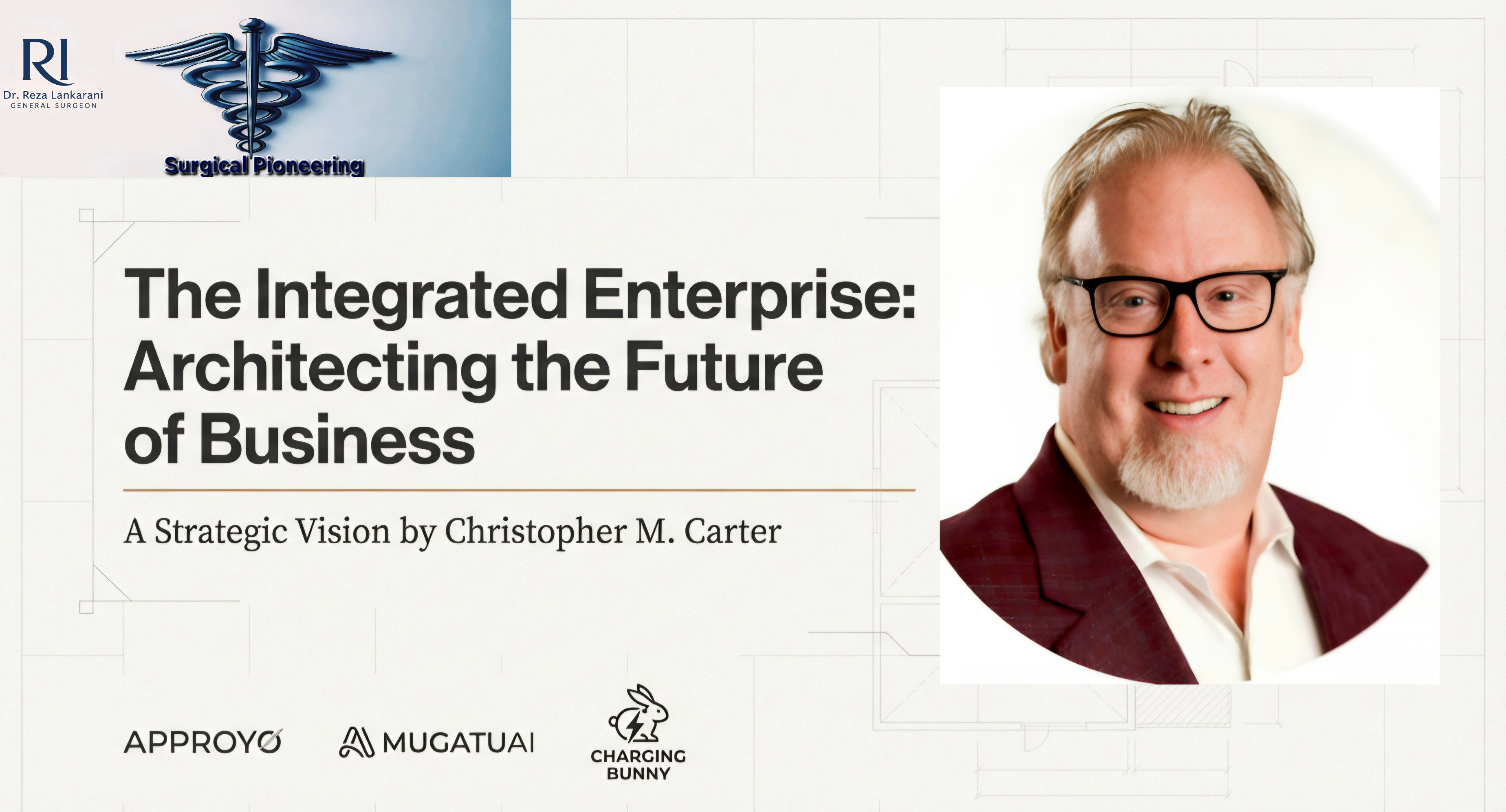
The global enterprise landscape is currently defined by a relentless drive toward digital transformation, a movement where legacy systems and modern cloud architectures must coexist to facilitate real-time decision-making. Central to the evolution of this ecosystem is Christopher Carter, a professional whose three-decade career serves as a blueprint for specialized entrepreneurship and technical innovation. As the founder of Approyo, Mugatu AI, and Charging Bunny, Carter has positioned himself at the nexus of several critical industry shifts: the migration of enterprise resource planning (ERP) systems to the cloud, the integration of predictive artificial intelligence within cybersecurity frameworks, and the decentralization of green energy through sustainable infrastructure. This report provides an exhaustive examination of Carter’s professional trajectory, the operational mechanics of his organizations, his contributions to technical literature, and the leadership philosophies that underpin his ventures in a rapidly shifting global economy.
The Architectural Foundation: Education and Early Career Trajectory
The professional narrative of Christopher Carter begins with a foundational commitment to the rigors of engineering and technology. His tenure at The Georgia Institute of Technology was the catalyst for his engagement with complex systems, providing the theoretical and practical groundwork required to navigate the high-stakes environment of enterprise software. Georgia Tech’s emphasis on technical precision and problem-solving became a defining characteristic of his subsequent career, particularly as he entered the SAP workforce during a period of significant growth for the German software giant. Following his graduation, Carter’s initial professional exposure was characterized by a blend of technical support and commercial operations. He worked within the SAP ecosystem before transitioning to a California-based startup, where he was tasked with managing day-to-day sales and marketing activities. This experience was instrumental in developing a holistic understanding of the technology sector; it required balancing the structural requirements of large-scale software with the agile, results-oriented demands of the venture-capital-backed startup world. The duality of this early career path—understanding both how technology is built and how it is sold—allowed Carter to move into multiple executive positions within the SAP ecosystem with a unique perspective on client needs and market gaps. Carter’s entrepreneurial journey was not a linear ascent but was informed by early ventures that provided essential lessons in both success and resilience. Before founding his current flagshiporganizations, he established an earlier business which he successfully scaled and eventually sold. However, this period of his life also included significant challenges, including the management of a company through bankruptcy. Far from being a deterrent, Carter characterizes the experience of bankruptcy as a formative period that sharpened his business instincts and fostered a level of resilience that would become a defining trait in his later career. This background underscores a broader entrepreneurial theme: the necessity of failure as a prerequisite for high-stakes success in the technology sector. Following the sale of his first company, Carter entered a brief period of retirement. This hiatus, however, was interrupted by the release of SAP HANA, a revolutionary in-memory database technology. Recognizing that HANA represented a fundamental shift in how data could be manipulated and utilized, Carter traveled to Germany to master the technology at its source. This deep dive into the technical core of SAP HANA provided the impetus for his return to the industry and the eventual founding of Approyo in December 2013.
Approyo and the Specialization of SAP Cloud Services
The founding of Approyo was a strategic response to a specific market ineficiency: the broad but shallow approach of many IT consulting firms. While many providers sought to manage multiple ERP systems simultaneously, such as Oracle, Microsoft Dynamics, and ServiceNow, Carter envisioned a firm that committed solely to the SAP ecosystem. This specialization was designed to position Approyo as a “true partner” for enterprises, ofering a depth of expertise that generalist firms could not replicate.
The Business Model of Targeted Innovation
Approyo operates primarily as an SAP Managed Service Provider (MSP), focusing on cloud-based solutions, migrations, and continuous hosting for global enterprises. The organization’s strategy is built upon the “platform ecosystem” trend, providing “ready to deploy” solutions that facilitate a seamless shift to the SAP HANA platform. This approach addresses a primary pain point for large organizations: the perceived risk and long timelines associated with migrating core business processes to the cloud. By utilizing a Platform-as-a-Service (PaaS) model, Approyo can launch a full SAP system in hours rather than the weeks or months typically required in legacy environments. The organizational identity of Approyo is further distinguished by its creative branding. The company’s name is a tribute to Bronson Arroyo, a Major League Baseball player and musician,reflecting Carter’s personal interests and a desire for an identity that stands out in a crowded technology market. Furthermore, Carter utilizes the “Alice in Wonderland” metaphor—encouraging clients to “go down the rabbit hole”—to describe the leap of faith required for digital transformation. This thematic approach humanizes the often intimidating process of technical migration, framing it as an explorative journey into the possibilities of Big Data and the cloud.
Global Expansion and the “Follow the Sun” Model
Since its inception in Muskego, Wisconsin, Approyo has grown into an international entity with approximately 173 employees as of early 2024. The firm has strategically expanded its reach into Brazil, the United Kingdom, Spain, and India, creating a global talent pool that allows for 24/7 support across multiple time zones. This expansion ensures that the company always has the right resources available for its clients, regardless of their geographical location or the time of day.
This global footprint is more than a byproduct of growth; it is a core component of the “Follow the Sun” operational model. By distributing technical expertise across several continents, Approyo mitigates the risks of service interruption and provides clients with the “sleep well at night” assurance that is central to Carter’s leadership philosophy. The ability to tap into diverse technical talent in regions like India and Brazil has been described by Carter as a “game changer,” allowing the firm to scale rapidly while maintaining a high standard of service.
The Convergence of ERP, AI, and Cybersecurity: The Overwatch Paradigm
As enterprises transitioned their most sensitive financial and operational data to the cloud, the need for proactive security measures became paramount. Carter recognized that traditional, reactive IT support was insuficient for the modern landscape. In response, he championed the development of Overwatch, an AI-powered monitoring and support platform that has become a cornerstone of Approyo’s value proposition.
Technical Mechanics of Overwatch
Overwatch is an integrative AI tool implemented on every client landscape Approyo manages. It is designed to provide proactive insights by understanding how a system will run in the coming weeks and identifying potential vulnerabilities before they can be exploited. The platform monitors not just SAP systems but also Oracle, other ERP platforms, and various cloudenvironments, creating a comprehensive security and performance layer. The financial and operational significance of Overwatch is substantial, with the proprietary technology represented as having a net worth of millions of dollars. Its primary functions include:
● Predictive Analytics: Analyzing historical data to forecast future system performance and hardware needs.
● Security Monitoring: Identifying vulnerabilities and proactively alerting administrators to potential breaches or disruptions.
● Operational Eficiency: Allowing companies to grow their SAP landscapes without the need for extensive new code or a significant increase in headcount.
● Cost Reduction: Optimizing cloud resources to control “cloud sprawl” and ensure that IT investments drive growth rather than just expense.
This proactive stance is particularly critical in an environment where 89% to 93.7% of all global finances flow through SAP systems. Any interruption in these systems can lead to massive revenue loss, making predictive tools like Overwatch essential for business continuity.
Mugatu AI and Defensive Intelligence
Building on the success of Overwatch, Carter launched Mugatu AI as a dedicated venture to provide AI-based predictive analytics for security disruptions. Mugatu AI wraps around existing enterprise systems to provide a defensive layer that anticipates risks. The mission of Mugatu AI is to redefine leadership in an AI-driven world, providing tools that empower teams and drive innovation while maintaining a robust security posture. Mugatu AI focuses on the intersection of management and technical support, helping organizations bridge the gap between their cybersecurity maturity and the confidence of the C-suite and board of directors. Carter’s work with Mugatu AI emphasizes that AI is not merely a tool for automation but a strategic asset that can transform tech expenses into profitable investments by minimizing downtime and maximizing system reliability.
Sustainability and Innovation: The Charging Bunny Initiative
A recurring theme in Christopher Carter’s career is the identification of aging or ineficient infrastructure and the application of modern technology to solve those problems. This is most evident in the launch of Charging Bunny, a venture focused on the renewable energy and electric vehicle (EV) sectors.
Addressing Grid Dependency Charging Bunny was born from Carter’s observation of the expanding EV market and the limitations of the existing electrical grid. He noted that much of the machinery in the traditional power industry is outdated and ill-equipped to handle the surging demand for EV charging points. To address this, Charging Bunny ofers solar-powered charging stations that operate independently of the grid. These standalone units utilize Tesla battery packs and charging solutions, providing a self-sustaining environment that does not rely on traditional power infrastructure.Investment and Creative Strategy Carter serves as the lead investor and the primary creative force behind Charging Bunny, having self-funded the venture to maintain control over its development and innovation. This “investor-creative” role allows for a rapid development cycle, as the company is not beholden to external funding requirements or the slow decision-making processes often found in large energy firms.
The launch of Charging Bunny represents a second-order insight into Carter’s professional strategy: he leverages his expertise in “Big Data” and AI to manage and optimize green energy systems, efectively cross-pollinating lessons from the ERP world into the sustainability sector.
This venture demonstrates that the future of enterprise leadership belongs to those who embrace disruption across multiple domains, rather than remaining siloed in a single industry.
Literary Contributions and Knowledge Distribution
Christopher Carter is a prolific author and a recognized thought leader, having written 17 books and achieved four-time best-seller status on Amazon. His literary work is a critical component of his mission to simplify technology and empower the next generation of technologists.
The “Mastering SAP” Series
His flagship series, “Mastering SAP,” is widely regarded as a definitive resource for organizations looking to optimize their usage of the platform. The series covers a range of topics from technical implementation to high-level business strategy. Key titles in the series include:
● Mastering SAP: The Power of AI in Business – How to Use AI with SAP: A bestseller that provides a roadmap for leveraging artificial intelligence to strengthen SAP operations.
● Mastering SAP: The Power of Cloud with SAP: Detailing the benefits and challenges of migrating ERP landscapes to cloud environments.
● Mastering SAP: Protecting your SAP environment in Today’s Cybersecurity World: A comprehensive guide to identity and access management, GRC (Governance, Risk, and Compliance), and multi-layered security in the SAP ecosystem.
● Mastering SAP: A Comprehensive Guide: A broad overview of the platform’s capabilities and its role in modern finance and operations.
Carter’s books are not merely commercial products; they are central to his philanthropic eforts. He frequently gives his books away to university students and members of the American SAP User Group (ASUG), choosing to focus on the development of young technologists rather thanthe promotion of his own company.
Contributions to AI and Emerging Tech Literature
Beyond SAP, Carter has authored several books specifically on the technical and philosophical aspects of artificial intelligence. These include:
● AI Algorithm Book: A deep dive into the mathematical and logical structures that underpin modern AI systems.
● AI Unleashed Profiles: Case studies and profiles of AI implementation across various industries.
● Small Language Models versus Large Language Models: A comparative analysis of the eficiency and utility of diferent AI architectures for specific business needs.
This extensive body of work establishes Carter as more than an entrepreneur; he is an educator who seeks to bridge the gap between complex technical concepts and practical business application.
Leadership Philosophy and Organizational Culture
The organizational culture at Approyo and Carter’s other ventures is characterized by a “people-first” philosophy that prioritizes trust, empathy, and professional development. This approach is rooted in Carter’s personal history and his belief that while technology evolves, the human element remains the heart of any successful business.
The “Hand Backwards” Principle
One of Carter’s most prominent leadership principles is the idea of “having your hand backwards” while climbing the ladder of success. This concept emphasizes the responsibility of successful leaders to help those coming up behind them. This is manifested in his extensive mentoring of students and his membership in the Forbes Coaches Council, where he contributes expertise on leadership and business growth.
Resilience and Adversity
Carter’s leadership style is also informed by the adversity he faced as a young man. Growing up in a household characterized by divorce and financial instability—including periods of sleeping on couches and reliance on welfare—he developed a fierce determination to support himself and his family. He uses these experiences to motivate both his staff and the young people he mentors, teaching them that passion and grit are more important than the skills learned from abook alone.
Industry Recognition and Global Influence
The impact of Christopher Carter’s work is reflected in a long list of awards and accolades from major technology and business publications. He is frequently cited as a transformational leader who has redefined the role of a CEO in the enterprise software space.
Recognition of Expertise
● Top SAP Expert: Industry Era recognized him as “One of the top 10 SAP experts in the world”.
● Industry Influencer: Mirror Review named him “One of America’s Top 10 Industry Influencers” and “One of the Top 20 Business Leaders to Follow in SAP”.
● Inc. 500/5000 Honoree: Both Approyo as a firm and Carter as a leader have been recognized on these prestigious lists of high-growth companies.
● ACQ Award: Winner of the ACQ award for excellence in SAP services.
● Revolutionary CEO: Aspioneer Magazine awarded him the title of “Revolutionary CEO of the Year”.
Media Presence and Thought Leadership
Carter is a “Go-To” contributor for Newsmax-TV on technology topics and has had his advice featured in a wide array of publications, including Inc., Forbes, ASUG.com, TechTarget, Entrepreneur, and CRN. He is also a regular on the podcast circuit, appearing on programs like “The Tech’o’Space Podcast,” “Smart Cherrys Thoughts,” and “Concrete Build Crypto Financing,” where he discusses the intersection of SAP, AI, and emerging technologies like blockchain and cryptocurrency. His membership in organizations like the American SAP User Group (ASUG), Hadoop World, and Cloud Expo further cements his role as a central figure in the technical community. Carter’s ability to speak on diverse topics—ranging from selective Go-Live and Big Data to the role of AI in real estate tokenization—illustrates his reach as a “visionary” who can connect disparate technologies into a cohesive strategy for growth.
The Sherpa Trails and Personal Passions
Beyond the corporate boardroom and the data center, Carter is an avid mountaineer, a passion that he has documented in his book entitled “Sherpa Trails”. This interest in summiting mountains serves as a metaphor for his professional life: a series of dificult climbs that require preparation, endurance, and a reliable team. He often draws parallels between the discipline of high-altitude climbing and the persistence required to navigate the complexities of digital transformation. Additionally, Carter is a deep enthusiast of music, which he describes as his “outlet” from the high-pressure world of technology. This multifaceted personality—as an author, an athlete, a musician, and a technologist—contributes to a leadership style that is grounded and relatable, helping to build a “human core” within his organizations.
Conclusion: Synthesis and Future Outlook
Christopher Carter’s professional journey serves as a case study in the power of specialization, resilience, and the proactive integration of emerging technologies. By focusing exclusively on the SAP ecosystem, he transformed Approyo from a small consultative firm into a global managed services powerhouse that sits at the nexus of cloud innovation and enterprise stability. His development of proprietary AI tools like Overwatch has moved the industry toward a model of predictive, “hyper-aggressive” system support, ensuring that global financial transactions remain secure and eficient. The diversification of his portfolio into Mugatu AI and Charging Bunny demonstrates a forward-looking strategy that anticipates the next major shifts in the global economy: the need for advanced defensive intelligence and the decentralization of sustainable energy infrastructure. Carter’s work in these fields is linked by a common thread: the belief that every challenge—whether it is an aging electrical grid or a complex ERP migration—carries the “seed of reinvention.”
As 2026 approaches, Carter’s vision for his collective enterprises remains clear: to expand global operations, continue innovating with AI-driven solutions, and foster a leadership culture that empowers the next generation of technologists. His legacy is defined not just by the companies he has founded or the awards he has won, but by the “hand backwards” he has extended to others, ensuring that as technology evolves, the people at the heart of the business remain the priority. The integration of predictive intelligence with sustainable infrastructure and human-centric leadership positions Carter as a pivotal figure in the ongoing transformation of the global enterprise landscape.
To access additional details, please refer to the Surgical Pioneering Podcast Series application available at the following link:
https://Surgicalpioneer.codeadx.me
Get full access to Reza Lankarani at lankarani.substack.com/subscribe
Disclaimer
This podcast’s information is provided for general reference and was obtained from publicly accessible sources. The Podcast Collaborative neither produces nor verifies the content, accuracy, or suitability of this podcast. Views and opinions belong solely to the podcast creators and guests.
For a complete disclaimer, please see our Full Disclaimer on the archive page. The Podcast Collaborative bears no responsibility for the podcast’s themes, language, or overall content. Listener discretion is advised. Read our Terms of Use and Privacy Policy for more details.