Lawmanity
Lawmanity
Podcast Description
Hosted by human rights lawyer, Jen Ang, the Lawmanity podcast asks big questions like: How does human rights law really work in practice? And how have activists used the law to create real social change?
Every episode we will bring you legal summaries of interesting cases and one-to-one interviews with activists and lawyers across the UK who are using the law in creative ways to challenge unfairness and secure justice for people and communities who are excluded, discriminated against and overlooked.
We will also bring you insights about the people behind the legends, with inspiration and advice on how to build a successful career in activism and law – and what it takes to stay focused, be resilient and have fun along the way!
Podcast Insights
Content Themes
This podcast focuses on human rights law, activism, and social justice. Episodes cover topics like the impact of the UK's Rwanda policy, legal battles faced by asylum seekers, and the role of law in promoting equality. Specific episodes include case studies of significant legal victories and interviews with legal experts who discuss their personal experiences in the field.
Hosted by human rights lawyer, Jen Ang, the Lawmanity podcast asks big questions like: How does human rights law really work in practice? And how have activists used the law to create real social change?
Every episode we will bring you legal summaries of interesting cases and one-to-one interviews with activists and lawyers across the UK who are using the law in creative ways to challenge unfairness and secure justice for people and communities who are excluded, discriminated against and overlooked.
We will also bring you insights about the people behind the legends, with inspiration and advice on how to build a successful career in activism and law – and what it takes to stay focused, be resilient and have fun along the way!
Episode Notes
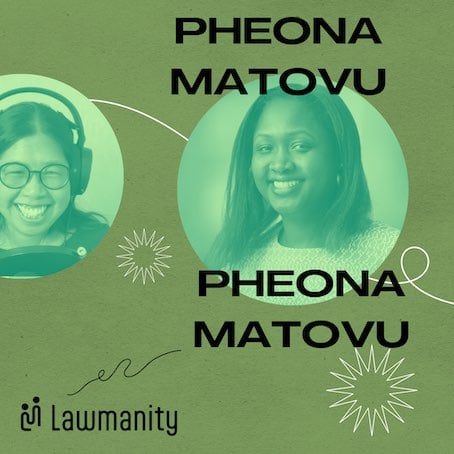
In this week’s episode, we speak with Pheona Matovu – activist, researcher, and co-founder of award-winning social enterprise Radiant and Brighter – about law, racial justice, migration, and the challenges of building systems that work for those most affected by exclusion and inequality.
Drawing on her work with people seeking asylum, refugees, and racially marginalised communities, as well as her ongoing PhD research into anti-racism practice, Pheona reflects on the ways law can reinforce exclusion and inequality, and what it would mean to design systems that work for those most affected by them.
Pheona shares her insights on:
• How law often operates as a barrier rather than a route to equality, and how legal systems can reproduce exclusion even while claiming to protect rights
• The challenges faced by people seeking asylum, and the tensions between legal processes and human dignity
• Why those most affected by laws and policies must be involved in the design of laws, and the role of integrity, humanity, and meaningful engagement in creating change
Additional resources for this episode are linked below:
• Radiant and Brighter: https://radiantandbrighter.com
• Radiant and Brighter Anti-Racism Journal: https://www.amazon.co.uk/Radiant-Brighter-Antiracism-Journal-Reflect/dp/1036954005
Find out more at https://lawmanity.pinecast.co
Disclaimer
This podcast’s information is provided for general reference and was obtained from publicly accessible sources. The Podcast Collaborative neither produces nor verifies the content, accuracy, or suitability of this podcast. Views and opinions belong solely to the podcast creators and guests.
For a complete disclaimer, please see our Full Disclaimer on the archive page. The Podcast Collaborative bears no responsibility for the podcast’s themes, language, or overall content. Listener discretion is advised. Read our Terms of Use and Privacy Policy for more details.