The Journal of Space Commerce Podcast

The Journal of Space Commerce Podcast
Podcast Description
This podcast focuses on issues related to the commercial space industry, and the impacts for people on Earth www.exterrajsc.com
Podcast Insights
Content Themes
The podcast covers themes related to the commercial space industry, such as space weather intelligence, satellite technology, space domain awareness, and the economic impacts of the space economy. Episodes delve into specific topics like the role of AI in space navigation, developments in space infrastructure, and new initiatives for sustainable space operations.
This podcast focuses on issues related to the commercial space industry, and the impacts for people on Earth
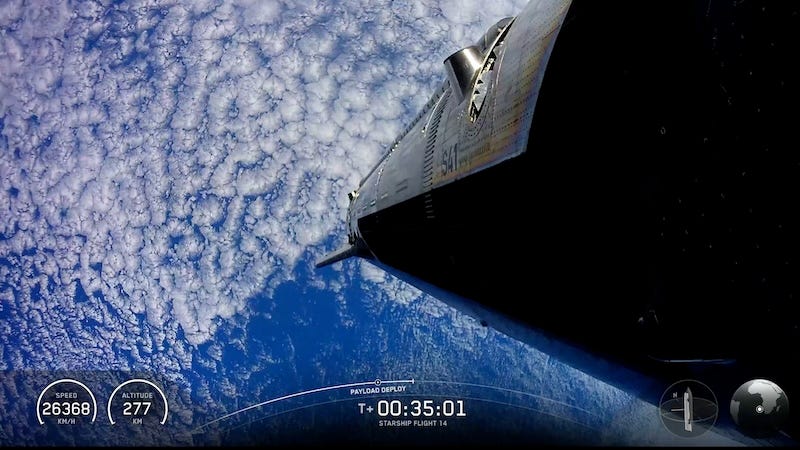
A SpaceX Starship reached orbit on Test Flight 14, marking a significant milestone towards NASAs goal of building an ongoing human presence on the moon.
Starship lifted off as its launch window opened at 7:48 am local time at Starbase Texas. The super heavy booster performed mostly nominally, though one of the 33 Raptor engines did shut down prematurely. Still, the mission continued with a clean stage separation and booster return to Earth, splashing down in the Gulf of America about 8 minutes after launch. The booster simulated the manuver that will be needed for a capture back at Starbase, but it did not attempt that land recovery on this mission.
There were more tense moments when one of the two Raptor Vac engines on Ship failed during the initial ascent. But the SpaceX team determined that since the sea level engines were all that were needed for orbital insertion and de-orbit burn, the mission could continue. Through the Starlink relay, SpaceX was able to provide spectacular images of Earth and the spacecraft in orbit while a batch of 28 operational Starlink V3 satellites were deployed.
Ship did not complete the planned six orbits of the Earth. The de-orbit burn was initiated after just one full orbit, with splashdown occurring in the northern Pacific Ocean. The mission was cut short after mission controllers determined that all objectives had been accomplished and they had collected all pertinent data.
With this orbital milestone achieved, SpaceX and NASA can start looking ahead to testing the in-orbit docking and refueling capability that will be necessary for the return to the lunar surface. Executive Order 14369 signed by President Trump last December directed NASA to land humans back on the Moon by 2028, with a permanent human presence established by 2030.
-0-
NASA and Boeing held a news conference Monday to provide an update on the Starliner program.
Boeing was awarded a commercial crew contract to provide transportation to and from the International Space Station in 2014. Three test flights were completed, one manned, that took Butch Wilmore and Suni Williams to the ISS … but ongoing issues with multiple systems forced NASA to bring the Starliner spacecraft back to Earth without its crew. Wilmore and Williams spend nearly nine months aboard the station, and eventually returned to Earth aboard a SpaceX Crew Dragon capsule.
In June, the NASA Office of Inspector General issued a report that said Starliner would be at least a decade behind schedule. In the meantime, the agency has shifted several crew rotation flights over to SpaceX, which is currently the sole U.S. provider of transportation services to the station.
During the news conference, NASA Administrator Jared Issacman said Starliner is still critical for assuring reliable continued access to ISS.
“So given our extensive history with Starliner and the taxpayer investment already made, we believe it represents the fastest path to preserving reliable crewed access to low Earth orbit. But from the beginning, commercial crew was built around competition, and NASA continues to see real value in having two crew transportation providers,” Issacman said. “Our forecasted demand is approximately 1 crewed mission to low Earth orbit every six months, and competition can help drive down costs, strengthen resilience, and support the broader commercial ecosystem.”
Isaacman noted SpaceX plans to retire Falcon 9 and Dragon as it transitions to Starship, which reached orbit the same day as the briefing. He said NASA wants a second ride.
John Mulholland, Boeing’s Starliner Program Manager, said the uncrewed flight is on track for the December–January timeframe, lined up with the station’s schedule.
“NASA and Boeing, as I mentioned, are confident in the Starliner for the uncrewed mission. The safety findings from CFT have been addressed. We’ve worked corrective action plans for the eight Starliner 1 PIT recommendations, and out of the 21 CFT in-flight anomalies, 19 are closed,” Mulholland said. “The remaining actions are expected to close in October. Some of the mitigations require in-flight demonstration, which we’ll achieve during Starliner 1.”
But NASA Astronaut Woody Hoburg, who has been named as the crewed Starliner mission commander, was blunt about the bigger problem NASA’s investigation found.
“So what keeps me up at night? It’s not the hardware, it’s the underlying pattern. The PIT, the program investigation team, they zoomed out and looked at root causes, so the organizational causes, and they identified 3. And I want to highlight one of those today,” Hoburg said. “It was inadequate systems engineering and integration, creating gaps in hardware qualification. In the case of the helium leaks and the crew module RCS failures, the unqualified environment was actually on the ground, not in space. And we now know that the hardware damage occurred before liftoff.”
Isaacman said that NASA would like nothing more than to see additional crewed and cargo transportation providers, a thriving commercial LEO destination, and a robust overall orbital economy. That would lead one to believe that the planned retirement of Crew Dragon could open the door for other companies to develop human-rated spacecraft.
-0-
The National Oceanic and Atmospheric Administration has awarded Spire Global a $33.2 million task order for commercial satellite weather data.
Spire, based in Virginia, will deliver radio occultation data from Dec. 1, 2026, to Dec. 1, 2028. Radio occultation uses global navigation satellite system signals to measure the atmosphere. Spire says its near-real-time data gives vertical profiles of pressure, humidity and temperature around the globe.
The order includes what the company calls Temporal Resolution Enhancements. Spire says they provide a broader range of time sampling.
The data will feed NOAA’s operational forecast models and support weather forecasting, space weather work and research with partner agencies and universities, according to the company.
The order also carries unfunded surge options. Spire says if NOAA exercises all of them, the order could be worth about $66 million over two years. NOAA’s award notice confirms the options but doesn’t put a dollar value on them.
The award falls under NOAA’s Space-Based Environmental Monitoring contract, a multiple-award indefinite delivery, indefinite quantity vehicle. Spire says it has a five-year base period and a five-year option. It sits under NOAA’s ProTech 2-point-0 program, which has a shared $8 billion ceiling.
The new order follows a $3.7 million NOAA contract for the same type of data. That one runs from Sept. 18 through Dec. 1, the day the new order begins.
Spire says it was also selected under the same contract to provide reflectometry, hyperspectral microwave sounding and thermospheric neutral density data. The company says it’s eligible for future task orders in those categories over the five-year contract period.
The FCC voted Wednesday to open more than 1,000 megahertz of spectrum to satellite broadband in the 12-point-7 and 42 gigahertz bands. The order is a binding rule, and it’s the latest step in the commission’s spectrum abundance proceeding. Chairman Brendan Carr has said the goal is to keep competitive, high-speed internet from next-generation satellites flowing to consumers.
The commission also asked for more. A further notice attached to the order seeks comment on another 1,450 megahertz in the Ku- and Ka-bands, plus 138-point-25 gigahertz in the D-band. Those numbers are proposals, not final allocations.
A second further notice adds bands to what the FCC calls its “Weird Space Stuff” docket. The commission opened that proceeding in March. It covers spectrum for missions that don’t provide connectivity to the public: in-orbit servicing, refueling, in-space manufacturing and operations around the moon. Those missions fall outside the FCC’s traditional service categories.
“This clarification means that our nation’s innovators can continue to build without the unpredictable specter of activist lawsuits or last-minute surprises,” Carr said. “In the end, by eliminating uncertainty and delays, providers can accelerate the deployment of network solutions, allowing consumers to enjoy improved service sooner.”
For broadband operators and their terminal and ground-segment suppliers, the order sets the bands they can build around. For servicing, manufacturing and lunar companies, the further notice is where they put their spectrum needs on the record.
-0-
European Space Agency member states have endorsed a framework that sets three priorities for Europe’s human and robotic exploration programs. They adopted the document, titled “A Call to Boost European Space Exploration,” at the International Space Summit in Paris.
The first priority is securing Europe’s access to and presence in low Earth orbit after the International Space Station era. The second is strengthening Europe’s presence on and around the moon, through international cooperation and what the agency calls targeted autonomy. The third is using low Earth orbit and the moon as stepping stones toward Mars.
The framework is political guidance, not a program commitment. The agency’s release doesn’t list costs, budgets or schedules for any program.
Director General Josef Aschbacher called the summit an important step toward a common European vision for exploration. He said Europe has set a course toward more autonomy in low Earth orbit, a stronger lunar role and a more competitive European space sector, while staying a reliable international partner.
The document describes space as a strategic domain for science, economic growth, technology leadership and international influence. It calls for sustained political commitment and coordinated investment.
For European station developers, lunar suppliers and their U.S. partners, the dollar figures come next. ESA is preparing options to turn the framework into concrete programs. Ministers will take them up at an Intermediate Ministerial Meeting in Rome on Dec. 15.
-0-
The International Space Station National Laboratory is expanding its Orbital Edge Accelerator to eight startups this year, up from six, with $500,000 to $750,000 in available investment per company.
The ISS National Lab announced the changes Sept. 22. The program is in its second year. Last year, each startup was eligible for up to $500,000. The Center for the Advancement of Science in Space manages the lab.
Six investment partners get credit for the increase: Cook Inlet Region Inc., Context Ventures, Draper Associates, Draper University, E2MC and Stellar Ventures. An ISS National Labs news release didn’t lay out how the money will be split or whether every startup gets the same amount. It also doesn’t name the eight companies.
Boeing is the presenting sponsor. One cohort member will win Boeing’s Technology in Space Prize, $100,000 in non-dilutive funding paid for by Boeing and the center.
Three flight sponsors, Exotrail, Loft Orbital and Rogue Space Systems, have committed to free or discounted flight opportunities. The release doesn’t describe the terms or name recipients. Each startup can also get up to $200,000 in cloud credits over two years through Google for Startups Cloud.
Sven Eenmaa, the ISS National Lab’s chief economist, said the program is built to turn promising space startup ideas into commercial businesses, drawing on private capital and the station’s assets.
The eight startups will present their planned spaceflight projects at a Demo Day in San Francisco in December. A date hasn’t been announced.
You Might Also Like
Open-Source AI Model Trained on Decades of Lunar Data Released for Moon Science
Two Contractors Selected to Build High-Revisit Satellite Fleet
War Department Commits $16 Million To Revive Radiation-Hardened Chip Line
In-Orbit Servicing Firm Signs Contract for Docking Propulsion System
The Dual-Identity Problem[Paywall]
Theme Stock Music “Interesting Facts” Licensed from Pond 5
This is a public episode. If you’d like to discuss this with other subscribers or get access to bonus episodes, visit www.exterrajsc.com/subscribe
Disclaimer
This podcast’s information is provided for general reference and was obtained from publicly accessible sources. The Podcast Collaborative neither produces nor verifies the content, accuracy, or suitability of this podcast. Views and opinions belong solely to the podcast creators and guests.
For a complete disclaimer, please see our Full Disclaimer on the archive page. The Podcast Collaborative bears no responsibility for the podcast’s themes, language, or overall content. Listener discretion is advised. Read our Terms of Use and Privacy Policy for more details.