Resilient Aging // Unfiltered
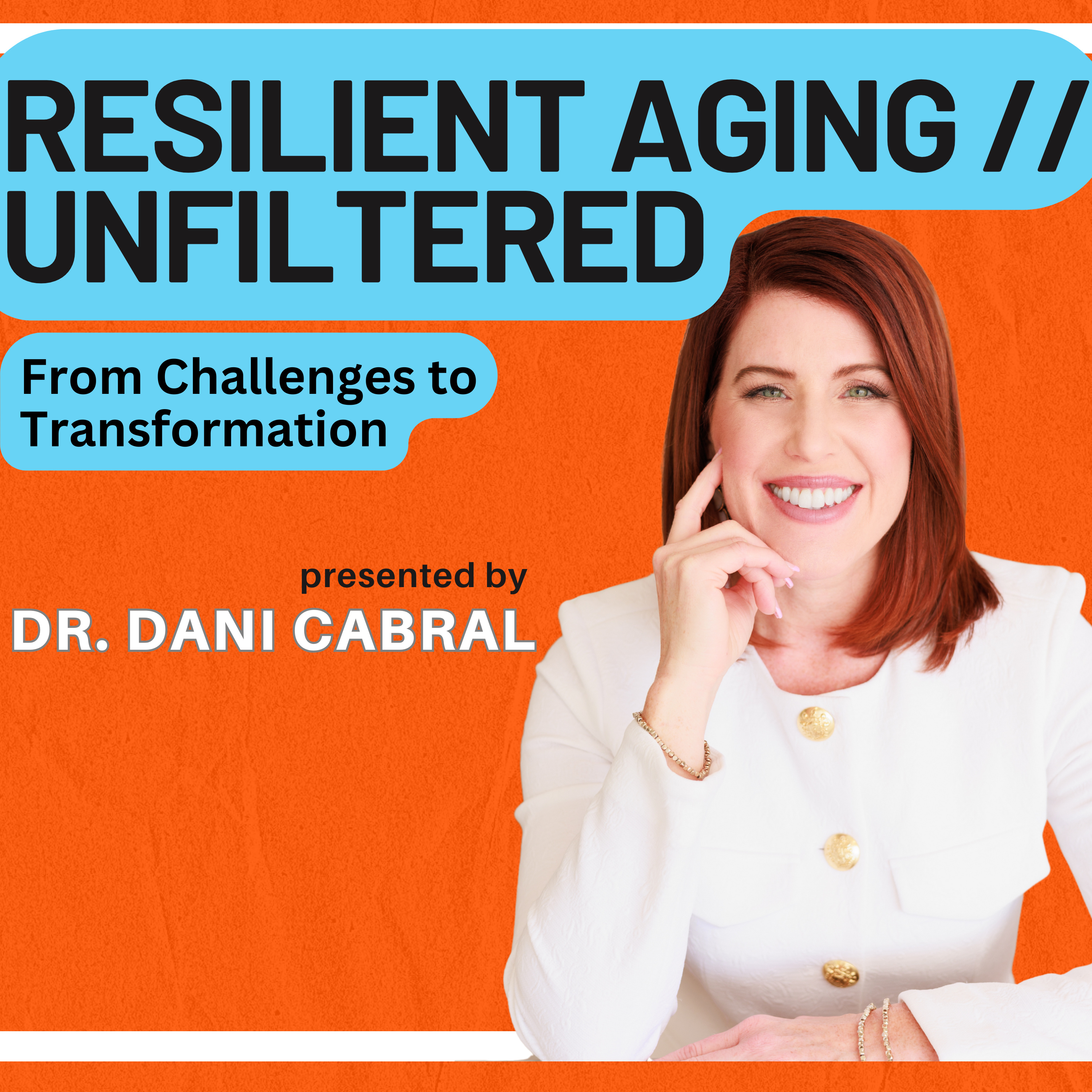
Resilient Aging // Unfiltered
Podcast Description
Welcome to the Resilient Aging // Unfiltered Podcast — where Dr. Dani Cabral (Alzheimer's Specialist Neurologist/Psychiatrist) dives into the complex, messy, transformational reality of aging in today’s world with unfiltered conversations that spark new mindsets and radical possibilities for transformation. No topic is off limits — from grief to reinvention, intimacy to identity, invisibility to power. We’re rewriting the rules on what it means to grow older. Aging isn’t about fading away — it’s about showing up fully, evolving boldly, and sharing hard-won wisdom along the way.
Podcast Insights
Content Themes
The podcast covers a broad array of topics related to aging, Alzheimer's disease, and dementia support, with specific episodes addressing subjects such as breaking myths around Alzheimer's, intimacy policies in memory care, the role of gut health in cognitive function, personal experiences with anti-amyloid treatments, and discussions on intimacy and sexuality in aging. Each episode emphasizes a unique aspect of aging, advocating for a proactive and compassionate understanding of Alzheimer's and the importance of community.
Welcome to Resilient Aging // Unfiltered, where Dr. Dani Cabral, brain aging neurologist & psychiatrist, explores the realities of aging in today’s world combining a biologic, medical, and societal perspective, focused on the opportunities for growth and transformation with aging. Dr. Dani translates complex research into language that is accessible, practical, and intellectually honest helping listeners understand what is established, what is promising, and what remains uncertain. These conversations challenge stigma, spark action, and redefine what’s possible with aging.
Psychedelics are having a moment in medicine but what do we actually know about how they work, and could they help an aging brain? In this episode, Dr. Dani Cabral talks with James Hosobe, a biomedical research analyst with a background in medicinal chemistry, pharmaceutical sciences, and psychedelic policy, to unpack the science, the hype, and the very real open questions around psychedelic-assisted therapy especially for older adults facing conditions like Alzheimer’s and Parkinson’s disease.
The conversation was sparked by patients and families reaching out after seeing news coverage of a woman with significant cognitive and functional impairment who reportedly improved after psilocybin use. Dr. Dani and James dig into why that single case report can’t tell us what we want it to and what would actually need to happen for psychedelics to become a legitimate tool in brain health.
James Hosobe is a biomedical research analyst with the Arizona Department of Health Services, where his work spans preclinical and clinical research, psychedelic policy, and evidence-based public health.
How to Find James Hosobe:
Linkedin: https://www.linkedin.com/in/hosobe
Instagram: https://www.instagram.com/5ht2andjames/
Resources Mentioned
Roland Griffiths’ Johns Hopkins research on psychedelic experiences Griffiths, R.R., Richards, W.A., McCann, U., & Jesse, R. (2006). Psilocybin can occasion mystical-type experiences having substantial and sustained personal meaning and spiritual significance. Psychopharmacology, 187(3), 268–283. Griffiths, R., Richards, W., Johnson, M., McCann, U., & Jesse, R. (2008). Mystical-type experiences occasioned by psilocybin mediate the attribution of personal meaning and spiritual significance 14 months later. Journal of Psychopharmacology, 22(6), 621–632.
Robin Carhart-Harris’s REBUS model (Relaxed Beliefs Under pSychedelics) Carhart-Harris, R.L. & Friston, K.J. (2019). REBUS and the anarchic brain: Toward a unified model of the brain action of psychedelics. Pharmacological Reviews, 71(3), 316–344.
Michael Pollan, How to Change Your Mind: What the New Science of Psychedelics Teaches Us About Consciousness, Dying, Addiction, Depression, and Transcendence (Penguin Press, 2018)
Dr. Gül Dölen’s research on the “critical period” (Johns Hopkins / UC Berkeley) — note: corrects the name mentioned in the episode audio, “Ben Gould Dolan,” to Dr. Gül Dölen Nardou, R., Sawyer, E., Song, Y.J., et al., & Dölen, G. (2023). Psychedelics reopen the social reward learning critical period. Nature, 618(7966), 790–798.
David Olson’s work on non-hallucinogenic psychoplastogens (UC Davis) Cameron, L.P., Tombari, R.J., Lu, J., et al., & Olson, D.E. (2021). A non-hallucinogenic psychedelic analogue with therapeutic potential. Nature, 589(7842), 474–479.
STAY CONNECTED!
🔔 Subscribe Now & Follow the Show
Never miss an episode! Discover more information, tips, expert care, and agingwisdom at theBrainLove Community YouTube Channel: / @brainlovecommunity
💬 Share This Episode
Know someone who needs to hear this? → Share this episode with a friend, family member, or care partner.
💡Learn More About BrainLove and Join our Email List
Discover our innovative approach to Alzheimer’s, brain aging, and resilient care.→ Visit https://brainlove.health/
🧠 Book Your Free BrainLove Discovery Call
Meet with us to explore how BrainLove can support you or your loved one. → Schedule now:
https://calendly.com/drcabral-mybrainlove/20min
💙 Follow Us on Social Media
Be part of the BrainLove movement.
→ Instagram: @drdanibrainlove
→ Facebook: @drdanibrainlove
🎙️Want to Suggest a Topic?
We’d love to hear from you.
→ Email us at [email protected]
Disclaimer
This podcast’s information is provided for general reference and was obtained from publicly accessible sources. The Podcast Collaborative neither produces nor verifies the content, accuracy, or suitability of this podcast. Views and opinions belong solely to the podcast creators and guests.
For a complete disclaimer, please see our Full Disclaimer on the archive page. The Podcast Collaborative bears no responsibility for the podcast’s themes, language, or overall content. Listener discretion is advised. Read our Terms of Use and Privacy Policy for more details.