The Weekly Dev's Brew

The Weekly Dev's Brew
Podcast Description
Join host Jan-Niklas Wortmann in 'The Weekly Dev's Brew, where we explore the latest in web development, JavaScript, TypeScript, and emerging technologies. Engage in coffee shop-style conversations with industry experts to learn about frameworks like React, Vue, Angular, and everything remotely related. Follow us on social media for more insights https://www.weeklybrew.dev/
Podcast Insights
Content Themes
The podcast centers around themes of web development, JavaScript frameworks, and emerging technologies. Episodes delve into topics such as the evolution of frameworks like Nuxt, SolidJS, and Vite, while exploring innovative practices like async JavaScript patterns and the impact of AI on coding and user experience. Specific episodes include discussions on Nitro's role in modern web development and the significance of signals in reshaping JavaScript frameworks.

The people building AI developer tools have stories most of us never hear. Stories of failed experiments, unexpected wins and workflows they swear by. The Weekly Dev’s Brew host Jan-Niklas Wortmann pulls those stories out through honest conversations about what AI actually changes for developers and how we write software.
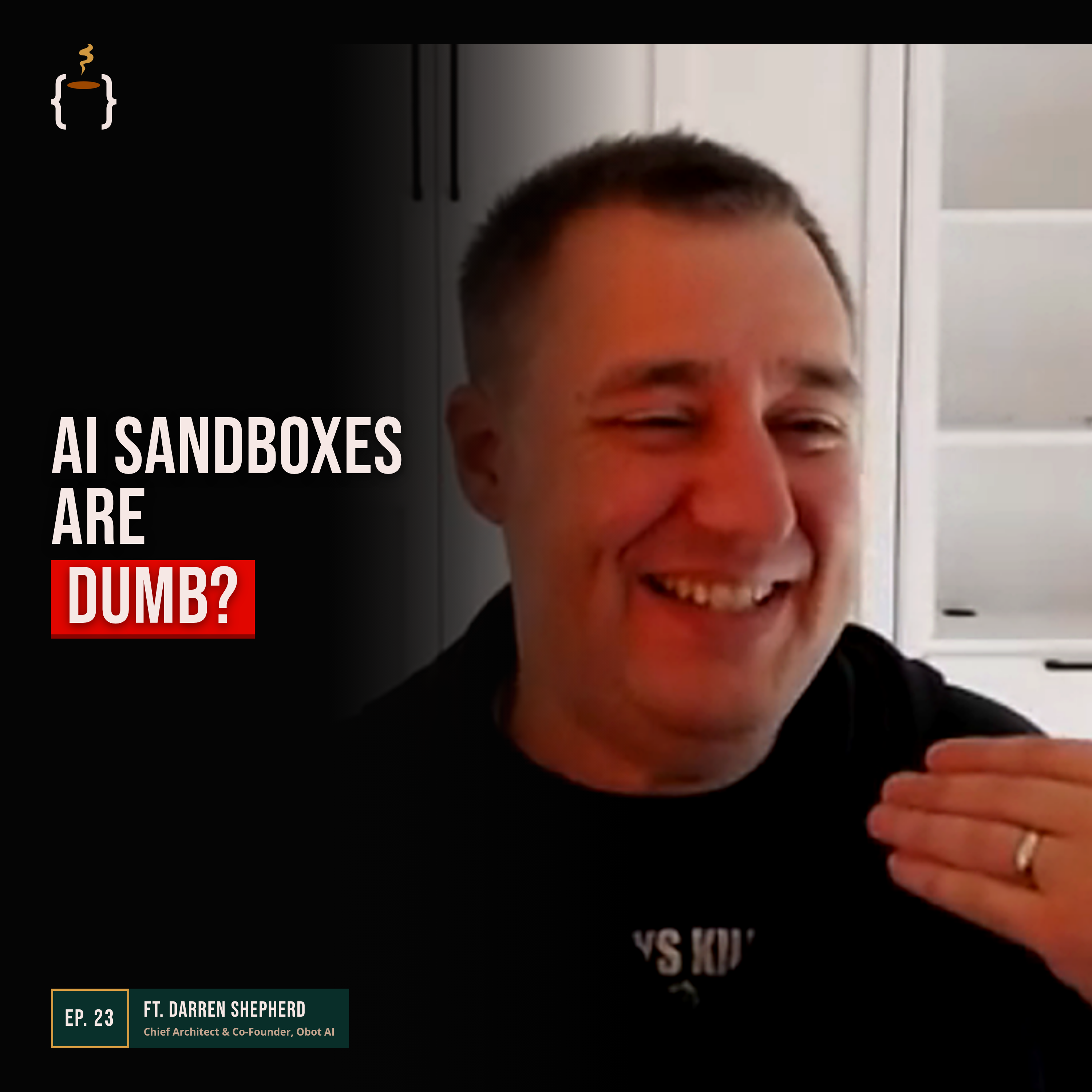
Why buy a sandbox when you can just launch a container? Darren Shepherd spent years at Rancher building on Kubernetes, so sandboxes looked dumb to him. Then he built his own coding agent to run 15 things in parallel without work-tree chaos, and the most interesting part of it turned out to be a sandboxing system. He had proved himself wrong.
The sharp part is where the sandbox boundary goes. The common pattern keeps the agent loop outside and sandboxes only its tool calls. Darren calls that completely flawed, because the loop itself directs code that holds secrets and talks to external systems. His answer: put the agent and its tools in one sandbox, with one policy for secrets and egress.
Darren is on X and GitHub at @ibuildthecloud. https://obot.ai/
Where does your boundary sit: around the agent itself, or only around the tools it calls?
Why buy a sandbox when you can just launch a container? Darren Shepherd spent years at Rancher building on Kubernetes, so sandboxes looked dumb to him. Then he built his own coding agent to run 15 things in parallel without work-tree chaos, and the most interesting part of it turned out to be a sandboxing system. He had proved himself wrong.
The sharp part is where the sandbox boundary goes. The common pattern keeps the agent loop outside and sandboxes only its tool calls. Darren calls that completely flawed, because the loop itself directs code that holds secrets and talks to external systems. His answer: put the agent and its tools in one sandbox, with one policy for secrets and egress.
Darren is on X and GitHub at @ibuildthecloud. https://obot.ai/
Where does your boundary sit: around the agent itself, or only around the tools it calls?
Show notes, transcript, and links: https://www.wordman.dev/podcast/darren-shepherd-ai-agent-sandboxes/
Key Takeaways
- A container is not a sandbox. Sandboxes sit one layer up: create, clone, copy files in and out, on a base image that mostly just carries language runtimes.
- Parallel agents need isolation. Running many tasks at once without Git work-tree chaos means giving each task its own sandbox.
- Egress is the policy surface, not ingress. Agents sit on the consuming side of services, so outbound traffic is what you control.
- Keep real secrets out of reach. Hand the agent a fake key with the right shape and swap in the real one at a transparent proxy, where policy and exfiltration checks live.
- Sandbox the agent loop, not only the tool calls. The loop directs code that holds secrets and talks to external systems, so the agent and its tools belong in one sandbox with one policy.
- Client-side agent loops beat centralized ones. Server-side provider tools such as web search open exfiltration paths that are hard to reason about.
- MCP's lasting value is the interface, not the protocol: a contract designed for AI, which is why it fits the enterprise.
- Output is not progress. Letting a model barf out thousands of lines feels productive until the regressions pile up, and one estimate raised in the conversation puts a skilled engineer's real gain at around 5 to 10 percent.
Chapters
- 00:00:00 Why sandboxes felt dumb
- 00:01:38 Building a coding agent
- 00:02:36 Parallelism and work-tree chaos
- 00:03:25 What a sandbox actually is
- 00:04:27 Files, secrets, and egress
- 00:08:20 Tool-call-only sandboxing is flawed
- 00:12:28 Put the agent in the sandbox
- 00:13:31 Client-side vs centralized loops
- 00:14:51 GPTScript, Clio, and MCP
- 00:20:00 MCP, OAuth, and staying in lane
- 00:30:01 Without fundamentals, AI gets dangerous
- 00:35:00 The 100x developer myth
- 00:40:00 AI is not a compiler
- 00:45:01 Distributed systems instincts
- 00:51:09 ADRs and keeping quality
- 00:55:04 Regression holes with agents
- 00:57:19 Model personalities and greenfield work
- 01:01:50 Skills as behavioral scripts
- 01:05:16 Plan-first and spec-driven development
- 01:12:30 Claude Code and tooling shifts
- 01:21:16 Wrap and finding joy with AI
Mentioned
Disclaimer
This podcast’s information is provided for general reference and was obtained from publicly accessible sources. The Podcast Collaborative neither produces nor verifies the content, accuracy, or suitability of this podcast. Views and opinions belong solely to the podcast creators and guests.
For a complete disclaimer, please see our Full Disclaimer on the archive page. The Podcast Collaborative bears no responsibility for the podcast’s themes, language, or overall content. Listener discretion is advised. Read our Terms of Use and Privacy Policy for more details.