Space Commerce Week

Space Commerce Week
Podcast Description
A weekly newsletter published to the community highlighting the news of the week and letting you know who our podcast guest is that week. We will look ahead to the coming week to see what's happening and let you know. www.exterrajsc.com
Podcast Insights
Content Themes
Focuses on recent developments in the space industry, including launch schedules, technologies, partnerships, government contracts, and economic impacts, with episodes detailing specific launches like SpaceX's Crew-10 and discussions on commercial lunar missions.
A weekly newsletter published to the community highlighting the news of the week and letting you know who our podcast guest is that week. We will look ahead to the coming week to see what’s happening and let you know.
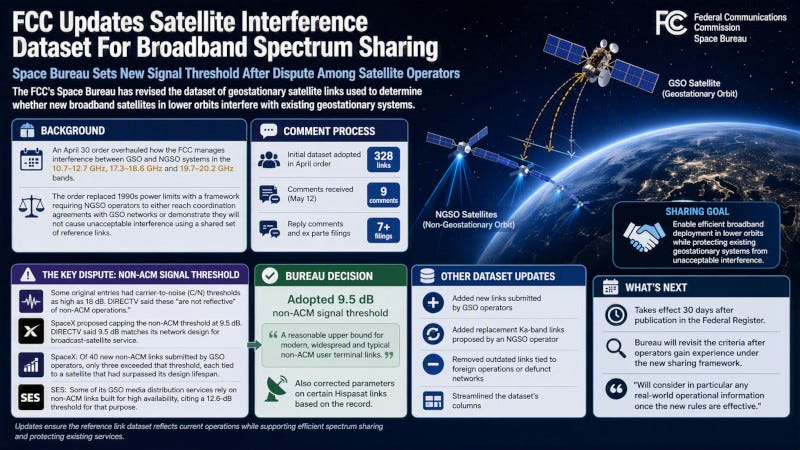
The FCC’s Space Bureau has set a new interference threshold for satellite broadband sharing. It’s a lower signal limit — the one satellite operator SpaceX pushed for — over objections from rival operator SES.
The update revises a dataset of geostationary satellite links, or GSO links, used to check whether new broadband satellites in lower orbits interfere with them. Those lower-orbit systems are called non-geostationary, or NGSO. The change stems from an April 30 order that replaced power limits dating back to the 1990s. Under the new framework, NGSO operators have two options: strike a coordination agreement with GSO networks, or prove they won’t cause unacceptable interference, using that shared dataset of links. The affected bands run from 10.7 to 12.7 gigahertz, 17.3 to 18.6 gigahertz, and 19.7 to 20.2 gigahertz.
The Bureau built an initial set of 328 reference links back in April. It opened the dataset for public comment in May, and got nine comments, seven replies, and several ex parte filings. The most contested issue: the signal threshold for links without adaptive coding. SpaceX proposed capping that threshold at 9.5 decibels — a number DIRECTV said matched its own network design. Of 40 new links submitted by GSO operators, only three came in above that level, and each was tied to a satellite already past its design lifespan. SES pushed back, arguing some of its media-distribution links need a higher threshold — around 12.6 decibels — to stay reliable.
In the end, the Bureau adopted that 9.5-decibel threshold. It also corrected some Hispasat link parameters and cleaned up outdated entries in the dataset. But it declined to revisit the broader selection criteria, saying that could introduce edge cases into the analysis. The revised notice takes effect 30 days after it’s published in the Federal Register. And the Bureau says it’ll take another look at the framework once operators have real-world experience from which to draw.
-0-
The Space Bureau wasn’t done with satellite paperwork this week. The FCC has opened a public comment period on Rocket Lab’s bid to acquire satellite fleet operator Iridium Communications. That deal also triggers a separate national security review, outside the Commission’s own docket.
Under the agreement, signed June 28, a Rocket Lab subsidiary would merge into Iridium. Iridium would come out the other side as a wholly owned Rocket Lab unit. The FCC has set a deadline for comments and petitions on the docket of Oct. 15, with oppositions due by Oct. 30, and replies by Nov. 9. Separately, the companies have notified Team Telecom — the federal committee that reviews foreign participation in U.S. telecom. They say a network security agreement Iridium already holds with the government will keep applying once the deal closes.
Iridium operates 66 low-Earth-orbit satellites, serving more than 2-and-a-half (2.55) million subscribers with mobile voice, data, maritime, and aviation connectivity. It also holds 8.725 megahertz of L-band spectrum, part of which supports government aircraft tracking. The filing would transfer several licenses to Rocket Lab: an international Section 214 authorization, one space station license, six earth station licenses, and a handful of experimental licenses.
Rocket Lab operates launch pads in Virginia and New Zealand, plus manufacturing sites in Long Beach, California, and Albuquerque, New Mexico. The company says a combined operation would be better financed to speed up a next-generation Iridium constellation. Both companies say the deal doesn’t raise competition concerns. And they say Rocket Lab’s foreign ownership falls within Section 310 limits, so no waiver is needed. For now, the Space Bureau has simply accepted the applications for filing. It hasn’t ruled on the merger’s merits — that decision comes after the Nov. 9 reply deadline.
-0-
A presidential commission charged with designing a new national space academy has held its first meeting, and opened the door for states to bid on hosting the campus.
President Trump created the commission through an Aug. 28 executive order, signed at NASA’s Johnson Space Center in Houston. It gives the panel 120 days to recommend how to build the academy — and the workforce pipeline behind it. NASA Administrator Jared Isaacman chaired the first session at NASA Headquarters in Washington. Members from across the federal government took part, including Secretary of War Pete Hegseth, National Economic Council Director Kevin Hassett, Air Force Secretary Troy Meink, and U.S. Chief Technology Officer Ethan Klein. Staff from the Office of Management and Budget, the National Security Council, and the White House also sat in.
The next morning, NASA published a Request for Information, asking governors — or their designees — to submit proposals for hosting the academy. Each state gets just one submission. NASA Deputy Administrator Matt Anderson said site selection would shape the institution’s future. And Isaacman said the RFI gives states a chance to help build what he called a legacy institution.
States need to detail site readiness, environmental and regulatory considerations, and the surrounding support ecosystem. NASA’s target timeline: break ground no later than 2027, temporarily host the first 300 students in 2028, and move into a permanent campus by 2031. State proposals are due by 6 p.m. Eastern time on Oct. 26.
NOAA has set up a new contract to buy commercial satellite data from 14 companies over the next decade. The goal: strengthen weather and space weather forecasting.
The contract is called Space-Based Environmental Monitoring, set up through NOAA’s Commercial Data Program. It took effect Sept. 1 and runs through Aug. 31, 2036 — a five-year base period plus a five-year option. The data breaks down into seven categories, and NOAA has named eligible suppliers for six of them. Two names show up again and again: Spire Global and Tomorrow.io, appearing across nearly every category, from GNSS radio occultation to microwave sounders to multispectral imagery. Other suppliers on the list include PlanetiQ, Muon Space, BAE Systems, Hydrosat, ICEYE US, and SpaceX. The seventh category — infrared sounders, which measure atmospheric temperature and moisture — still doesn’t have a vendor.
NOAA Assistant Secretary Taylor Jordan said the agency wants to maximize the value of data coming from its commercial partners. The contract sits under NOAA’s ProTech 2.0 vehicle — an $8 billion shared-ceiling contract set up back in 2021 that also covers procurement for the National Weather Service and other NOAA offices. The Commercial Data Program itself runs under authority Congress granted through the Weather Research and Forecasting Innovation Act of 2017 and the PROSWIFT Act of 2020. And NOAA says it can add categories and vendors to the contract as its needs change over the next 10 years.
-0-
But the NOAA contract wasn’t the only reason Tomorrow.io showed up in the news this week. The company was confirmed as the customer behind a $187 million satellite contract that had gone undisclosed since March.
Denver-based York Space Systems will build at least 20 spacecraft for the program, using its M-CLASS platform. York is sole prime on this phase — responsible for both building the satellites and integrating the payloads. Each spacecraft will carry five Tomorrow.io instruments: Gen-2 microwave sounders, GNSS radio occultation and reflectometry sensors, infrared and visible imaging, and space-based precipitation radar. Together, they’re designed to give forecasters a fuller read on the atmosphere, updated on a global scale.
York Chief Technology Officer Michael Laczjok (LAYT-shih-kohk) said the M-CLASS platform was built for exactly this kind of mission. Tomorrow.io Chief Executive Shimon Elkabetz said the program needed a partner that could move fast on demanding payload requirements. York says it’s put more than $755 million into production capacity to build constellations at this scale. And that $187 million figure only covers DeepSky’s first phase — the companies haven’t said how many more spacecraft, or how much more funding, later phases will need.
-0-
The Office of the Assistant Secretary of the Air Force for Space Acquisition and Integration has selected Antares Nuclear for a $161 million Strategic Breakthrough award. The goal: advance nuclear power for spacecraft.
The Torrance, California-based company says the award funds development of its R1-S reactor design. Antares plans to demonstrate that reactor on the ground first, then integrate it with a spacecraft for flight certification ahead of launch. The company will also operate a separate electricity-producing reactor, called Mark-1, at a ground-to-space test site. Testing is scheduled for 2027 and expected to run more than six months, paired with a nitrogen closed Brayton cycle power conversion system. Antares calls this the largest current Department of War contract in space nuclear power — though the company didn’t cite a comparison figure.
Chief Executive Jordan Bramble said the Space Force partnership turns the company’s long-held focus on space into what he called a codified mission. The award builds on an earlier milestone. Back on June 4, Antares’ Mark-0 microreactor reached initial criticality at Idaho National Laboratory, under Department of Energy authorization. That made Antares the first private company to bring an advanced reactor to criticality under the DOE’s Reactor Pilot Program. The broader effort ties back to Executive Order 14369, “Ensuring American Space Superiority,” and the National Initiative for American Space Nuclear Power — both of which call for reactors in orbit as early as 2028, and on the lunar surface by 2030.
Theme Stock Music “Interesting Facts” Licensed from Pond 5
You might also like:
* Satellite Leasing Deal Sets $300 Million Framework for Orbital Computing Fleet
* Space Data Center Startup Taps German Firm to Build Its Satellites
* New Propulsion Test Stand Opens At Houston Spaceport
* Going Public as Industrial Validation[Paywall]
* SkyFi Launches Rowan, its Conversational AI Navigator for Satellite Imagery[Paywall]
This is a public episode. If you’d like to discuss this with other subscribers or get access to bonus episodes, visit www.exterrajsc.com/subscribe
Disclaimer
This podcast’s information is provided for general reference and was obtained from publicly accessible sources. The Podcast Collaborative neither produces nor verifies the content, accuracy, or suitability of this podcast. Views and opinions belong solely to the podcast creators and guests.
For a complete disclaimer, please see our Full Disclaimer on the archive page. The Podcast Collaborative bears no responsibility for the podcast’s themes, language, or overall content. Listener discretion is advised. Read our Terms of Use and Privacy Policy for more details.