Neural Compass
Neural Compass
Podcast Description
Welcome to Neural Compass, a new podcast from Jimini Health.We’re charting the future of mental and behavioral health — at the intersection of AI, psychiatry, neuroscience, and real-world clinical care.Hosted by Jimini’s own Mark Jacobstein, Neural Compass features honest, forward-thinking conversations with the leaders shaping what’s next — from healthcare executives to AI pioneers.Whether you’re building in this space, investing in it, or navigating it as a decision-maker, this podcast is your guide to the breakthroughs, challenges, and ideas defining the next era of care.Learn more: jiminihealth.com
Podcast Insights
Content Themes
The podcast covers a range of topics including advancements in AI and mental health care, the role of data in improving therapeutic relationships, and innovative treatment models. Episodes feature discussions like the impact of AI on therapy with guests such as Dr. Lyle Ungar, the importance of measurement-based care with Dr. Amber Childs, and strategies for addressing anxiety with Dr. Luana Marques, providing unique insights and practical tools.
If you work in mental health, invest in it, build in it, or just believe it deserves better than it is getting: Neural Compass is for you.
Filter episodes by category to find exactly what you’re looking for, from AI Meets the Clinic to Founders & Funders to Behavioral Science, right here: https://jiminihealth.com/podcast
Every two weeks, Jimini Health co-founder Mark Jacobstein sits down with the scientists, clinicians, and executives who are actually moving the field. The conversations go deep. The guests are the real thing.
Episodes have covered the clinical case for ketamine, the genomics of psychiatric diagnosis, what AI can and cannot do for behavioral health, and what it takes to reform mental healthcare from inside the system.
Guests have included former National Institute of Mental Health director Tom Insel, Yale psychiatry chair John Krystal, and researchers and executives at the frontier of behavioral health and AI.
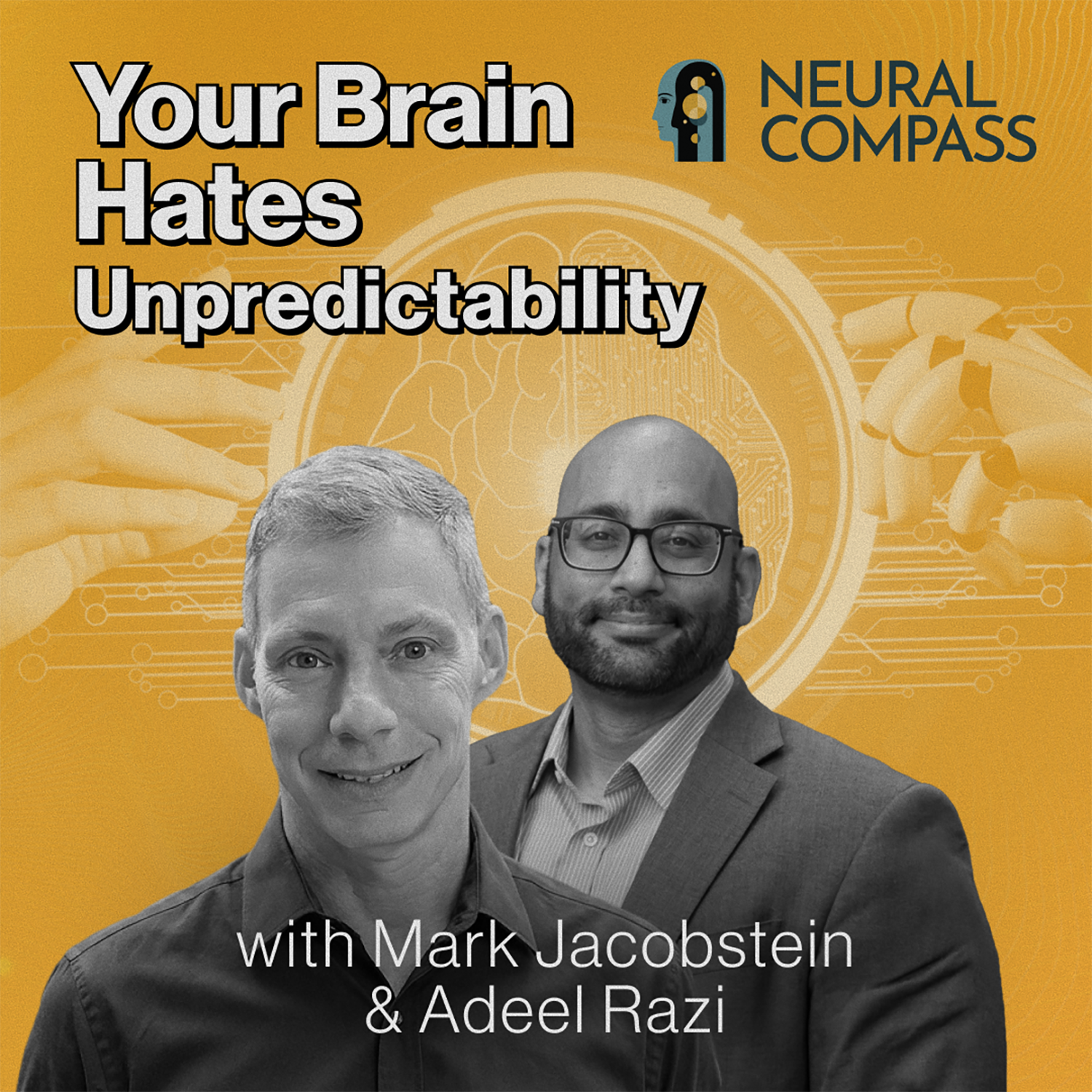
About the Guest:
Episode Highlights
[00:16:26] Finding Structure Beneath Psychedelic Disorder
Dr. Adeel Razi explains that psychedelic brain activity is not simply random or disorganized. His research found structured neural trajectories beneath the apparent disorder, with stronger organization linked to deeper subjective experiences. The findings also provide evidence that factors such as music, meditation, and other elements of set and setting actively shape brain dynamics.
Dr. Razi describes psychiatric conditions as rigid brain trajectories, using the analogy of a ball trapped in a deep valley. Psychedelics can act as a perturbation that temporarily flattens that landscape, allowing the brain to escape an unhealthy pattern. Therapy and context may then help guide it toward healthier, more stable trajectories.
Dr. Razi discusses DishBrain, a closed-loop biological system capable of learning to play Pong. His team is now studying whether these neurons can learn multiple tasks without forgetting earlier ones – a challenge artificial neural networks often face. By observing biological neurons during continual learning, the researchers hope to uncover principles that could eventually inform new AI models.
Disclaimer
This podcast’s information is provided for general reference and was obtained from publicly accessible sources. The Podcast Collaborative neither produces nor verifies the content, accuracy, or suitability of this podcast. Views and opinions belong solely to the podcast creators and guests.
For a complete disclaimer, please see our Full Disclaimer on the archive page. The Podcast Collaborative bears no responsibility for the podcast’s themes, language, or overall content. Listener discretion is advised. Read our Terms of Use and Privacy Policy for more details.