The Growth House Podcast
The Growth House Podcast
Podcast Description
Welcome to The Growth House Podcast. My name is Ben Fennell, and I'm founder and CEO of The Growth House. This is an interview series where we explore leadership and teamship and growth, a series of topics that during 16 years as CEO of BBH, I grew passionate about and I've dedicated the last five years into studying it in as much detail as I possibly can. So we'll be speaking to business leaders, senior members of the military and special forces, athletes, coaches, technologists, and even astronauts and will be looking to understand the behaviours, the tools, and critically the habits that become part of the working daily and weekly life of a high performance team. If you enjoy this podcast and want to find out more, please look us up www.growthhouse.co.uk hope you really enjoy the interviews. Hosted on Acast. See acast.com/privacy for more information.
Podcast Insights
Content Themes
The podcast delves into themes such as leadership development, mental health, diversity and inclusion, and high-performance habits. Episodes include discussions on subjects like conflict resolution with hostage negotiator Kirk Kinnell, personal growth through adversity with Jason Fox, and the integration of AI tools in leadership with AI Ethicist Henry Shevlin, all aimed at showcasing actionable insights for listeners.
Welcome to The Growth House Podcast. My name is Ben Fennell, and I’m founder and CEO of The Growth House. This is an interview series where we explore leadership and teamship and growth, a series of topics that during 16 years as CEO of BBH, I grew passionate about and I’ve dedicated the last five years into studying it in as much detail as I possibly can. So we’ll be speaking to business leaders, senior members of the military and special forces, athletes, coaches, technologists, and even astronauts and will be looking to understand the behaviours, the tools, and critically the habits that become part of the working daily and weekly life of a high performance team. If you enjoy this podcast and want to find out more, please look us up www.growthhouse.co.uk hope you really enjoy the interviews.
Hosted on Acast. See acast.com/privacy for more information.
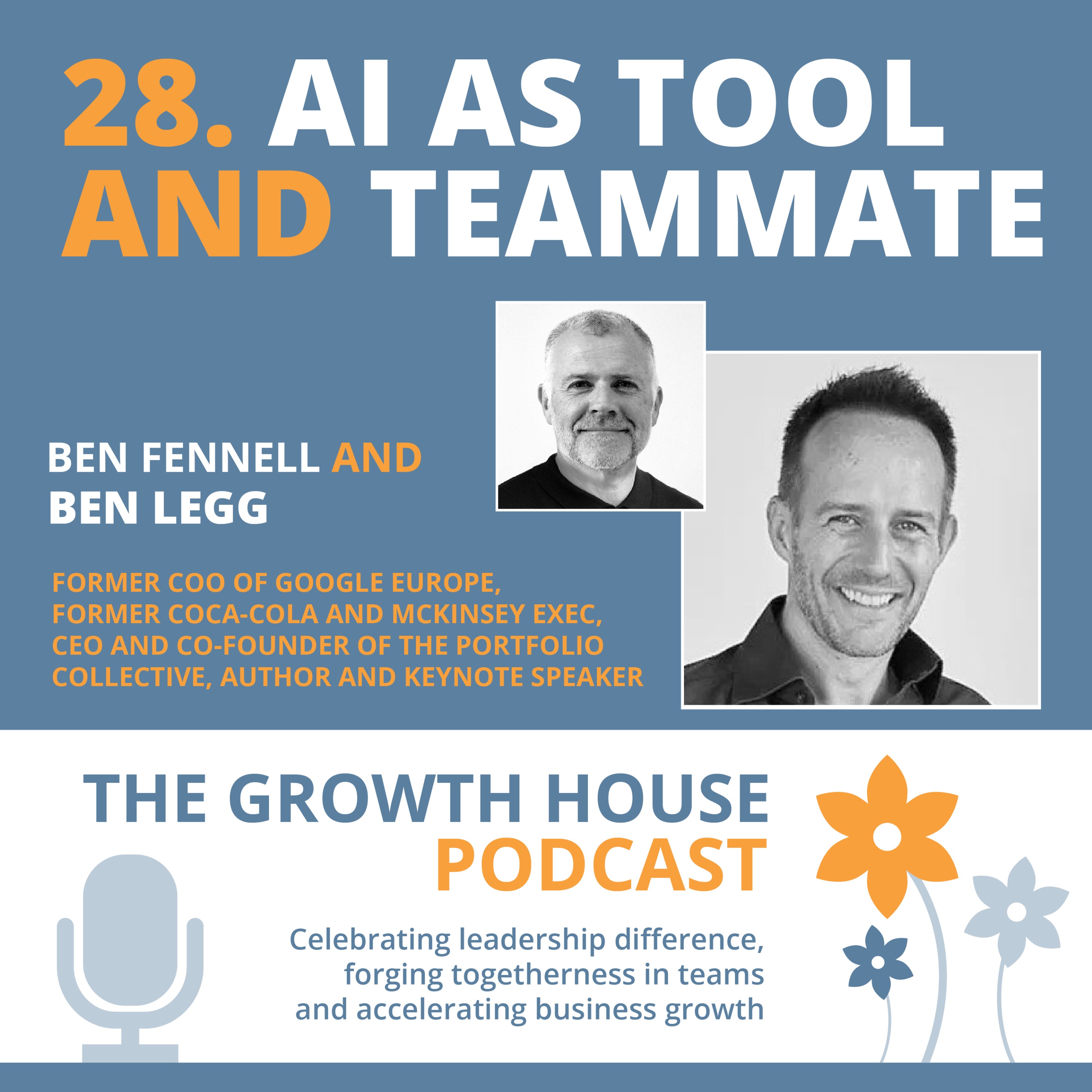
Our latest podcast is with the wonderful Ben Legg, a man who has done so many different things in his career that it makes your head spin. He’s been a British soldier, a McKinsey consultant, a Coca-Cola and Google Executive, Ben is now an entrepreneur and inspirational speaker in the AI space. I think it is the breadth and diversity of Ben’s background that makes his perspective so insightful and so practical. Ben has just joined The Growth House speaker roster and so it’s a very great pleasure to share this conversation.
2:19 – Ben Legg’s career journey
British Army engineer → McKinsey → Coca-Cola (Greece, Poland, India) → COO of Google Europe → portfolio career in AI (speaking, investor advisory, board/mentoring work).
5:12 – Running an agentic business
How Legg runs a 6-person (1 + 5 fractional) consultancy by automating routine work and deciding the human/AI split per project.
7:37 – Claude as the orchestration layer
Claude sits at the centre of his tech stack (Notion, email/calendar, Gemini, Granola, Xero) and runs 62 personal agents.
8:06 – Why Claude specifically
Claude’s edge isn’t the LLM itself but its ability to organise, coordinate, and orchestrate across other tools.
9:00 – Building confidence to adopt AI
Two paths: quick wins (e.g., a 20-minute email agent) vs. going all-in over a fixed period, illustrated by Legg’s own “power user in a month” experiment with Claude.
12:30 – AI as teammate, not tool
The “graduate trainee” analogy — training agents like a junior teammate who improves daily, vs. generic AI which resets every session.
14:45 – Case study: Klarna
Headcount cuts, partial rehiring, and eventually ~30–40% cost reduction with doubled revenue — mistakes made in public.
~17:40 – Case study: IKEA
Freed-up call centre staff retrained into design roles, generating $1.3bn in new revenue.
19:06 – Freeing humans for higher-value work
Parallel example from a telco client; AI takes the mundane, humans take the complex/creative.
20:14 – Dual agenda: AI skills + critical thinking
The future-of-work case for developing both; also why parents need to be AI power users to teach their kids.
22:58 – Four levels of AI competence
Legg’s framework for gauging a room’s AI maturity (from “not using AI” to “building agentic workflows”).
23:53 – Watchout: “Pilot purgatory”
Individual productivity gains without solving big cross-functional problems — still needs proper change/project management.
~25:20 – Watchout: “Shadow AI”
Risks of employees using personal AI accounts with company data when organisations dither or over-restrict.
26:36 – Token budgets and ownership
Why giving AI budget ownership to line managers/P&L owners drives better trade-off decisions than IT-owned token systems.
27:42 – Data quality as the foundation
Why “rubbish in, rubbish out” becomes urgent once AI (not humans) is doing the reconciling — the “library with no organisation” analogy.
30:24 – “Turkeys voting for Christmas”?
Jevons paradox — efficiency increases demand rather than destroying jobs, especially in healthcare, entertainment, travel, education.
33:51 – Case study: Radiologists
Geoffrey Hinton’s 2016 prediction vs. reality — radiologist numbers and pay have grown as scanning volume increased.
36:54 – Gamifying learning with his kids
Building Gemini “gems” (agents) for storytelling and colouring with his children as a way of teaching AI literacy through play.
39:48 – AI and human connection
Ben Fennell’s own example (Suno + personalised song) and discussion of AI freeing time for higher-value human connection.
41:08 – The “AI super user” in every team
Why teams now need a designated AI champion alongside other core skill sets.
43:03 – Closing three questions
- 43:48 – Leadership behaviour: leading from the front on AI adoption
- 45:07 – Teamship behaviour: “share and learn,” including failures
- 46:50 – Growth advice: use AI to find new opportunities, and always weigh human vs. AI split at every stage
Hosted on Acast. See acast.com/privacy for more information.
Disclaimer
This podcast’s information is provided for general reference and was obtained from publicly accessible sources. The Podcast Collaborative neither produces nor verifies the content, accuracy, or suitability of this podcast. Views and opinions belong solely to the podcast creators and guests.
For a complete disclaimer, please see our Full Disclaimer on the archive page. The Podcast Collaborative bears no responsibility for the podcast’s themes, language, or overall content. Listener discretion is advised. Read our Terms of Use and Privacy Policy for more details.