On Lightness
On Lightness
Podcast Description
a conversational podcast on the meaning of the word "lightness". Three definitions are explored by a different guests every month.
lightness¹ the quality of having little weight.
lightness² the state of being light in color or shade.
lightness³ being carefree or feeling without burden.
Engineers, Biologists, Architects, Designers, and Photographers are confronted with questions about their field and how it relates to lightness in an attempt to find the essence of the words meaning. For each episode, there will be articles published with the mentioned references and further investigations.
lllightness.substack.com
Podcast Insights
Content Themes
The podcast investigates three definitions of lightness: the quality of having little weight, the state of being light in color or shade, and being carefree or feeling without burden. Episodes delve into specific topics such as material efficiency in biology, architectural designs inspired by nature, and the emotional aspects of lightness, with examples including discussions on biomimicry and structural innovations like the FlectoLine Facade.
a conversational podcast led and produced by architect Leon Hidalgo on the meaning of the word “lightness”. Three definitions are explored with a different guests every month.
lightness¹ the quality of having little weight.
lightness² the state of being light in color or shade.
lightness³ being carefree or feeling without burden.
Engineers, Biologists, Architects, Designers, and Photographers are confronted with questions about their field and how it relates to lightness in an attempt to find the essence of the words meaning. For each episode, there will be articles published with the mentioned references and further investigations.
This month, I interviewed architecture and engineering historian Dr. Giulia Boller, who is a lecturer and senior postdoctoral researcher at ETH Zurich. We talked about her PhD and her recently published book on the shell builder Heinz Isler and reflected on the role of mid-century lightweight pioneers in the reduction of building material.
This episode was moderated and produced by Leon Hidalgo.
lllightness is a reader-supported publication. To receive new posts and support my work, consider becoming a free or paid subscriber.
The following article is meant as an informational extension of the podcast episode:
Giulia was trained both as an architect and civil engineer. In her first years after finishing her studies, she worked at the Renzo Piano Building Workshop, where she first came into contact with an architectural language of lightness.
After that, she was accepted as a PhD student at ETH, where the opportunity arose to write a dissertation on the newly acquired archival remains of the shell builder Heinz Isler, who had passed away in 2009. She recently published parts of this research, among others, in a book through gta Verlag titled Heinz Isler, Built Experiments – Entrepreneurial Networks.
The idea of lightness for Giulia is directly linked to the work of the mid–20th century lightweight pioneers. First coming to mind is Frei Otto, but also figures like Robert Le Ricolais and Heinz Isler himself.
Lightness¹ the quality of having little weight
Resource scarcity and cheap labour in certain mid-century contexts (for example postwar Italy or Mexico) were not abstract economic conditions but concrete forces shaping how people like Pier Luigi Nervi and Félix Candela drew and built. These constraints pushed them toward structural languages that did more with less material. At the same time, Giulia sees this as part of a broader, global cultural shift: architects and engineers became fascinated with long-span, columnless spaces, and for the first time the public gaze began to include not only the architects of these buildings but also the engineers behind them.
Within this constellation, the fascination with natural structures becomes clear in Frei Otto’s collaborations with biologists, where an interdisciplinary research process set out to trace connections between form and forces. At the same time, Heinz Isler saw biomatter more as a source of formal inspiration rather than as something he would ever want to reproduce literally. Sergio Musmeci, on the other hand, turned more toward the mathematical foundations of shape, while still sharing with the others a key reference point in D’Arcy Thompson’s book On Growth and Form.
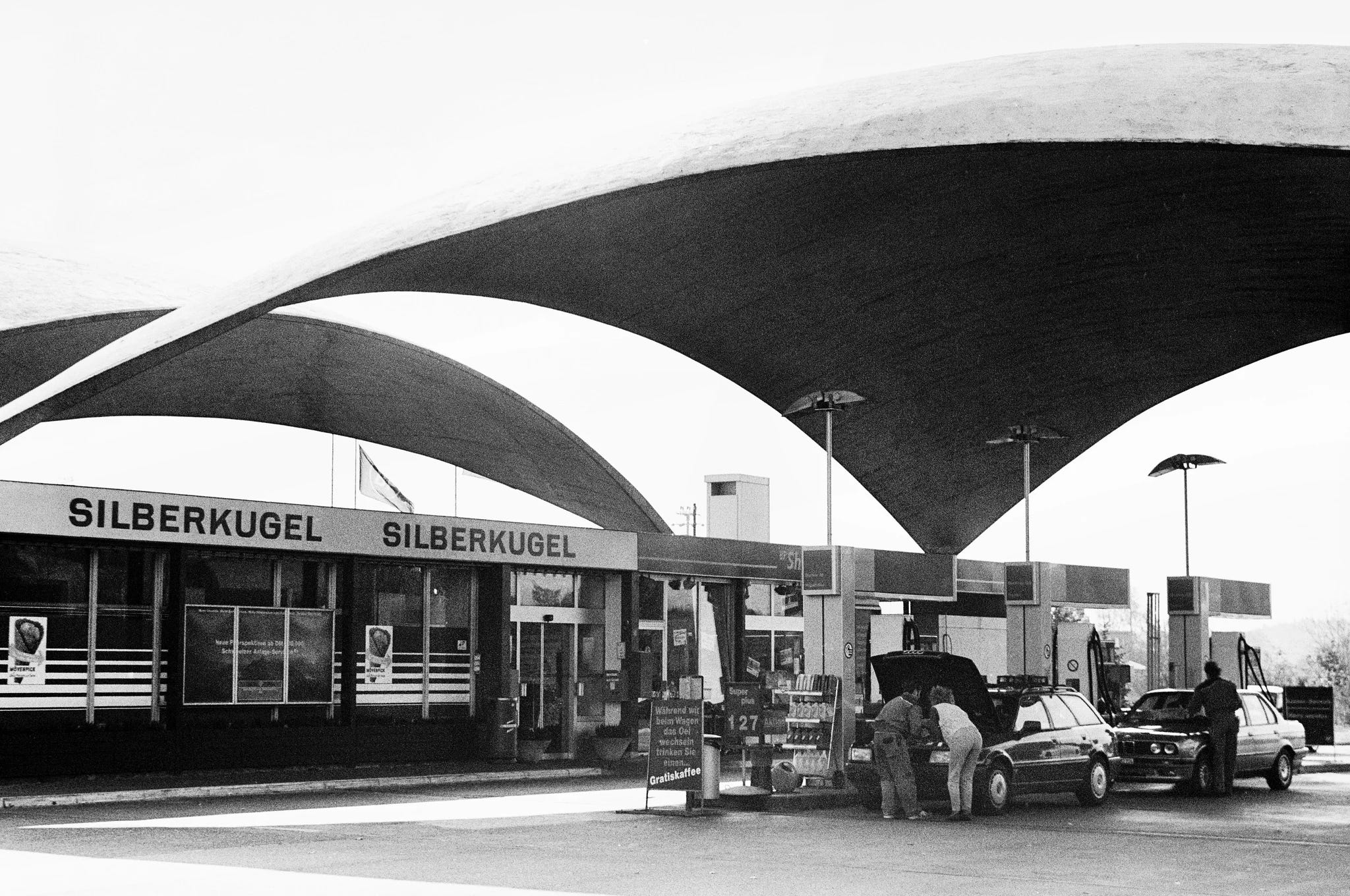
One of Giulia’s favourite structures is the Deitingen service station by Heinz Isler, where two mirrored triangular shells form simple roofs over a roadside gas station.
Another is the Gatti Wool Factory in Rome by Pier Luigi Nervi, whose roof is conceived as a series of minimal-material slabs.
Lastly the concrete factory by Swiss engineer Heinz Hossdorf comes to mind, which for Giulia exemplifies a collaborative effort in which an engineer takes an active role in shaping an architectural masterpiece.
lightness² the state of being light in color or shade
At RPBW, the aspect of lightness was mentioned as a spatial concept of visibility and transparency. Not in the sense of a material property, but as the ability, upon entering a room, to read the full stratification of spaces and elements that together make up the building.
Giulia recalls from a research project on the Olympic Stadium in Munich that new plexiglas panels had to be developed specifically for the roof. They needed to let light pass through while avoiding strong reflections that would disturb television cameras. This was crucial because the Olympic Games (1972) for the first time were to be broadcasted live.
For Isler, one of the key challenges of shell construction was how to bring light into the dark centre of these roofs. His answer was to develop a production method for glass-fibre shells that could be used as central skylights. These glass-fibre domes could be produced using similar techniques to his hanging models. Legend has it, that selling this system to another company provided the capital he needed to open his own engineering office.
On a recent trip to Algeciras in southern Spain, Giulia visited the city’s market hall, an early concrete-shell structure by Spanish engineer Eduardo Torroja. Its skylight produces a striking and unexpected light atmosphere, leaving a strong impression on her.
lightness³ being carefree or feeling without burden
When thinking about the physical feeling of lightness, the first image that comes to Giulia’s mind is the famous load tests of Candela’s shells, workers standing on the thin concrete surfaces to prove their structural sufficiency. For her, the sensation of lightness is connected to structures that suggest movement, or that are literally in motion as well as structures that visualize gravitational forces.
Towards the end of her work on Isler’s archive, Giulia opened a box that had apparently gone untouched throughout the entire research process. Inside she found something she had not expected at all: computer calculation printouts. Until then, Isler had been known to oppose to the use of computers in structural calculation. The discovery gave Giulia the rare opportunity to reveal a completely unknown side of the Swiss engineer.
Get full access to lllightness at lllightness.substack.com/subscribe
Disclaimer
This podcast’s information is provided for general reference and was obtained from publicly accessible sources. The Podcast Collaborative neither produces nor verifies the content, accuracy, or suitability of this podcast. Views and opinions belong solely to the podcast creators and guests.
For a complete disclaimer, please see our Full Disclaimer on the archive page. The Podcast Collaborative bears no responsibility for the podcast’s themes, language, or overall content. Listener discretion is advised. Read our Terms of Use and Privacy Policy for more details.