Governance Unplugged – Internal Audit, Risk & Controls

Governance Unplugged - Internal Audit, Risk & Controls
Podcast Description
Governance Unplugged is a podcast dedicated to exploring the essential pillars of sound governance to help organizations thrive in today’s dynamic business environment. Designed for internal auditors, risk managers, senior management and board members, the podcast delves into how robust governance, risk management, and internal controls lay the foundation for organizational safety and prosperity. By providing meaningful insights and practical strategies, the podcast aims to equip listeners with interesting insights supporting their needs to safeguard their organizations and ensure long-term success.
Podcast Insights
Content Themes
The podcast explores themes such as internal audits' evolving role, risk management strategies, and governance principles. Notable episodes include discussions on the transformation of internal audit with insights from industry leaders like Nicolas Steyaert and Cynthia Boumann, focusing on topics like internal audit’s strategic influence and integrating AI into auditing processes.
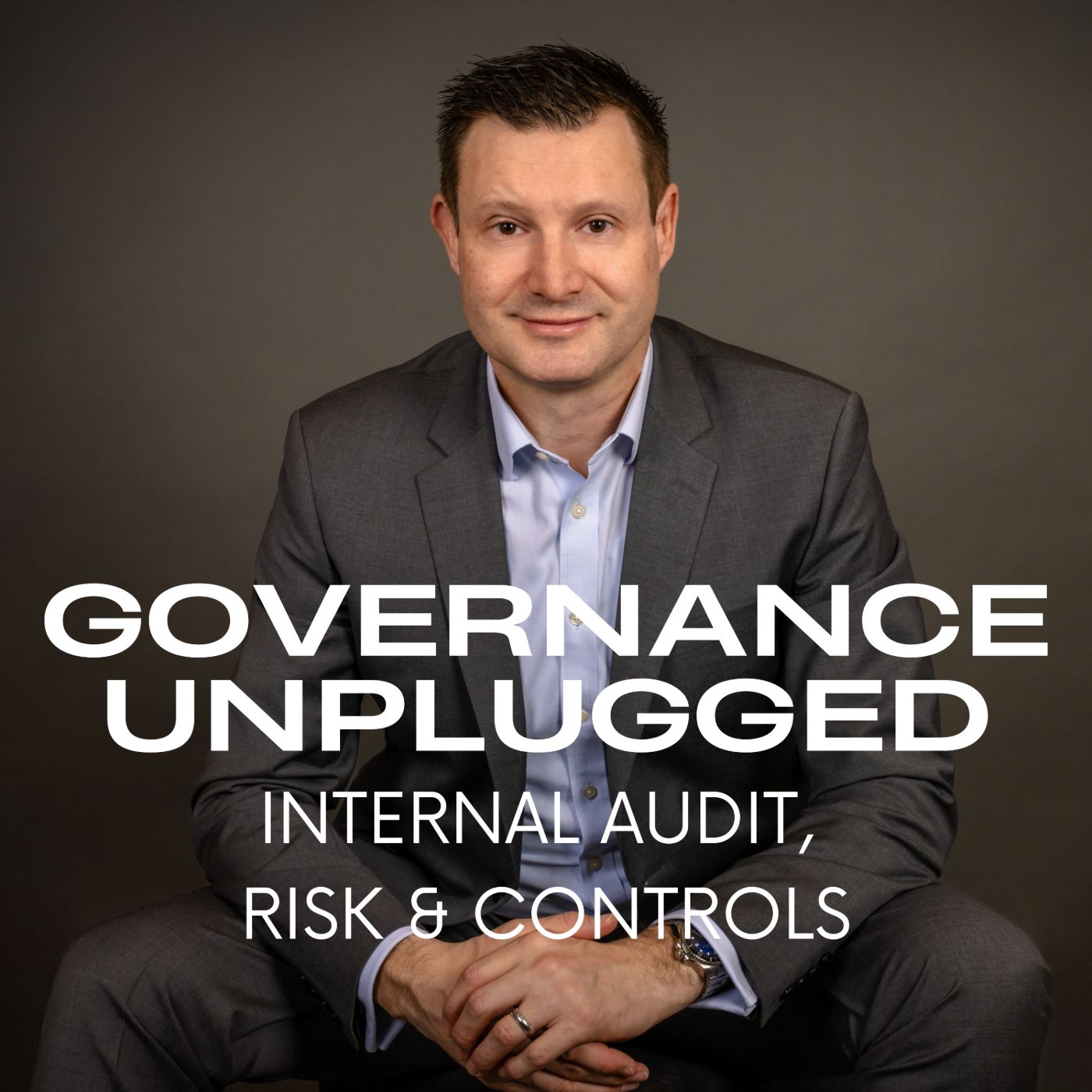
Governance Unplugged is a podcast dedicated to exploring the essential pillars of sound governance to help organizations thrive in today’s dynamic business environment. Designed for internal auditors, risk managers, senior management and board members, the podcast delves into how robust governance, risk management, and internal controls lay the foundation for organizational safety and prosperity. By providing meaningful insights and practical strategies, the podcast aims to equip listeners with interesting insights supporting their needs to safeguard their organizations and ensure long-term success.
Most boards spend their time working inside the governance system, and almost no time looking at the system itself. In this episode, Steven Brassem argues that governance is not a structure you build once and then maintain. It is a continuing alignment task between mission, strategy, risk profile, governance and culture — and the context never stops moving.
From there the conversation goes to the two things boards find hardest. First, culture: how a supervisory board oversees something nobody can fully measure, without prescribing one ideal culture. Steven’s method starts not with values or surveys but with what the organisation is trying to achieve, then works backwards to the behaviours that matter and the risks that pull them off course — misalignment, disparity, misconduct.
Second, artificial intelligence — and here Steven reverses the familiar question. Everyone is discussing the governance of AI. He asks about AI in governance: how directors, executives and board secretaries already use these tools inside the governing process itself. Influence arises before authority. By the time a model has framed the problem, filtered the evidence or pre-structured the meeting, much of the decision has quietly been made. That is where artificial governance begins.
The episode closes on assurance: why boards tend to validate audit plans rather than direct them, and why an epistemic monoculture — management, the second line and internal audit all leaning on the same data and the same model — can reproduce identical blind spots three times over and call it independence.
KEY TOPICS
— Governance as a continuing alignment task, not a structure you build once
— Why boards rarely step back and review the governance system itself
— What misalignment looks like in practice — the Wells Fargo post-mortem
— Culture as a governance obligation: UK Code, King IV, ASX, APRA, MAS, HKMA, EBA — and the Dutch Corporate Governance Code
— Overseeing culture without prescribing a single ideal culture
— Starting from objectives, not values or survey scores
— Three categories of cultural effectiveness risk: misalignment, disparity, misconduct
— Formal institutions — reward systems, approval layers, decision procedures — pulling against culture
— AI in governance rather than the governance of AI
— Influence before authority: omission, framing and cognitive surrender
— When AI pre-structures the meeting — and governance becomes theatre
— Agentic AI and the chain of accountability
— Rules of engagement for recording, and how behaviour changes when everything is on tape
— Beyond the heat map: vulnerability and controllability instead of probability
— Moving risk thinking to the point of decision, not the board pack
— Risk awareness as a cultural trait and a competitive advantage
— Boards validating audit plans rather than directing them
— The epistemic monoculture and what it does to layered assurance
— The one question every board should ask about its own use of AI
Disclaimer
This podcast’s information is provided for general reference and was obtained from publicly accessible sources. The Podcast Collaborative neither produces nor verifies the content, accuracy, or suitability of this podcast. Views and opinions belong solely to the podcast creators and guests.
For a complete disclaimer, please see our Full Disclaimer on the archive page. The Podcast Collaborative bears no responsibility for the podcast’s themes, language, or overall content. Listener discretion is advised. Read our Terms of Use and Privacy Policy for more details.