The Sentinel Podcast

The Sentinel Podcast
Podcast Description
World-class forecasters make sense of the world and how events could escalate into globally-catastrophic events. blog.sentinel-team.org
Podcast Insights
Content Themes
The podcast delves into themes of global catastrophic risk, geopolitics, nuclear conflict potential, and the intricacies of forecasting future events, with episodes exploring topics such as U.S. foreign policy implications on Iran, and the nuclear risks associated with India and Pakistan amidst rising military tensions.
World-class forecasters make sense of the world and how events could escalate into globally-catastrophic events.
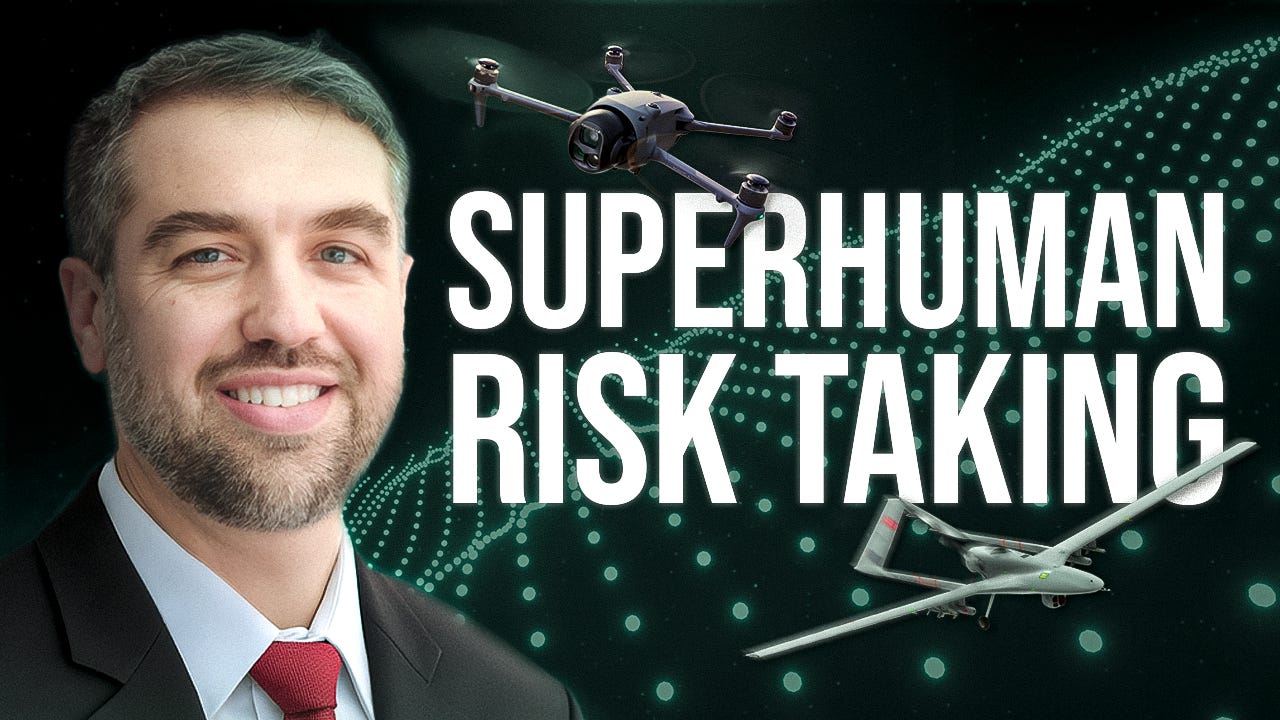
A conversation with Paul Scharre, author of Four Battlegrounds: Power in the Age of Artificial Intelligence, who joins us to talk about
* how AI’s superhuman command and control abilities will change the battlefield
* why offense/defense balance isn’t a well-defined concept
* “race to the bottom” dynamics for autonomous weapons
* how a US/taiwan conlict in the age of drones might play out
* and more…
Links mentioned: Gradual Disempowerment, Swarms over the Strait
Transcript
Rai Sur 00:00:36
Today we’re speaking with Paul Scharre. Paul is the Executive Vice President at the Center for a New American Security and the author of Four Battlegrounds: Power in the Age of Artificial Intelligence. He also formerly worked at the Pentagon on emerging technologies. Welcome, Paul.
Paul Scharre 00:00:52
Thanks for having me.
Rai Sur 00:00:53
We’re also joined by Sentinel forecaster and co-founder Nuno Sempere, Sentinel Superforecaster Lisa, and Superforecaster Scott Eastman, whose specialty is in geopolitics, epidemiology, and AI. Welcome, Scott.
Paul, what is command and control, and how do you see AI significantly altering it?
Paul Scharre 00:01:18
The term command and control is used by militaries to describe the internal organizational and informational processes used to organize military forces and coordinate their behavior. Militaries work in a very hierarchical format, with teams, squads, platoons, companies, and battalions. The way they communicate has evolved from signal flags on the battlefield to radio communications, to today’s use of computers.
Improvements in command and control can yield dramatic improvements on the battlefield, even if the military forces themselves are the same. We often think about the physical hardware of drones, missiles, or robots, and that’s absolutely valuable. But there are also potentially transformative effects in command and control.
If a military can gather more information about the battlefield, make sense of it faster than the adversary, make better decisions, and execute those decisions in a coordinated fashion, it can have dramatic effects. This is particularly true if they can change the battlespace faster than the adversary can react, leaving the adversary constantly trying to respond to what happened six hours ago.
Nuño Sempere 00:03:04
What’s a concrete example of this?
Paul Scharre 00:03:11
During the US advance into Iraq in 2003, US military forces were advancing very rapidly toward Baghdad. Through a precision bombing campaign, the US disrupted the command and control of Saddam Hussein’s forces by taking out headquarters and radio communications.
This created a situation where Iraqi commanders were reacting to events after they had already happened. They would identify the location of US troops, but by the time they reacted, the US forces had already advanced. That’s a potential advantage of having better situational awareness and command and control. Artificial intelligence has a lot of potential value in this space.
Rai Sur 00:04:11
In Four Battlegrounds, you wrote about how AI might change decision-making and strategic planning at higher levels. What are the potential impacts there, and how could it change the look of warfare?
Paul Scharre 00:04:25
Let’s imagine what this evolution might look like 15 to 30 years down the road as militaries integrate more AI, autonomy, drones, and robotics. Military advantage can come from better technology—better drones, larger production capacity, more robots on the battlefield. We tend to think about the physical object, which is important. But major advantages can also come from improvements in command and control, and we can see examples of this in gaming.
Look at how AlphaZero plays chess. The pieces are the same for both the human and the AI, so there’s no material advantage. In many cases, the situational awareness is the same—they’re looking at the same board. Yet we’ve seen that AI is able to process that information better and more holistically than people. In games like StarCraft or Dota 2, the AI can see the big picture and comprehend it all.
Across a number of games, AI agents can engage in coordinated, multi-axis attacks and balance their resources more effectively than people. This isn’t just in real-time strategy games; chess grandmasters have noted that AlphaZero can conduct attacks across the whole board more effectively. We’ve also seen AI systems engage in superhuman levels of calibrated risk-taking. In chess, this can look like ferocious attacks. In StarCraft and Dota 2, human players have talked about feeling constantly pressured by the AI, never having a moment to rest.
In poker, AI systems bet differently than humans, engaging in wild betting swings that are hard for even cold-blooded poker players to manage because of human emotions. There’s an information processing element, but also a psychological one. In combat, you get lulls in the action because people need to rest and reset. AI systems don’t. In the command and control aspect, AI has the potential to not just be better than humans, but to transform the very strategy and psychology of war.
Rai Sur 00:07:53
What does this look like in practice, at the level of grand strategy, where generals use game theory and deception? What does adoption look like there, and what is the minimum capability required? Naively, it sounds like an AGI-complete problem.
Paul Scharre 00:08:27
There are many beneficial things militaries could do on the command and control front that are not AGI-complete problems. If you hand over all your military forces to an AI, you need a lot of trust in its intelligence to handle that complexity.
But you can imagine very narrow algorithms that optimize logistics or communication on the battlefield, which would have significant advantages. You could also have more advanced algorithms that assist with planning military operations while commanders remain in the loop. The AI could generate plans for offensive or defensive operations, and commanders would still review and decide what to execute. Over time, they might see that the AI’s plans are better than what humans come up with and decide to trust them more.
Rai Sur 00:09:29
Who is best positioned to gain these advantages sooner rather than later?
Paul Scharre 00:09:35
In general, more technologically advanced militaries have some advantages, but we’ve seen AI technologies diffusing very rapidly. The biggest limiting factor for militaries isn’t getting access to AI technology, but finding the best ways to use it and transform how they operate.
The history of military-technical revolutions shows that what matters is not getting the technology first or even having the best technology, but finding the best ways of using it. An interesting historical example is British innovation in carrier aviation during the interwar period. The British military was ahead in inventing carrier aviation but fell behind Japan and the United States due to bureaucratic and cultural squabbles. It was primarily a technology adoption problem, not a technology creation problem.
This suggests that militaries in active conflicts, like we’re seeing in Gaza and Ukraine, are much more incentivized to overcome these barriers to adoption. They’re also getting real-world feedback on how effective these technologies are, whereas getting those feedback loops in peacetime is much more challenging.
Nuño Sempere 00:11:22
So you would greatly discount which countries have top AI labs as a factor, because you think adoption feedback loops are more important?
Paul Scharre 00:11:32
Yes, absolutely. The top US AI labs are maybe a few months ahead of the top Chinese labs—perhaps 12 months, but not three years. The US military is, charitably, five years behind leading AI labs in adopting the technology, and realistically more like 10 years behind in actually using it.
It’s not enough to have an image classifier on your drone video feed; you also have to use it to transform your intelligence operations and make your analysts more e…
Get full access to Sentinel Global Risks Watch at blog.sentinel-team.org/subscribe
Disclaimer
This podcast’s information is provided for general reference and was obtained from publicly accessible sources. The Podcast Collaborative neither produces nor verifies the content, accuracy, or suitability of this podcast. Views and opinions belong solely to the podcast creators and guests.
For a complete disclaimer, please see our Full Disclaimer on the archive page. The Podcast Collaborative bears no responsibility for the podcast’s themes, language, or overall content. Listener discretion is advised. Read our Terms of Use and Privacy Policy for more details.