Truth and Reckoning
Truth and Reckoning
Podcast Description
Truth and Reckoning is a broadcast of the Community Environmental Legal Defense Fund (CELDF) focused on environmental justice, frontline action, community rights, and the rights of nature. celdf.substack.com
Podcast Insights
Content Themes
The podcast delves into themes such as environmental justice, community organizing, rights of nature, and frontline activism. For example, episodes feature discussions on the rights of water in New York State and the plight of Diamondback Terrapins in Virginia Beach, with a focus on community-led actions against environmental destruction and the misconceptions surrounding restoration projects.
Truth and Reckoning is a broadcast of the Community Environmental Legal Defense Fund (CELDF) focused on environmental justice, frontline action, community rights, and the rights of nature.
Welcome to Truth and Reckoning, a newsletter from the Community Environmental Legal Defense Fund (CELDF). We are organizers, lawyers, and revolutionaries who educate and agitate to confront systemic injustice and restore humanity’s relationship with the Earth.
For more than 30 years, we’ve helped communities resist corporate power, reject regulatory false promises, and assert their right to self-governance grounded in ecological balance.
In this episode, we explore the legacy of James Boggs (“Jimmy”) and Grace Lee Boggs, community organizers in Detroit, and the importance of place-based activism. Our guests share insights on rebellion, revolution, and building resilient communities rooted in shared values and natural connections.
James and Grace were important political activists, authors, and organizers in the Detroit community for seven decades. They were also students of past movements and historical revolutions, who then evolved the strategies and philosophies they learned from their movement elders and applied them in the Detroit community. Their ideas led them to create many local alternatives to the current systems that were neglecting and ignoring the local communities. This led to programs like City of Hope, Detroit Summer, Gardening Angels and Riverwise Detroit magazine as well as the Boggs Center and the Boggs School which still exist today offering alternative models of education and community resistance and resilience to the residents of Detroit.
In this conversation we celebrate and explore their legacy with three Detroit residents who are carrying their work forward:
* Shea Howell has been a Detroit activist for more than four decades. She works with youth, artists, and community-based development. She is engaged with issues of social justice and peacemaking. She is a co-founder of Detroit Summer, the Boggs Center and Riverwise Magazine. She also is a member of Coalition for Police Transparency and Accountability and the National Council of Elders. She is professor emerita of Communication at Oakland University and is currently a riverboat captain.
* Megan Douglass is the Managing Editor of Riverwise Magazine, a social justice and organizing magazine and political education hub in Detroit. She holds a B.A. in Political Science from the University of Michigan, an M.A. in Anthropology from the University of Central Florida, and is ABD in her Ph.D. in Anthropology at Wayne State University, where she also teaches Anthropology. She has over 25 years of teaching experience at all levels. Her research focuses upon studying decolonized methodologies, sustainable movements and the link between grassroots activism and spirituality. She is a mother, a notorious “pollinator” and always ready for a laugh. Her favorite sayings are “if you aren’t angry you aren’t paying attention” and the quote from Ella Baker “strong people don’t need strong leaders.”
* Valerie Jean Blakely (she/her) is a movement photojournalist from Detroit, the Assistant Editor for Riverwise Magazine, the Communications Director for the People’s Water Board Coalition, and produces and co-hosts the weekly Water Wednesday Webcast.
Topics discussed:
* Jimmy and Grace Boggs’ revolutionary philosophy
* The importance of place-based community organizing
* Rebellions and their role in social transformation
* Values shift from rights to responsibilities
* The impact of capitalism on community and environment
* Building trust and relationships in activism
* The role of history and memory in resistance
Upcoming Training on People’s Assemblies: On Tuesday, October 6th at 5pm Pacific/8pm Eastern, CELDF is hosting part 2 of our ongoing training series, “People’s Assemblies and The Revolutionary Potential of Grassroots Power” taught by our partners Professor Camila Vergara and Denzel Caldwell. Click here for more information and to register:
The recording of part 1 of this training series can be viewed here.
About James Boggs and Grace Lee Boggs
James (Jimmy) Boggs and Grace Lee Boggs (June 27, 1915-October 5, 2015) were two of America’s foremost revolutionary thinkers, human rights activists, and community organizers of the 20th century. Their marital union, which began in 1953 and spanned 40 years and produced prolific writings and publications and philosophy of dialectical humanism which still motivates and resonates with activists and young people today.
James was born in sharecropping Marion Junction, Alabama. He later moved to Detroit, where he worked in the Chrysler auto plants for 28 years and began as a labor leader and leading political activist in the Black Power movement.Jimmy is noted for predicting in the 1960s that automation in the auto plants would replace workers and that revolutionaries must become “revolutionists.” A revolutionist is “a ‘revolutionary’ who accepts responsibility for leadership which involves projecting a philosophy of change, developing a method or form of struggle based on a new ideology, and organizing to change society along the lines of this new ideology.”
Grace Lee Boggs, of Chinese descent, was born in Providence, Rhode Island, and later moved to New York City, where her father, Chin Lee, became New York’s premier Chinese restaurant owner. She was University educated and then realized she needed to come out of that “ivory tower” and actually put into practice the ideas being discussed. She did this in Detroit.
Some Grace Lee Boggs quotes:
“What does it mean to be a human being in the 21st century?”
“It becomes clearer every day that organizing or joining massive protests and demanding new policies fail to sufficiently address the crisis we face. They may demonstrate that we are on the right side politically, but they are not transformative enough.They do not change the cultural images or the symbols that play such a pivotal role in molding us into who we are.”
“The social activists among us struggle to create actions that go beyond protests and negativity and build community because community is the most important thing that has been destroyed by the dominant culture.”
“The most radical thing I ever did was to stay put.”
“Whether or not the media recognize it, the Great Turning is a reality. Although we cannot know yet if it will take hold in time for humans and other complex life forms to survive, we can know that it is underway…To see this as the larger context of our lives clears our vision and summons our courage.”
James Boggs quotes:
“What we must begin to do is what we find hardest to do–confront our own individualism and materialism, our own going along with the system…”
“Stop thinking of yourself as a minority, because thinking like a minority means you are thinking like an underling.”
“People are not born with opinions. Their opinions are shaped by their environments and their teachers…And they can be shaped by the wrong environment and the wrong teachers.”
About the Boggs Center
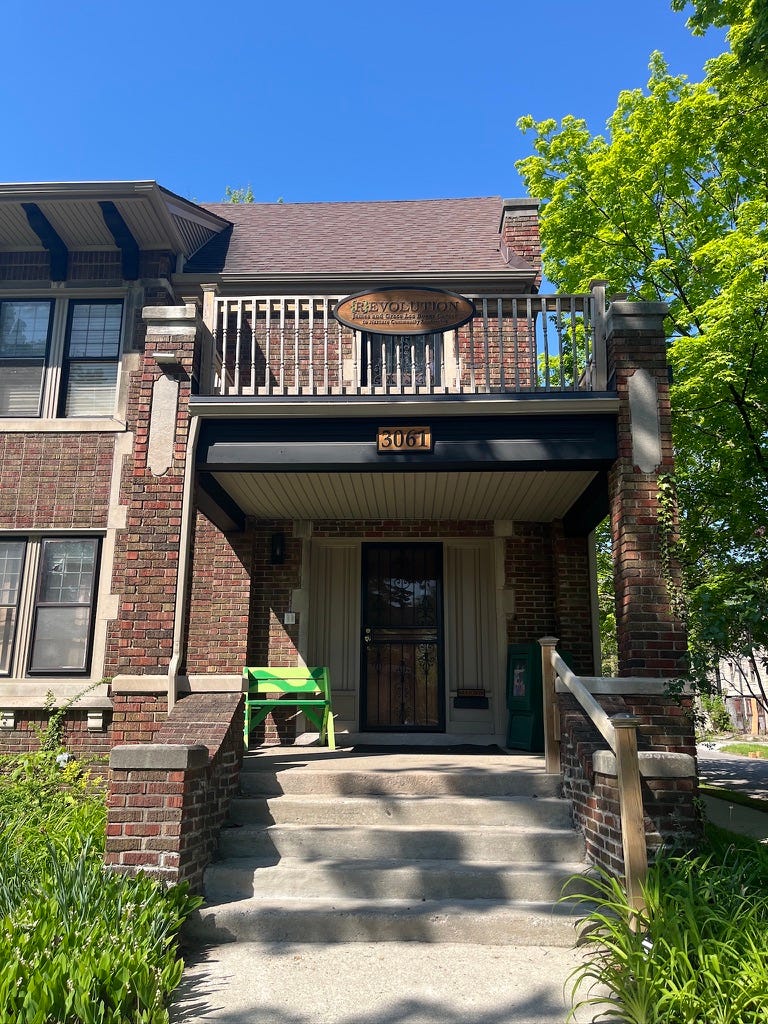
The James and Grace Lee Boggs Center is a Community Think Place and Visioning Center that through dialogues and multimedia honors the work of community people, brings together elders and young people, and opens up the minds especially of young people and children to rethink fundamental ideas about revolution, politics, and citizenship because, as Jim Jackson puts it, ‘Ideas are the beginning of power. Ideas that enlarge people have been taken out of the struggle. Instead people use ideas to blame others for what is going on instead of to empower themselves.’”
The organization’s mission is to nurture the transformational leadership capacities of individuals and organizations committed to creating just, productive, conscious, and ecologically sustainable communities.
Links and Resources
* The National Council of Elders
* The People’s Water Board Detroit
About the Truth and Reckoning Podcast
If you’re new here, this is Truth and Reckoning, a newsletter from the Community Environmental Legal Defense Fund (CELDF). In this show, we learn from front-line organizers and communities fighting against environmental destruction. We explore different perspectives and innovative strategies for movement building, the potency and potential of rights of nature, and effective action in defense of our communities. And, we share inspiring stories of people working towards right relationship with the land and each other.
You can find the show on: Apple Podcasts, Spotify, Pocketcasts, YouTube (in video and audio versions), and anywhere else you get your podcasts (click here to find this podcast via your preferred app).
Curious to know more?
* Join the CELDF email list
Get full access to Truth and Reckoning at celdf.substack.com/subscribe
Disclaimer
This podcast’s information is provided for general reference and was obtained from publicly accessible sources. The Podcast Collaborative neither produces nor verifies the content, accuracy, or suitability of this podcast. Views and opinions belong solely to the podcast creators and guests.
For a complete disclaimer, please see our Full Disclaimer on the archive page. The Podcast Collaborative bears no responsibility for the podcast’s themes, language, or overall content. Listener discretion is advised. Read our Terms of Use and Privacy Policy for more details.