Five Rules for the Good Life Podcast

Five Rules for the Good Life Podcast
Podcast Description
Five rules for the good life and other tips for living well as told by those who made it
their business to do so. fiverules.substack.com
Podcast Insights
Content Themes
The podcast explores practical advice for living well, with themes spanning cooking, hosting, and lifestyle tips. Examples include cooking pasta like a professional with advice on seasoning water and the proper marriage of noodles and sauce, as well as hosting stress-free dinner parties focusing on simplicity and ambiance.

The best advice usually comes from someone who learned it by living it. On Five Rules for the Good Life, I sit down with my favorite people from the culinary community and ask them to share five rules on something they know inside and out. Each episode gets straight to the good stuff: the habits, opinions, and little revelations that come from years of doing the work. Short conversations with plenty to chew on, and something you can bring into your own life at the dinner table and beyond.
The Guests
Chefs, restaurateurs, writers, bakers, artists, and the people who make food culture worth caring about. Some you already love; others you’ll be very happy to meet. All have a perspective worth learning from.
“I started Queer Soup Night because the things I knew how to do were make a lot of food and throw a party.” – Liz Alpern
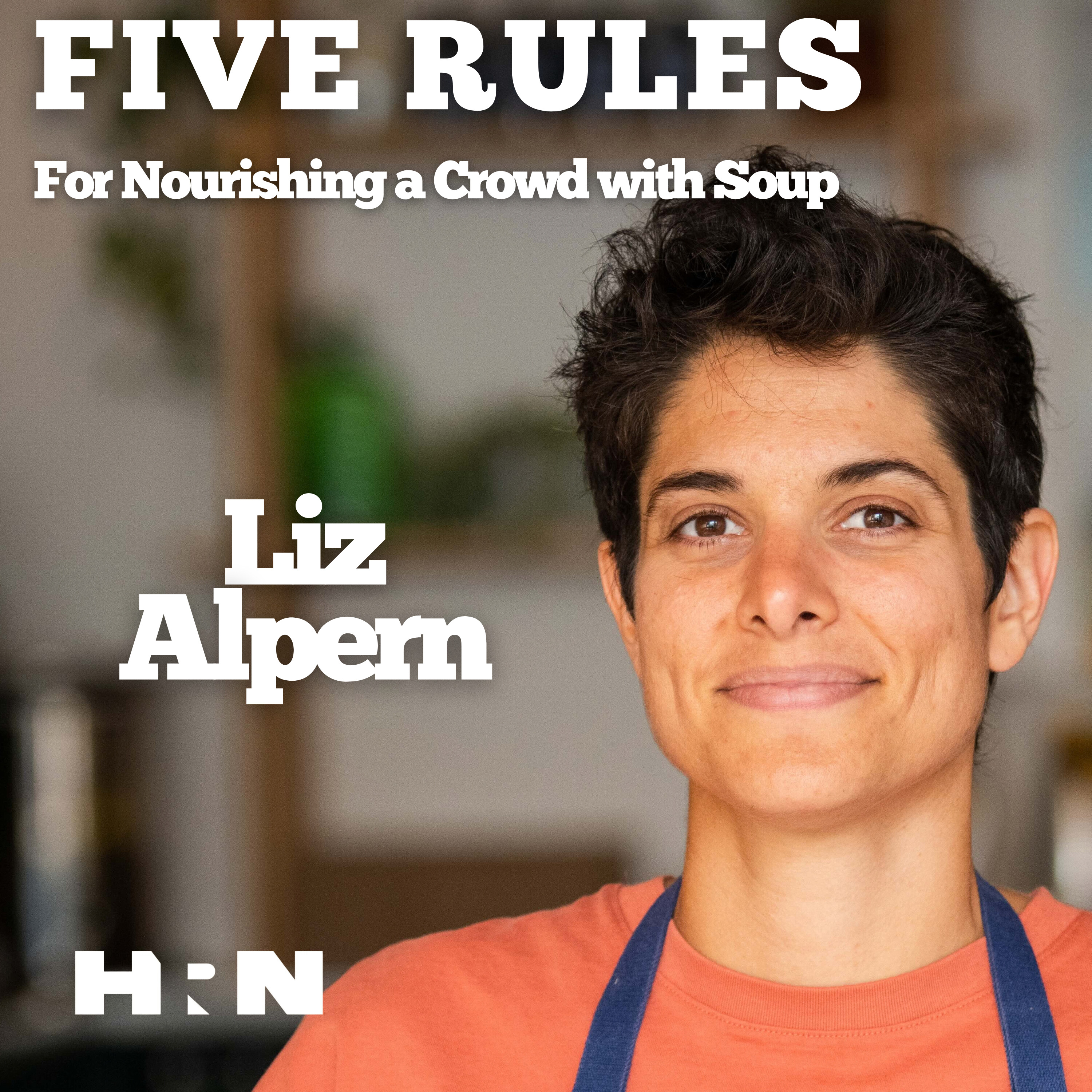
Liz Alpern knows how to feed people and give them a reason to come together. The creator of Queer Soup Night joins me to share her Five Rules for Nourishing a Crowd with Soup, from thinking through where people will eat to keeping things simple with a little flair. We get into the resourcefulness behind a great pot of soup, the power of showing up for your community, and why making a shopping list can be its own act of self-preservation. With her forthcoming Queer Soup Night cookbook arriving in January 2027 and now available for pre-order, Liz shares an approach to hospitality and activism that starts with the skills you already have.
Liz and I say “soup” 51 times in this episode, which feels like an appropriate level of enthusiasm. I love how deeply she cares about soup and how that passion carries into her activism and the community she’s built around feeding people. She thinks about everything from what’s in the pot to whether someone walking through the door will feel comfortable, welcome, and cared for. Her rule about starting with what you know really stays with me: Liz knew how to cook and throw a party, and she put those skills to work bringing people together when they needed it.
Introduction
Hello, and welcome to Five Rules for the Good Life. I’m your host, Darin Bresnitz. Today, I’m joined by the creator of Queer Soup Night, Liz Alpern, whose new book, Queer Soup Night, the cookbook, Over 50 Ways to Activate Community, will be available everywhere January 2027.
She’s here to share her five rules for nourishing a crowd with soup. She talks about the importance of understanding where the crowd will be eating, how despite best efforts, you can’t make everyone happy, and that it’s always great to keep it simple, but add a little flair. It’s a great conversation for anyone interested in upping their soup game, but also understanding how to feed people and create community around activism.
When you have a moment, please subscribe and rate this podcast. So let’s get into the rules here on HRN. Liz, so nice to meet you.
Thank you for taking the time. I’m so excited to talk to you about Queer Soup Night and the new book. Welcome to the show.
Thank you. I’m so glad to be here.
Soup Community and Activism
There are so many dishes that exist in almost every culture. Bread, noodles, but almost none as prevalent as soup.
Yes.
What is it about this dish that connects people all over the world?
Oh, I could talk about this all day. A few things come to mind for me. At the heart of soup is resourcefulness. Whatever you got, you can turn it into soup.
My ancestors in Eastern Europe were able to pull together a few scraps of chicken, a half an onion, and a crusty carrot and turn it into something. When you’re talking about the way that ancestral cuisine developed, we’re talking about cultures that were resourceful, that didn’t have grocery stores, that didn’t have refrigerators. Every culture around the world developed in this way.
So every culture around the world developed a resourcefulness and soup is it. You can get so much out of so little.
I love soup. I love how democratized it can be. I have always believed that food is and should be political and stand for something. What drove you to bring together community, activism, and soup?
I have always been a passionate soup lover, if you can’t already tell from the way I speak lovingly about soup. Always dreamed of feeding everybody soup. So much of what I love about soup is the abundance. You can just picture that giant pot of soup.
I always envisioned serving my friends and community that soup and certainly did in my own home. I always wanted to make it bigger. It wasn’t until the first election of Trump that I felt propelled to take some initiative and do something different.
A lot of people were looking for ways to get more involved in some of the resistance work that was happening. I felt like this was an amazing opportunity for me to feed people that I’d always wanted to. It turned out that people wanted the soup.
I love how you’ve brought people together all over the country and that these voices are represented in your new book, Queer Soup Night, which is part cookbook, part manifesto, part activism guide.
You got it.
Why did you want to bring all these elements together in this book?
We have been throwing this party, Queer Soup Night, since 2017. Our 10-year anniversary was coming up.
Congratulations.
Thank you. It felt important to me at that time to mark this moment of having really committed to this model and seeing it grow for all this time. Simultaneously feeling like the world does not feel safer. The world does not feel more comfortable for queer people. If anything, we are in way more dire straits or in a space of alarm.
We throw events all over the country. We have chapters all over the country, but that doesn’t mean we have chapters everywhere. At any given time, we maybe have around a dozen chapters that are actively throwing events, anywhere from New Mexico to Brooklyn to Oakland to Chicago. But there are so many places where Queer Soup Night hasn’t happened yet.
People hear about us. They follow us. They reach out to us. We wanted to find a way to give a little of that magic, a little bit of that fire that Queer Soup Night gives you, and that nourishment that Queer Soup Night gives you to places that we hadn’t been yet.
A book just felt like such a natural place to go with that impulse. We had hundreds and hundreds of chefs cook for us. There were so many good recipes. We have 51 soup recipes plus much more content. But the 51 recipes, each recipe is from a chef who has cooked for us before, and it tells often the story of what’s meaningful and important to them. Often it was a recipe that they cooked for a Queer Soup Night event.
It’s just a snippet, but we really wanted to find a way to bring Queer Soup Night to a lot more people and a lot more homes and a lot more places.
I love how you’ve brought together this messaging, showing people how to bring together people over soup, community, and support, which is why I’m so excited for you to share your five rules for nourishing a crowd in soup.
That’s right.
Rule One: Consider Where Your Crowd Will Be Eating
For anyone who’s been politically active or activated in the last decade, they know that the fight is everywhere. Your first rule talks about what it means to go to where you need to take care of people. What’s your rule number one?
Rule number one is consider where your crowd will be eating. We’re talking about soup, so it has some logistical challenges. We really love feeding people in public spaces that are easily accessible. Queer Soup Night has our own rule internally, where we say we like to be in bars, restaurants, parks, outside, anywhere that somebody could spontaneously show up.
Actually, when you’re feeding a crowd, the where matters because you need to figure out, are people going to need seats? Are they going to be comfortable? We want to bring hospitality to our nourishment. When we nourish people, it’s not just about food. It’s about the environment.
The where of it all is also about saying, hey, are people going to be able to find it? Are they comfortable when they get their soup? How are we going to serve the soup? Where are we going? Where are we getting the soup? Do they have a spoon, napkin, garbage? As a hospitality person, I’m just all about it.
Rule Two: Keep It Simple but Add a Little Bit of Flair
When people make soup, especially for the first time, they think it’s a kitchen sink, empty the fridge type of endeavor. Your second rule talks about keeping focus and keeping this in mind when making soup. What’s your rule number two?
Rule number two is keep it simple, but add a little bit of flair.
Love it.
I am a big proponent of don’t go overboard when you’re making soup. This is soup, folks. You know what people want when they want soup? They want comfort. So you don’t need to make a soup with 16 garnishes and a foam on top. No. You need it to be simple, nourishing, and taste really good. However, a little bit of flair goes a long way.
If you’re making a simple lentil coconut curry soup, the soup of vegan homes everywhere, that one of the first things I certainly learned to make when I was cooking on my own, add a garnish. Add some toasted seeds with some spice. Add a crostini that you’ve made, that drizzle of olive oil. Add some fresh herbs. Give it something to make it feel special while staying nourishing.
Rule Three: You Cant Make Everyone Happy but You Can Aim for 90 Percent
When you’re serving a lot of people, as soup is one of the great meals that you can stretch.
That’s right.
There’s a lot of spoons going in.
Yep.
But that doesn’t mean that everyone’s going to enjoy it, and it ties directly into your rule number three.
My rule number three is you can’t make everyone happy, but you can aim for 90%. And I think you should aim for 90% happiness.
When you serve food to people, when you’re in the hospitality industry, when you’re a chef, you are constantly going to get feedback. You’re going to get critiques, and you’re also going to get questions.
Yeah.
Does this have onions? Does this have garlic? Does this have peanuts? Does this have dairy? Does this have soy? You should be keeping in mind who your crowd is and how you can make them happy, but know that probably about 10% of the people will have some allergy you can’t please. 10% of the people just might not like cumin, and that’s okay. Look, aim for 100.
Yeah.
When I’m serving people, I know that it might happen that there’s still somebody who doesn’t like what I made, even if I made something really good. It’s just about peace of mind. It’s about saying it’s okay if one customer walked away unhappy, as long as you did what you could.
Rule Four: Channel Your Inner Virgo and Make Your Lists
When you’re cooking for others, you have to also take care of yourself. Part of that is being okay with someone not liking your soup, but also it’s taking care of yourself when you’re making the soup, which makes up your rule number four.
Rule number four, channel your inner Virgo. That’s me. I’m a Virgo. And make your lists.
Love it.
If you’re a person who cooks professionally, if you’re a person who produces events professionally, you are already making lists. You know this.
100%.
In my world, there’s a lot of people who really want to gather people, and it’s not necessarily as natural to them as they wish it was. I know. These rules build. They don’t live in isolation. If you’re keeping it pretty simple, you know you’re going to have a couple of people that aren’t that happy. You can do this.
Yes.
As much as we talk about soup in theory and say, a little bit of this, a little bit of that, not everybody can cook that way. When you’re cooking for 300 people, you got to make a list. I’m doing an event on Monday. I just made my prep list, my shopping list. I’m ready to go. That comes pretty naturally to me.
Anybody who wants to host and bring people together, it’s good to get practice in that list making planning mindset because it really can prevent you from being overwhelmed later.
Rule Five: Stick With What You Know
Being overwhelmed can happen when you’re cooking for people, especially if you’re out in the world feeding them because they’re protesting. It can really mean a lot to people when you nourish them.
Yeah.
Your fifth and final rule talks about when you’re bringing people soup on the front lines, it’s okay not to try something new. What’s your rule number five?
Rule number five is stick with what you know. I started Queer Soup Night because the things I knew how to do were make a lot of food and throw a party.
Hell yeah.
Those are the things I knew how to do.
Let’s go.
They’re kind of still the things that I know how to do.
You know how to write a book now.
I do. I know how to write a book. It’s my second book, actually. I got a few other skills. That’s how I found myself in the world of Queer Soup Night. The reason it’s been successful is because it was something that I knew how to do.
So it was easy for me to ask for help. It was easy for me to grow it, to change it. And I’m not saying it was easy every minute. When you’re starting something new, sticking with something you know allows you to grow that thing that you’re doing further than you thought.
Yes.
A lot of people love it when they’re having people over for the first time. They’re like, let’s try a new recipe. And I say, if you’re a confident cook, that’s fine. But if you’re not a confident cook, maybe stick with what you know. Same thing with activism.
Yeah.
If you’re going to make a move, if you’re going to get involved, if you’re going to try and make change, start with what you know.
The Book and What’s Next
Liz, I love all of this. The book is beautiful. The soup is delicious.
Thank you.
If people want to pre-order the book and check out your next event, where can they go?
You can pre-order our book. It’s very easy to find the link at our Instagram, Queer Soup Night, or on our website, queersoupnight.com. We are also being published by Combo’s Press, an amazing independent press in upstate New York.
So Combo’s Press has a website, and that’s where you actually will go and pre-order the book. It comes out in January of 2027, which is our exact 10-year anniversary.
Amazing.
So our next event is going to be in Brooklyn on Tuesday, October 13th. That’s the day after Indigenous Peoples Day. So come back. You don’t have anything in your house from your long weekend. We will feed you that night at Eddie’s Grocer in Greenpoint, and you can pick up some amazing stuff at Eddie’s while you’re there.
Congratulations on everything. I’m hoping to share a bowl of soup with you next time you make it out to LA.
Definitely. We’re definitely going to be promoting the book in LA in January, so we’ll definitely be in touch.
Amazing. Thank you so much.
Thanks. It’s such a pleasure. Bye.
See Privacy Policy at https://art19.com/privacy and California Privacy Notice at https://art19.com/privacy#do-not-sell-my-info.
Disclaimer
This podcast’s information is provided for general reference and was obtained from publicly accessible sources. The Podcast Collaborative neither produces nor verifies the content, accuracy, or suitability of this podcast. Views and opinions belong solely to the podcast creators and guests.
For a complete disclaimer, please see our Full Disclaimer on the archive page. The Podcast Collaborative bears no responsibility for the podcast’s themes, language, or overall content. Listener discretion is advised. Read our Terms of Use and Privacy Policy for more details.