Weekly LIVE Updates at Projectkin
Weekly LIVE Updates at Projectkin
Podcast Description
Archives of our weekly updates from Barbara, the Projectkin ringleader. Each week, she shares a short update about what's ahead for the coming week, inviting guests to share their perspectives or plans for special events. Though the program is live, recordings provide access to useful links and references discussed during the program. The live event is available only to subscribers and followers through the Substack app for web, desktop, or mobile. Subscriptions are free. projectkin.substack.com
Podcast Insights
Content Themes
The content centers around genealogical storytelling and community engagement, discussing themes like family history projects, collaborative genealogical research, and digital tools for family historians. Specific episodes highlight topics such as managing family archives, memorial aspects of family storytelling, and the challenges of identifying mystery photos.
Archives of our weekly updates from Barbara, the Projectkin ringleader. Each week, she shares a short update about what’s ahead for the coming week, inviting guests to share their perspectives or plans for special events. Though the program is live, recordings provide access to useful links and references discussed during the program. The live event is available only to subscribers and followers through the Substack app for web, desktop, or mobile. Subscriptions are free.
What a delight to see friends return for our livestream chat. Thank you, Linda Teather, Ann Larkham, MakeApathwayLouise Waddington, Diane Burley, Fine. I’ll Handle It. and many others for tuning into my live video with Kathy Stone! I can’t tell you how much it means to us here on the American Pacific coast and the Canadian Rockies to see all of you joining from the UK, the continent, across the American states and Canadian provinces.
Your thoughts, comments, and encouragement are the glue that holds this community together. The little ❤️s you drop keep us motivated and give this series a little more visibility. Feel free to create clips from this post to share with your friends.
Projectkin can offer these and all of our programs around the world for free, thanks to the generous support of our patrons. Learn more about us and join the fun!
Back to Basics
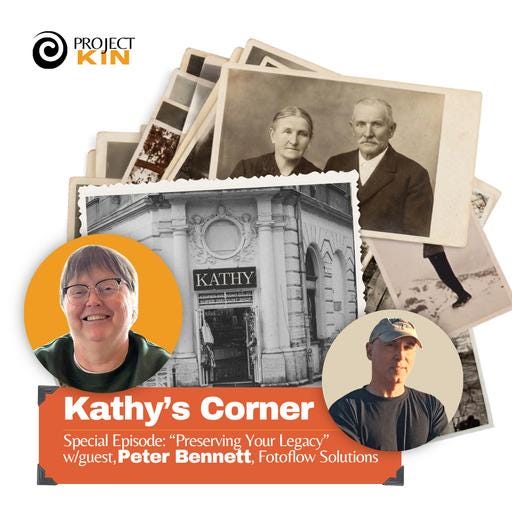
On Kathy’s return after an August hiatus, we’re going back to basics to talk about the best way of handling our family archives. Kathy’s expertise and connections run deep in photo organizing and archiving.
This week, during The Photo Managers’ annual Save Your Photos month, Kathy’s asked photographer, organizer, and instructor Peter Bennett to join us as her guest. This is part of her monthly program for Kathy’s Corner.
Your homework
Peter’s expertise, combined with his teaching skills, makes him the perfect person to get us off on the right foot. Ahead of Thursday’s program, take a moment to drop us a note in the comments here or a DM to Kathy Stone to share what photo tools you use today: Apple Photos, Google Photos, Mylio, Lightroom — it doesn’t matter; just share what you use. This feedback will help Kathy tailor the discussion to your interests.
Since photos have become so much a part of our daily lives today, protecting and preserving them has also become a necessary habit of adulthood. If you think of preservation as a step, then the collection of all steps you take is a workflow.
What you do, from snapping a photo or scanning to preserving an artifact and telling stories, can affect whether the materials are actually preserved, whether you can find them, and whether they’re accessible to others. This is why the workflow is so important. The best workflow is the one that meets your goals and is one you follow through on as a habit.
October: Review of Tools
So, we’re going to talk about all of that in October. Your feedback in the comments here and after Thursday’s program will help Kathy tune the discussion to your interests. Go ahead and share how YOUR workflow works from the time you snap an image or handle an archival photo to the moment you consider it preserved. If you’d like to share an image you’ve created of your workflow, go ahead and share it as a link, or DM to Kathy Stone.
Coming up: A Challenge
Here at Projectkin, we’re all about stories. All of this will lead to a session that combines November and December episodes with a special program focused on stories. So while you’re looking at your collection, think about the images that trigger special memories and stories, then stay tuned for details and ways for you to participate.
Resources Mentioned
* Kathy’s epic article about managing photos after a disaster you weren’t prepared for.
* The note posted by MamaCarole that sparked our most conversation about archiving materials:
* The first in a series of eight steps Kathy’s always used for her own workflow, articulated first for Ponga, then revised as we brought Kathy to Projectkin:
If you can’t make it on Thursday, you can always catch up by watching the recording. As always, you’ll find the full archive at Kathy’s Corner: Projectkin.org/kathys-corner.
About Kathy Stone
Kathy has been the “cornerstone” of Projectkin from the beginning, when we started on another platform more than three years ago. Kathy’s commitment to the physical artifacts of family history now inspires our whole community. Learn more about what Kathy is doing today at her own publication, where she supports families with the physical legacy of the past:
As Projectkin, we’re here to help families tell their stories in any form. I feel strongly that our collections of photos and other artifacts are key to our memories and, in turn, our stories.
Is this the kind of thing your friends and followers might appreciate as well? Kindly add a recommendation so they know how you feel. You’ll be doing us the favor of spreading our work.
Thank you.
Get full access to Projectkin at projectkin.substack.com/subscribe
Disclaimer
This podcast’s information is provided for general reference and was obtained from publicly accessible sources. The Podcast Collaborative neither produces nor verifies the content, accuracy, or suitability of this podcast. Views and opinions belong solely to the podcast creators and guests.
For a complete disclaimer, please see our Full Disclaimer on the archive page. The Podcast Collaborative bears no responsibility for the podcast’s themes, language, or overall content. Listener discretion is advised. Read our Terms of Use and Privacy Policy for more details.