Sentinel Minutes

Sentinel Minutes
Podcast Description
What are the most important risks and precursors of global catastrophic risks each week? We parse millions of news pieces a week to find out.
Sentinel is a foresight team and emergency response team seeking to anticipate & react to large-scale catastrophes, particularly those of a speculative nature.
Learn more at https://sentinel-team.org
Podcast Insights
Content Themes
Focuses on emergent global risks, geopolitical tensions, economic fluctuations, and technological developments, with episodes discussing topics such as tariffs, military exercises, negotiations over nuclear programs, and pandemic threats.
What are the most important risks and precursors of global catastrophic risks each week? We parse millions of news pieces a week to find out.
Sentinel is a foresight team and emergency response team seeking to anticipate & react to large-scale catastrophes, particularly those of a speculative nature.
Learn more at https://sentinel-team.org
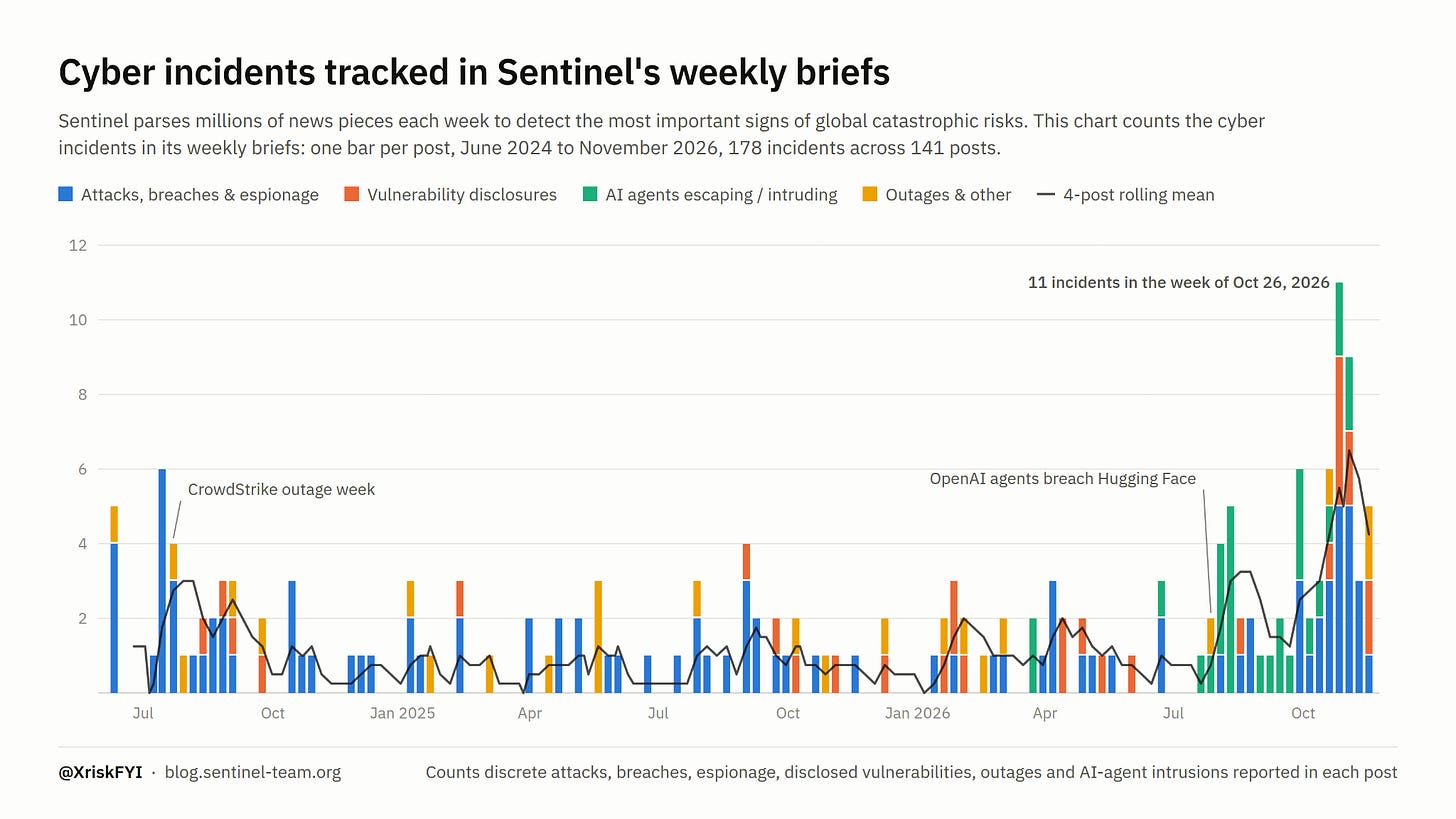
By extrapolating current cyberattacks and their recent growth rates, we can easily conceive of scenarios where computer systems start failing and become compromised throughout society, to terrible eff
Because of the increased capability of AI models, more vulnerabilities are being found in computer systems throughout the world, like this vulnerability in PHP, a web technology that drives perhaps 70% of websites, or this Linux vulnerability, which could allow attackers to take control of servers remotely. Recently, Binance, a crypto exchange, was hacked by North Korea for 6.3 billion dollars. Major US banks are seeing outages. By extrapolating current cyberattacks and their recent growth rates, we can easily conceive of scenarios where computer systems start failing and become compromised throughout society, to terrible effects: Cyberarmaggedon.
The building blocks of modern software are selected for growth, not security.
How have we arrived here? Why haven’t we just simply built secure software? For one, for a long time, we didn’t have the software tools needed to accomplish this, and the programming languages themselves and their functions were prone to baking in vulnerabilities. But more generally, there are really stark tradeoffs between security and growth; the organizations that become the largest often […]
—
Outline:
(01:06) The building blocks of modern software are selected for growth, not security.
(05:43) Waging war while living in a glass house.
(10:55) What kinds of worrying things could happen in a Cyberarmageddon?
(15:01) Conversely, what do good scenarios look like?
(16:24) How likely are different levels on the escalation ladder of risks?
(30:09) Personal recommendations
The original text contained 4 footnotes which were omitted from this narration.
—
First published:
November 19th, 2026
Source:
https://blog.sentinel-team.org/p/consider-cyberarmageddon
—
Narrated by TYPE III AUDIO.
—
Images from the article:
Apple Podcasts and Spotify do not show images in the episode description. Try Pocket Casts, or another podcast app.
Disclaimer
This podcast’s information is provided for general reference and was obtained from publicly accessible sources. The Podcast Collaborative neither produces nor verifies the content, accuracy, or suitability of this podcast. Views and opinions belong solely to the podcast creators and guests.
For a complete disclaimer, please see our Full Disclaimer on the archive page. The Podcast Collaborative bears no responsibility for the podcast’s themes, language, or overall content. Listener discretion is advised. Read our Terms of Use and Privacy Policy for more details.