Scale Up Your Practice by Obesity Canada

Scale Up Your Practice by Obesity Canada
Podcast Description
Tune into Scale Up Your Practice, Obesity Canada’s podcast for healthcare professionals.
Hosted by Dr. Roshan Abraham and Michelle McMillan, each episode dives into practical, evidence-informed conversations about obesity care—covering topics like weight stigma, patient-centered approaches, and the connection between obesity and other health conditions.
You’ll hear expert perspectives, real-world experiences, and insights to help you provide better, more compassionate care.
Listen now and scale up your practice.
🎧 Available on Spotify, Apple Podcasts, and YouTube.
Podcast Insights
Content Themes
The podcast centers on various themes including obesity stigma, patient-centered care, and the relationship between obesity and other health conditions, with episodes discussing topics like weight stigma in healthcare, the Canadian Adult Obesity Clinical Practice Guidelines, and behavioral change in clinical practice.
Tune into Scale Up Your Practice, Obesity Canada’s podcast for healthcare professionals.
Hosted by Dr. Roshan Abraham and Michelle McMillan, each episode dives into practical, evidence-informed conversations about obesity care—covering topics like weight stigma, patient-centered approaches, and the connection between obesity and other health conditions.
You’ll hear expert perspectives, real-world experiences, and insights to help you provide better, more compassionate care.
Listen now and scale up your practice.
🎧 Available on Spotify, Apple Podcasts, and YouTube.
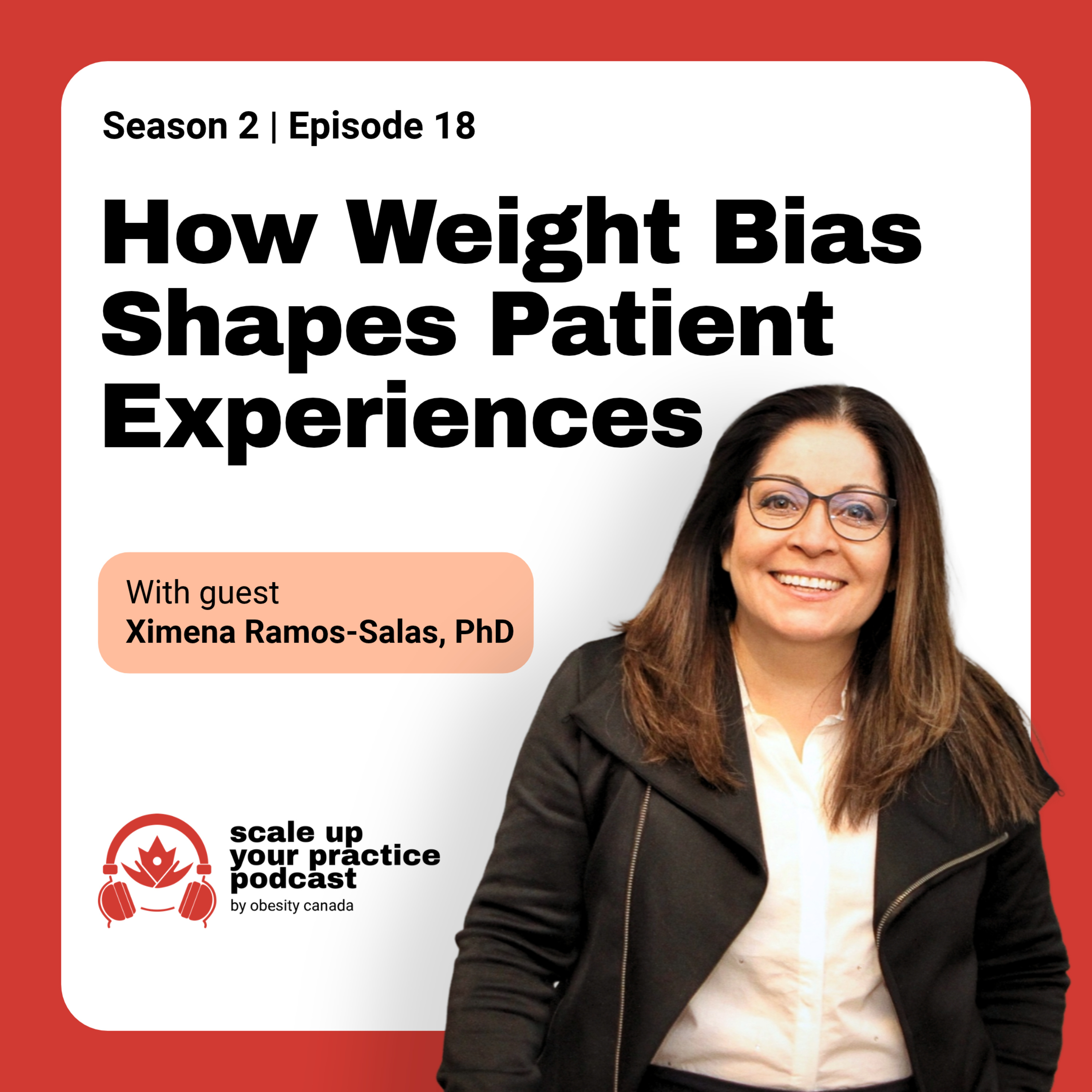
Weight bias in healthcare can change more than how a patient feels during an appointment. It can influence trust, clinical decisions, diagnostic accuracy and whether someone feels safe returning for care.
Dr. Ximena Ramos-Salas joins Dr. Roshan Abraham and Michelle McMillan to unpack how weight bias, weight stigma and discrimination show up across the healthcare system, from individual assumptions to clinic environments and institutional policies.
They explore why education alone is not enough, how diagnostic overshadowing can put patient safety at risk, and what healthcare professionals and organizations can do to create care that is more respectful, equitable and grounded in the realities of obesity as a chronic disease.
In this episode
- The difference between weight bias, weight stigma and weight discrimination
- How weight bias can influence clinical reasoning, diagnosis and patient safety
- What diagnostic overshadowing can look like in obesity care
- How stigmatizing healthcare experiences can affect trust and willingness to seek care
- Why understanding obesity as a chronic disease is essential to reducing bias
- How implicit bias can shape interactions even when stigma is not intentional
- Why education needs to be supported by changes to policy, culture and clinical environments
- Practical ways healthcare teams can examine assumptions, language, equipment and clinic spaces
- How respect, listening and shared decision-making can support stronger engagement in care
Dr. Ramos-Salas also challenges healthcare professionals to look beyond individual intentions and consider the systems surrounding every clinical interaction, because creating safer obesity care requires change at more than one level.
Additional resources
- Free course: The Impact of Weight Bias & Stigma: https://utm.guru/uuIZ1
- Free course: Words Matter: The Consequences of Weight Bias & Stigmatizing Language: https://utm.guru/uuIZ2
- Canadian Adult Obesity Clinical Practice Guidelines: Chapter 1: Reducing weight bias and stigma in obesity management, practice, & policy https://utm.guru/uuIZ3
- Article: The burden of weight stigma, American Psychological Association: https://utm.guru/uuIZ4
Learning objectives
- Analyze the root causes, conceptual distinctions, and systemic manifestations of weight bias, weight stigma, and weight discrimination within health professions education and clinical practice.
- Evaluate the clinical consequences of unaddressed weight bias—including diagnostic overshadowing, delayed care-seeking, compromised psychological safety, and internalized stigma.
- Apply evidence-informed, interdisciplinary strategies—such as reflective self-assessment, person-first language, and structural clinic audits—to dismantle weight bias and foster equitable healthcare environments.
Enjoying the podcast?
Support Scale Up Your Practice by:
- Sharing this episode with a colleague or team member
- Subscribing on your favourite podcast platform
- Leaving a review to help more listeners find the show
Have a question or a topic you’d like us to cover?
Email us at [email protected]
Disclosures
This episode script was developed using NotebookLM to synthesize complex source materials into a structured educational format. The tool was used to analyze the Canadian Obesity Education Competencies (COECs), the Obesity Canada Strategic Plan, and guest-specific research. Specific prompts were utilized to extract relevant learning objectives, map them to CanMEDS roles, and generate competency-based interview questions.
While NotebookLM assisted in drafting the narrative arc and educational framework, all content has been reviewed, fact-checked, and refined by the podcast hosts and Obesity Canada's clinical experts. This ensures the script aligns with current Clinical Practice Guidelines and authentically represents the lived experience perspective.
Disclaimer
This podcast’s information is provided for general reference and was obtained from publicly accessible sources. The Podcast Collaborative neither produces nor verifies the content, accuracy, or suitability of this podcast. Views and opinions belong solely to the podcast creators and guests.
For a complete disclaimer, please see our Full Disclaimer on the archive page. The Podcast Collaborative bears no responsibility for the podcast’s themes, language, or overall content. Listener discretion is advised. Read our Terms of Use and Privacy Policy for more details.