Moral Footprint

Moral Footprint
Podcast Description
Modern life's pursuit of endless growth is pushing us to the brink, where personal burnout mirrors planetary overshoot. MORAL FOOTPRINT, hosted by behavioural scientist Jeni Miles, explores how we can live and work within Earth’s limits.
Covering climate action, post-growth economics, modern motherhood and systems change, Season One maps our relationship with power, privilege and planetary boundaries.
Blending behavioural science & business, Jeni tackles key questions: How do we move beyond growth? How can we unlearn overconsumption and transform extractive systems?
Launching March 2025! 🌱
Podcast Insights
Content Themes
The podcast covers critical themes such as climate action, post-growth economics, modern motherhood, and systems change. Episodes delve into topics like corporate sustainability failures, the impacts of decolonizing design, and the intrinsic connections between personal burnout and environmental overshoot, with specific discussions on frameworks like matereality and indigenous knowledge.
Jeni Miles explores how we can realign life and work within ethical & ecological boundaries.
MORAL FOOTPRINT covers climate action, post-growth economics, modern motherhood & systems change, mapping our our relationship with power, privilege and Earth’s limits.
Blending behavioural science & business, Jeni tackles key questions: How do we move beyond growth? How can we unlearn overconsumption and transform extractive systems?
Learn more at JeniMiles.com
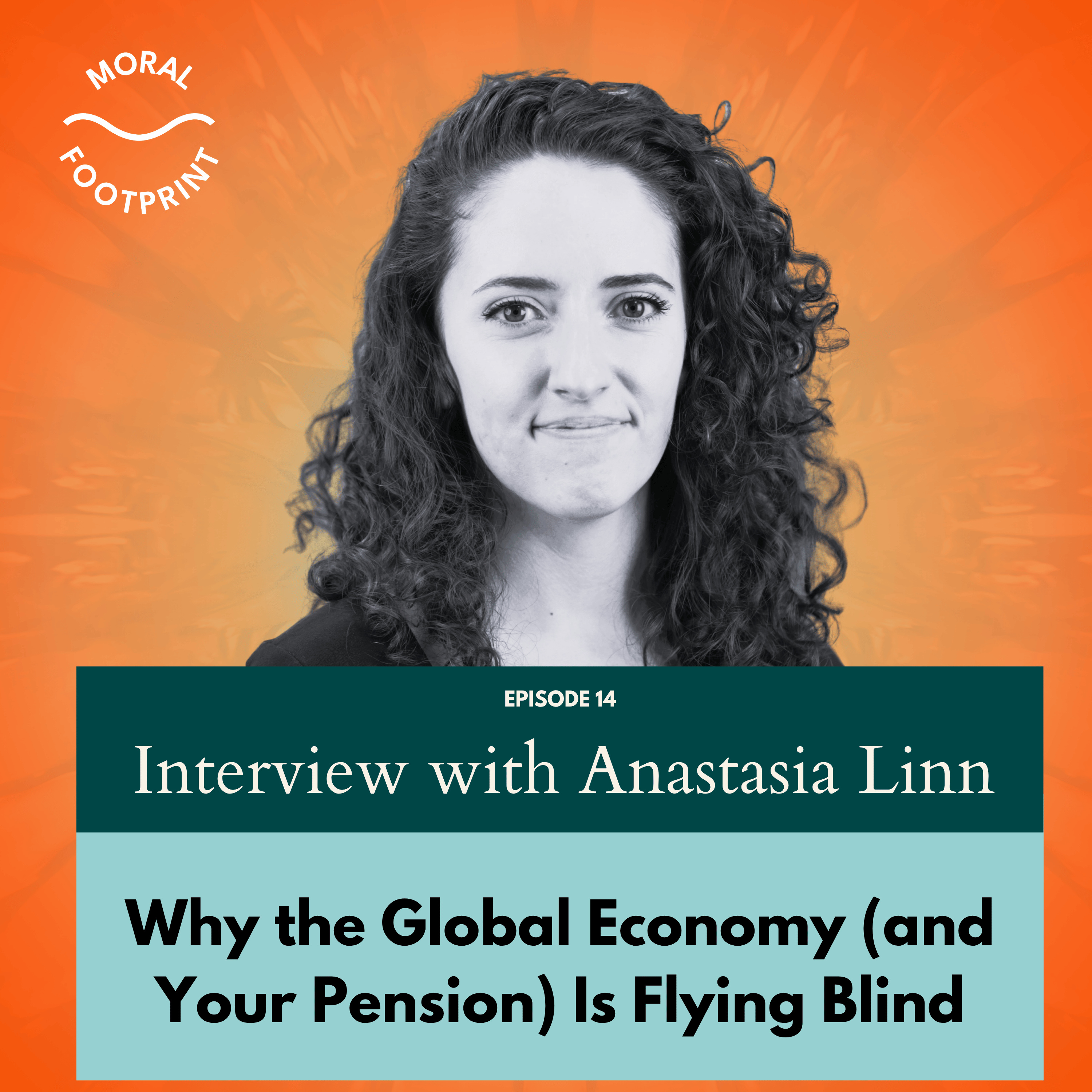
Host Jeni Miles talks to Anastasia Linn, co-founder of the Arketa Institute for Post-Growth Finance, about why sustainable finance is built on flawed economic foundations.
They explore ecological economics, the risks facing pension funds, moral purity in climate action, and why staying inside extractive industries — not leaving them — may offer the greatest leverage for change.
KEY TAKEAWAYS:
- Discover why neoclassical economics, the foundation of all mainstream finance, leaves nature and energy out of its models entirely.
- Understand the shift from an ”empty world” to a ”full world” economy, and why growth-based finance no longer fits planetary limits.
- Learn why walking away from extractive industries may be less effective than staying and using your position for change.
- Explore how ”multi-capital” thinking (natural, social, human and manufactured capital) reframes what a secure retirement actually looks like.
- Hear why UK actuaries are warning that ecological collapse threatens the entire financial system, even as other institutions downplay the risk.
- Move beyond the trap of moral purity, and understand why shame-based climate narratives can hold back real systemic change.
- Find out why hope, in Anastasia's view, isn't something you wait for. It's something you build through action.
CHAPTERS
00:00 Introduction
02:31 Anastasia's journey: from design and organisational psychology into finance
07:40 What's wrong with neoclassical economics
10:40 ”Empty world” vs ”full world” economics
12:12 Founding the Arketa Institute for Post-Growth Finance
15:27 Why staying inside the system can be more powerful than leaving
23:22 Moving beyond moral purity in climate action
29:58 The UK Actuaries' Planetary Solvency report & the ”ground shifting” in finance
35:53 Post-growth pensions and multi-capital thinking
39:21 Why pension funds are unprepared for multiple ”bubbles”
46:40 Emotional resilience, climate grief and active hope
50:12 Where to find Anastasia and the Arketa Institute
ABOUT THE GUEST
Anastasia Linn is co-founder of the Arketa Institute for Post-Growth Finance. Her background spans the Center for Sustainable Finance and Private Wealth, the World Climate Foundation, and the House of Beautiful Business. Follow her on Linkedin: https://ch.linkedin.com/in/avlinn
LINKS & RESOURCES
- Arketa Institute — https://www.arketa-institute.org/
- Institute and Faculty of Actuaries — Planetary Solvency report — https://actuaries.org.uk/planetary-solvency-tipping-into-the-wild-unknown/
- A Tale of Two Actuaries (Matt Orsagh) — https://degrowthistheanswer.substack.com/p/a-tale-of-two-actuaries
- Financial activism playbook & zine (Jasmine Rashid) — https://www.jasminerashid.com/
- Rethinking Economics – https://rethinkeconomics.org/
- Triodos Bank — https://www.triodos.co.uk/
- Alexis Shotwell — https://www.alexisshotwell.com/
- Against Purity: Living Ethically in Compromised Times (Alexis Shotwell) — https://www.upress.umn.edu/9780816698646/against-purity/
- Joanna Macy — https://www.joannamacy.net/
- Active Hope (Joanna Macy & Chris Johnstone) — https://newworldlibrary.com/product/active-hope-revised
- Good Grief Network — https://goodgriefnetwork.org/
- ⭐ Leave a review — it helps more people find the show
- 🔗 Follow Jeni Miles on LinkedIn (https://www.linkedin.com/in/jenifisher/) or subscribe to the Moral Footprint Substack (https://moralfootprint.substack.com/)
Disclaimer
This podcast’s information is provided for general reference and was obtained from publicly accessible sources. The Podcast Collaborative neither produces nor verifies the content, accuracy, or suitability of this podcast. Views and opinions belong solely to the podcast creators and guests.
For a complete disclaimer, please see our Full Disclaimer on the archive page. The Podcast Collaborative bears no responsibility for the podcast’s themes, language, or overall content. Listener discretion is advised. Read our Terms of Use and Privacy Policy for more details.