Wired for Change

Wired for Change
Podcast Description
In a world that's evolving faster than ever, the key to staying ahead lies in understanding the intricate dance between people, process and technology - and the impact they create for humans, organizations and society. This dance is critical for moving forward and yet, more than 70% of these initiatives fail. This show is meant to help leaders and teams with the many decisions and shifts that are required to drive successful innovation, transformation and change.
Podcast Insights
Content Themes
The podcast explores a diverse range of topics focused on the impact of technology on society and organizations, offering episodes such as Healing the Health Data Divide which delves into digital health education and initiatives, The Trust Crisis addressing misinformation and its societal implications, and What's Changing in Cybersecurity that discusses the evolving landscape of cyber threats amid digital transformation.
Wired for Change is a podcast about the leaders, ideas, and systems shaping our future.
Hosted by Amy Yee, each episode features candid conversations with executives, innovators, policymakers, entrepreneurs, researchers, and changemakers working at the intersection of technology, cybersecurity, healthcare, government, defence, and society.
Together, we explore how organizations and nations navigate complexity, build resilience, adopt emerging technologies, and make decisions when the stakes are high. Rather than focusing on technology alone, Wired for Change examines the people, relationship
Healthcare is under enormous pressure. But at the same time, there may be more possibilities for how we create and deliver health than ever before.
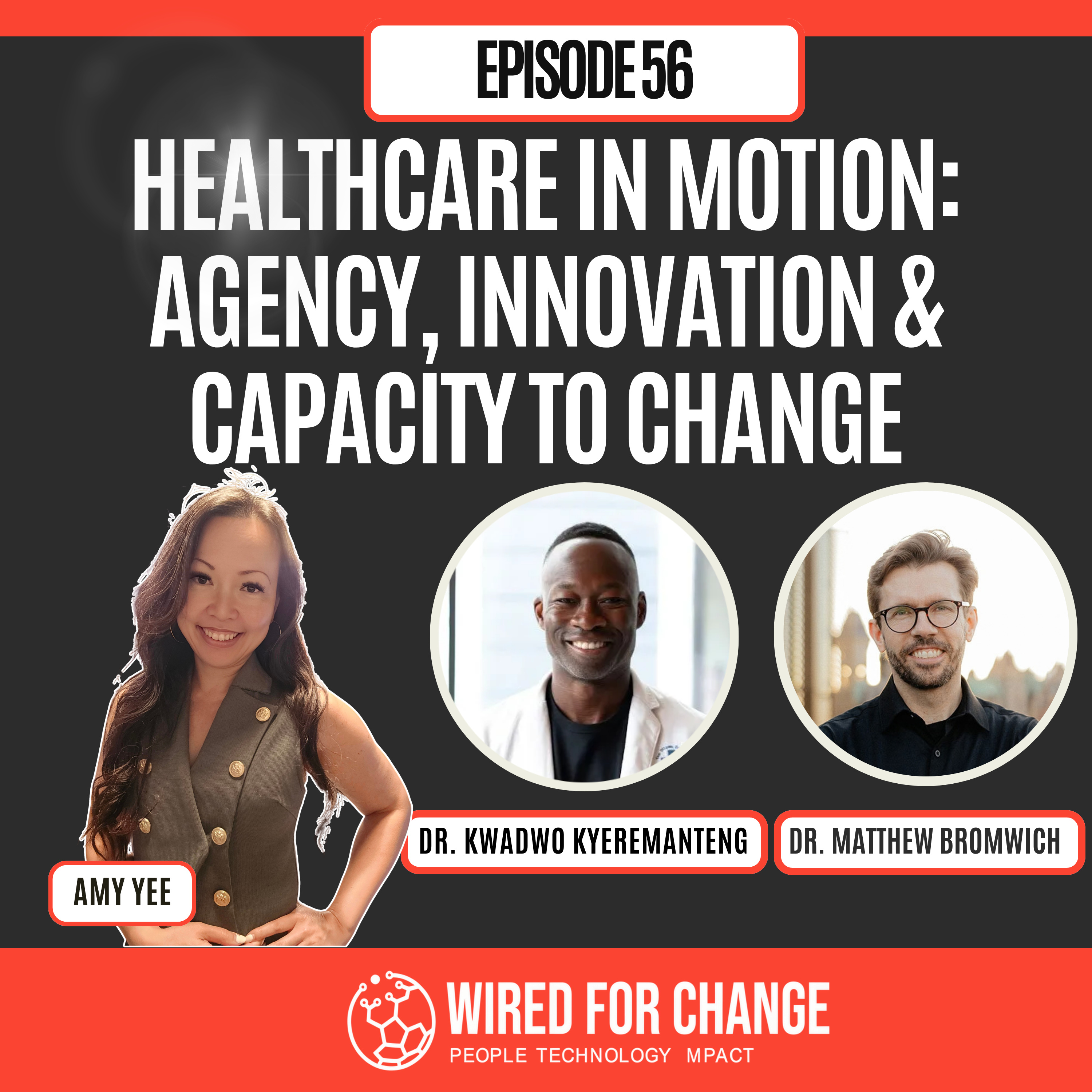
In this episode of Wired for Change, Amy Yee is joined by Dr. Kwadwo Kyeremanteng and Dr. Matthew Bromwich for a candid, sometimes provocative and ultimately optimistic conversation about agency, innovation, prevention, technology—and what it really takes to create capacity for change in healthcare.
Kwadwo brings the perspective of an ICU physician and health advocate who has increasingly turned his attention upstream: to prevention, health literacy and helping people take greater agency over their own health.
Matthew brings the perspective of a surgeon and innovator who has spent his career turning problems encountered in clinical practice into new technologies and solutions—and confronting the much harder challenge of getting good ideas adopted and scaled.
Together, they ask: Where does healthcare actually begin? If we designed healthcare today, would we build the same system? Why do proven innovations struggle to spread? What role can AI play in giving patients and clinicians greater agency? And if we already have many of the ideas and tools we need, how do we create the capacity to actually change?
It’s a wide-ranging conversation about moving healthcare forward—not through one enormous transformation, but through better incentives, greater agency, thoughtful innovation and the willingness to act.
CHAPTERS
00:00 – Healthcare under pressure—and full of possibility
01:00 – Meet Dr. Kwadwo Kyeremanteng and Dr. Matt Bromwich
04:00 – From treating illness to preventing it
08:00 – Scaling impact beyond the doctor-patient relationship
15:00 – Great ideas aren’t enough: the challenge of adoption
19:00 – When is change worth the effort?
25:00 – Access, navigation and the changing role of the patient
31:00 – Where does healthcare actually begin?
45:00 – If we designed healthcare today, what would we do differently?
54:00 – What can we learn from healthcare systems doing things differently?
58:00 – What has to change for innovation to spread?
1:05:00 – Culture, risk and why organizations resist change
1:13:00 – Leadership, identity and the human side of change
1:21:00 – Do patients have more agency than they think?
1:26:00 – Creating capacity for change
1:33:00 – What Kwadwo and Matt are building next
Dr. Kwadwo Kyeremanteng’s latest book, The Opportunities in Healthcare: Redesigning Our Medical Systems in the Age of AI, Prevention, and Courageous Leadership, explores what we can do now to create a healthier future.
Learn more: https://drkwadwo.ca/books
Dr. Matthew Bromwich is CEO of CORE Innovation, which works to move health and healthcare innovations from invention to real-world adoption.
Learn more: About Us | CORE Innovation
Disclaimer
This podcast’s information is provided for general reference and was obtained from publicly accessible sources. The Podcast Collaborative neither produces nor verifies the content, accuracy, or suitability of this podcast. Views and opinions belong solely to the podcast creators and guests.
For a complete disclaimer, please see our Full Disclaimer on the archive page. The Podcast Collaborative bears no responsibility for the podcast’s themes, language, or overall content. Listener discretion is advised. Read our Terms of Use and Privacy Policy for more details.