What the Bible Actually Says

What the Bible Actually Says
Podcast Description
What the Bible Actually Says. Join Dr Tyson Putthoff—a published scholar, college professor, conference speaker & Jesus follower, as he takes a radically fresh, thought-provoking approach to examining Scripture.
Discover what the Bible actually says about critically important & relevant topics—challenging dangerous assumptions, exploring ancient worlds & examining biblical texts in ways you never imagined. By making academic tools & insights accessible, this podcast will empower you to think about Scripture like a scholar & beyond.
Join us & you’ll never read the Bible the same way again!
Podcast Insights
Content Themes
Focuses on a fresh examination of biblical texts and theological insights, covering topics like the historical Jesus, the implications of key scriptural moments such as the cleansing of the Temple, and how traditional interpretations can skew understanding. For example, episodes challenge historical assumptions and encourage listeners to explore the radical redefinitions of faith and access to the divine.
What the Bible Actually Says. Join Dr Tyson Putthoff—a published scholar, college professor, conference speaker & Jesus follower, as he takes a radically fresh, thought-provoking approach to examining Scripture.
Discover what the Bible actually says about critically important & relevant topics—challenging dangerous assumptions, exploring ancient worlds & examining biblical texts in ways you never imagined. By making academic tools & insights accessible, this podcast will empower you to think about Scripture like a scholar & beyond.
Join us & you’ll never read the Bible the same way again!
What if the way we instinctively describe grief, addiction, depression, and despair—consuming, swallowing, pulling us under—is remarkably close to the way the Bible itself imagines Death?
In this episode of What the Bible Actually Says, we go behind the biblical text into the ancient Near Eastern world to recover one of Scripture’s most vivid images: Death as the Devourer.
Ancient Canaanite texts describe Mōt, the god of death, as an insatiable cosmic predator—an enormous mouth and throat that swallows everything within reach. The biblical writers knew this imagery. And once you recognize it, passages throughout the Hebrew Bible begin to look very different.
Sheol enlarges its appetite and opens its mouth. Death shepherds humanity toward the grave. The cords of Death entangle the living. Sheol reaches upward from below. Death has plagues and a sting.
This is not Death as a passive biological event. It is Death imagined as a hungry power that reaches into the world of the living and consumes life.
We explore the ancient Canaanite figure Mōt, the biblical concept of Sheol, and texts from Psalms, Isaiah, Habakkuk, Hosea, and Jonah to see how deeply this imagery runs through Scripture. We also ask why this ancient language still feels so recognizable when people describe experiences of grief, trauma, addiction, depression, oppression, and loss.
And then we turn to resurrection.
If Death is the great Devourer, the tomb is its mouth. It opens. It receives. It swallows.
But in the resurrection of Jesus, Death swallows something it cannot hold.
In this episode:
• Mōt, the Canaanite god of Death
• Why the Ugaritic texts matter for reading the Bible
• Death as the hungry, insatiable Devourer
• What Sheol actually means—and why it is not simply “hell”
• Isaiah’s image of Sheol opening its mouth
• “Death shall be their shepherd” in Psalm 49
• The cords and snares of Death in Psalm 18
• Jonah’s descent into the “belly of Sheol”
• Grief, addiction, depression, oppression, and the experience of being consumed
• Why naming the monster can diminish its power to produce fear
• The resurrection of Jesus as Death’s great reversal
The biblical writers weren’t being morbid when they gave Death a mouth, an appetite, and agency. They were giving people language for something human beings actually experience: the sense that suffering can take, drain, consume, and keep demanding more.
But the story doesn’t end inside the hungry mouth.
The one who entered the tomb came back out.
And the Gospel announces that everything Death has swallowed will not remain there forever.
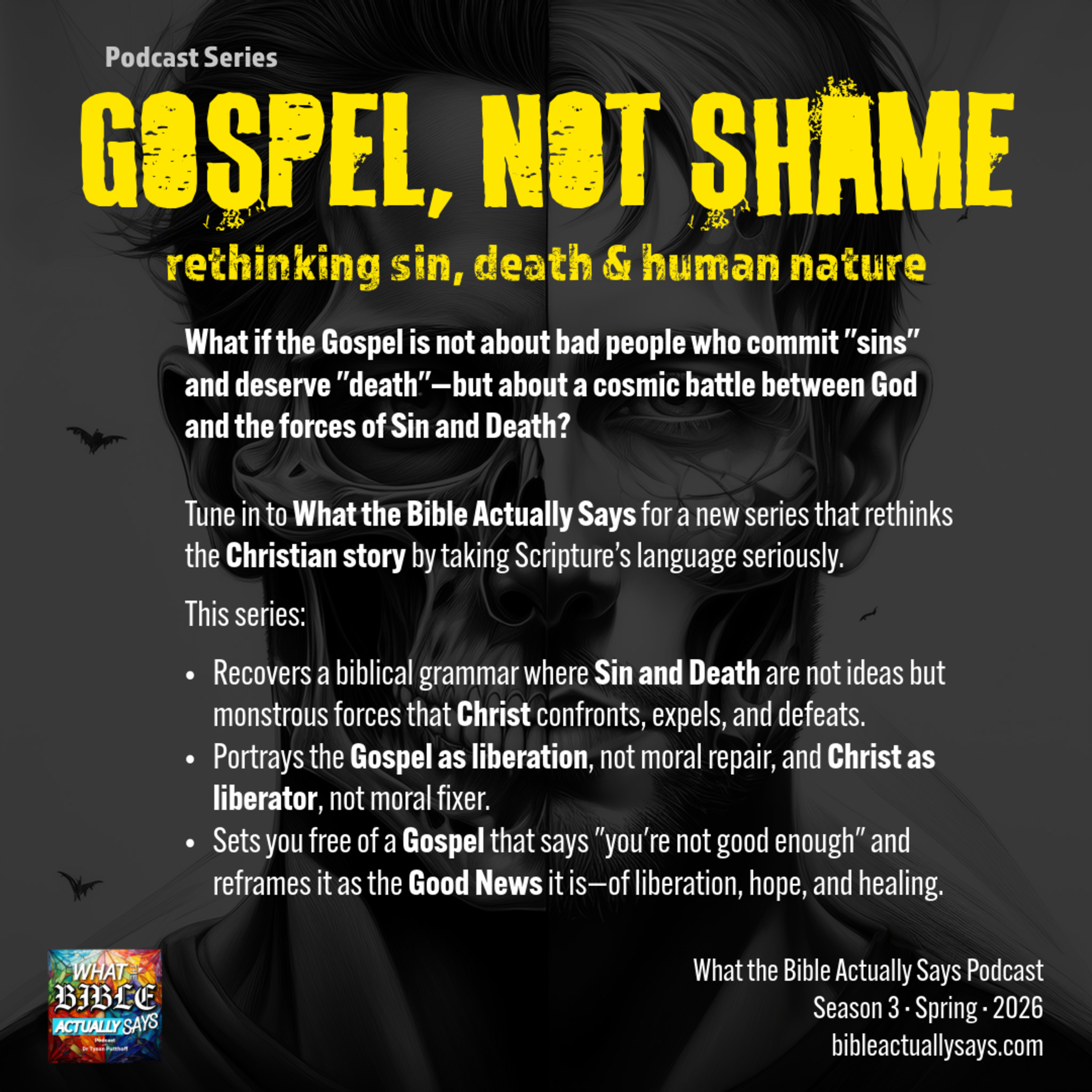
This episode continues Season 3: Gospel, Not Shame — Rethinking Sin, Death, and Human Nature, expanding on themes from I, Monster: A New Model for Understanding Sin, Death, and Human Nature.
Lekh ulmad — go and learn.
Disclaimer
This podcast’s information is provided for general reference and was obtained from publicly accessible sources. The Podcast Collaborative neither produces nor verifies the content, accuracy, or suitability of this podcast. Views and opinions belong solely to the podcast creators and guests.
For a complete disclaimer, please see our Full Disclaimer on the archive page. The Podcast Collaborative bears no responsibility for the podcast’s themes, language, or overall content. Listener discretion is advised. Read our Terms of Use and Privacy Policy for more details.