Farabi Innovations
Podcast Description
A podcast where visionary ideas meet cutting-edge technology. We dive into the least talked-about challenges and explore the emerging trends shaping the future of business, with a special focus on AI, Data, Digital Transformation, and Product Management.
Whether you're a tech enthusiast, a leader navigating the digital age, or simply curious about what’s next, Farabi is your go-to space for deep insights, expert discussions to stay ahead in a rapidly evolving world.
We also offer services tailored to help your business thrive in this digital era—visit us at https://farabi.company
Podcast Insights
Content Themes
The podcast concentrates on themes surrounding AI, Data, Digital Transformation, and Product Management, with episodes that dissect challenges like building innovation teams, as seen in the 'Building a Culture of Innovation' episode, and practical discussions on digital transformation in enterprises, highlighted in the episode 'Digital Transformation in the Enterprise and the role of Data and AI'.

A podcast where visionary ideas meet cutting-edge technology. We dive into the least talked-about challenges and explore the emerging trends shaping the future of business, with a special focus on AI, Data, Digital Transformation, and Product Management.
Whether you’re a tech enthusiast, a leader navigating the digital age, or simply curious about what’s next, Farabi is your go-to space for deep insights, expert discussions to stay ahead in a rapidly evolving world.
We also offer services tailored to help your business thrive in this digital era—visit us at https://farabi.company
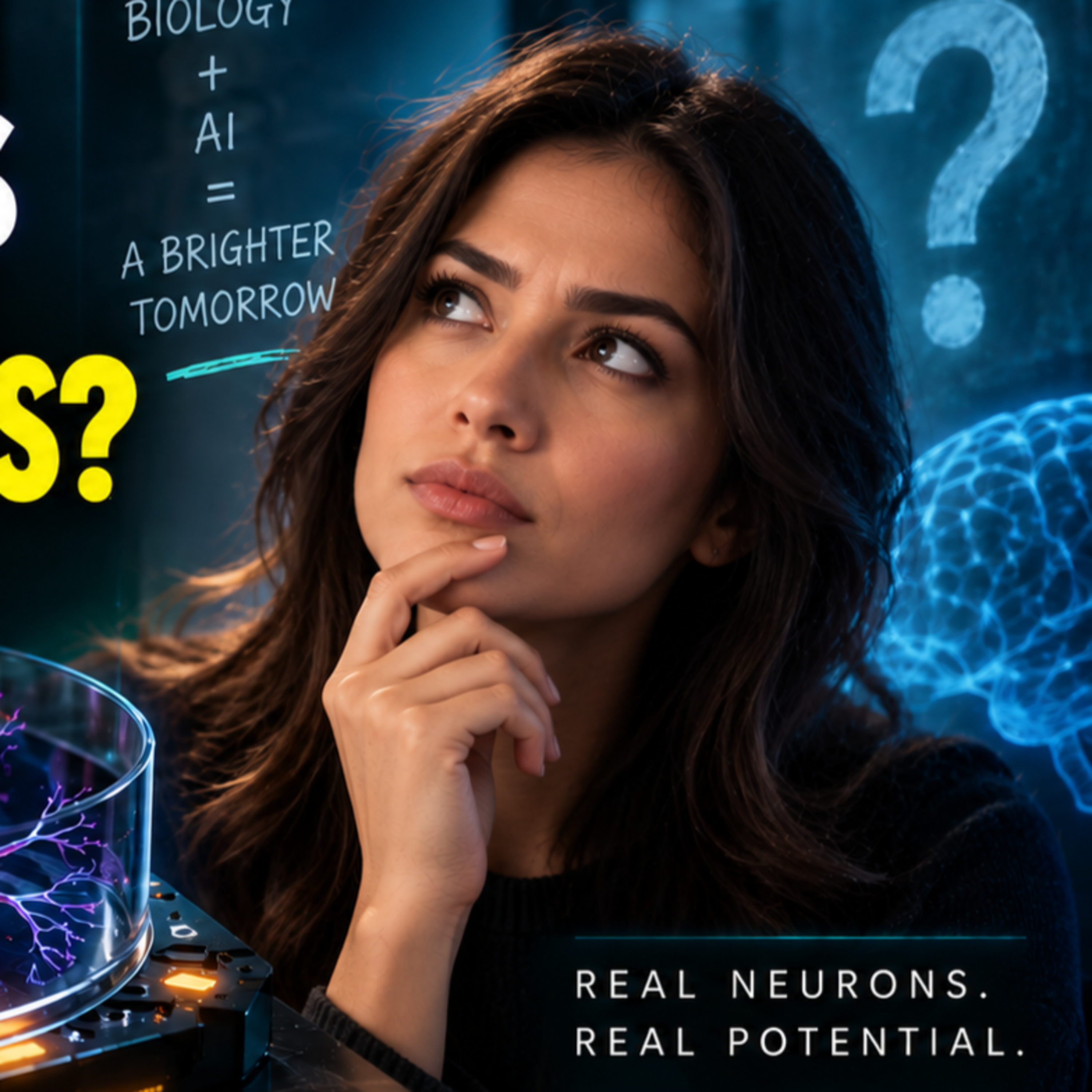
What if the next generation of computers isn’t built entirely from silicon, but from living neurons?
In this episode of the Farabi Future Forum, we speak with Dr. Ewelina Kurtys of FinalSpark about the emerging world of biocomputing and wetware.
FinalSpark is exploring how living neurons can be used as part of computational systems, with the long-term goal of developing biological processors that could consume dramatically less energy than conventional silicon hardware.
We discuss how wetware computing actually works, why brain organoids are often misunderstood, how researchers interact with living neurons through electrical signals, and the challenge of teaching biological neural networks to perform meaningful computation.
We also explore:
• Why biological neurons can be far more energy efficient than silicon
• How wetware could work alongside traditional AI and machine learning
• Whether LLMs could eventually run on biological processors
• The tradeoff between speed and energy efficiency
• The challenge of scaling wetware into future bioservers
• How generative AI is already being used to help design experiments
• Funding challenges for long-term deep-tech research
• The ethical questions surrounding biological computing
• Why the future of computing may involve hybrid systems combining biology, silicon, AI, and other emerging technologies
A fascinating conversation about a field that is still in its early stages—but may eventually change how we think about computers altogether.
Farabi Future Forum explores emerging technologies, artificial intelligence, science, engineering, and the ideas shaping our future.
Disclaimer
This podcast’s information is provided for general reference and was obtained from publicly accessible sources. The Podcast Collaborative neither produces nor verifies the content, accuracy, or suitability of this podcast. Views and opinions belong solely to the podcast creators and guests.
For a complete disclaimer, please see our Full Disclaimer on the archive page. The Podcast Collaborative bears no responsibility for the podcast’s themes, language, or overall content. Listener discretion is advised. Read our Terms of Use and Privacy Policy for more details.