Growing up WEIRD Podcast
Growing up WEIRD Podcast
Podcast Description
WEIRD cultures are Western, Educated, Industrialised, Rich, and Democratic. Us WEIRD adults get allergy, diabetes, arthritis, etc – and these are shaped by how we’re raised. Traditional cultures show us how to give children better adult health. guenbradbury.substack.com
Podcast Insights
Content Themes
The show primarily focuses on health-related issues affecting WEIRD children, encompassing themes such as childhood constipation trends, the impact of paternity leave on maternal behavior, and the anatomical development of jaws and teeth with specific episodes exploring changes in jaw deformity patterns in South American Amerindian communities.
WEIRD cultures are Western, Educated, Industrialised, Rich, and Democratic. Us WEIRD adults get allergy, diabetes, arthritis, etc – and these are shaped by how we’re raised. Traditional cultures show us how to give children better adult health.
If you like to listen – hit play. If you prefer to read, click the transcript button top right on the web version.
In this episode, Greg Dickens and I discuss recent news on how a child’s microbiome is associated with their risk of type 1 diabetes, how different types of risk factors predict the later risk of cardiovascular disease, and how a person’s birth order affects their risk of different diseases. We then talk about how independent mobility might influence a child’s wellbeing, and how different types of light affect the risk of short-sightedness in tree shrews. We then talk about frustration tolerance, why children need it, and how we can help them learn this skill. Finally, we talk about our children’s school’s new sliced-grape policy, and the risks it poses to children’s health.
For more information on how to reduce parental frustration, see this article: https://guenbradbury.substack.com/p/making-children-unfrustratable-part-df0
For more information on allergy development, see this podcast episode:https://guenbradbury.substack.com/p/avoiding-allergies
My veterinary degree taught me about mammalian body systems.
My career in health research taught me about Western health and Western bodies.
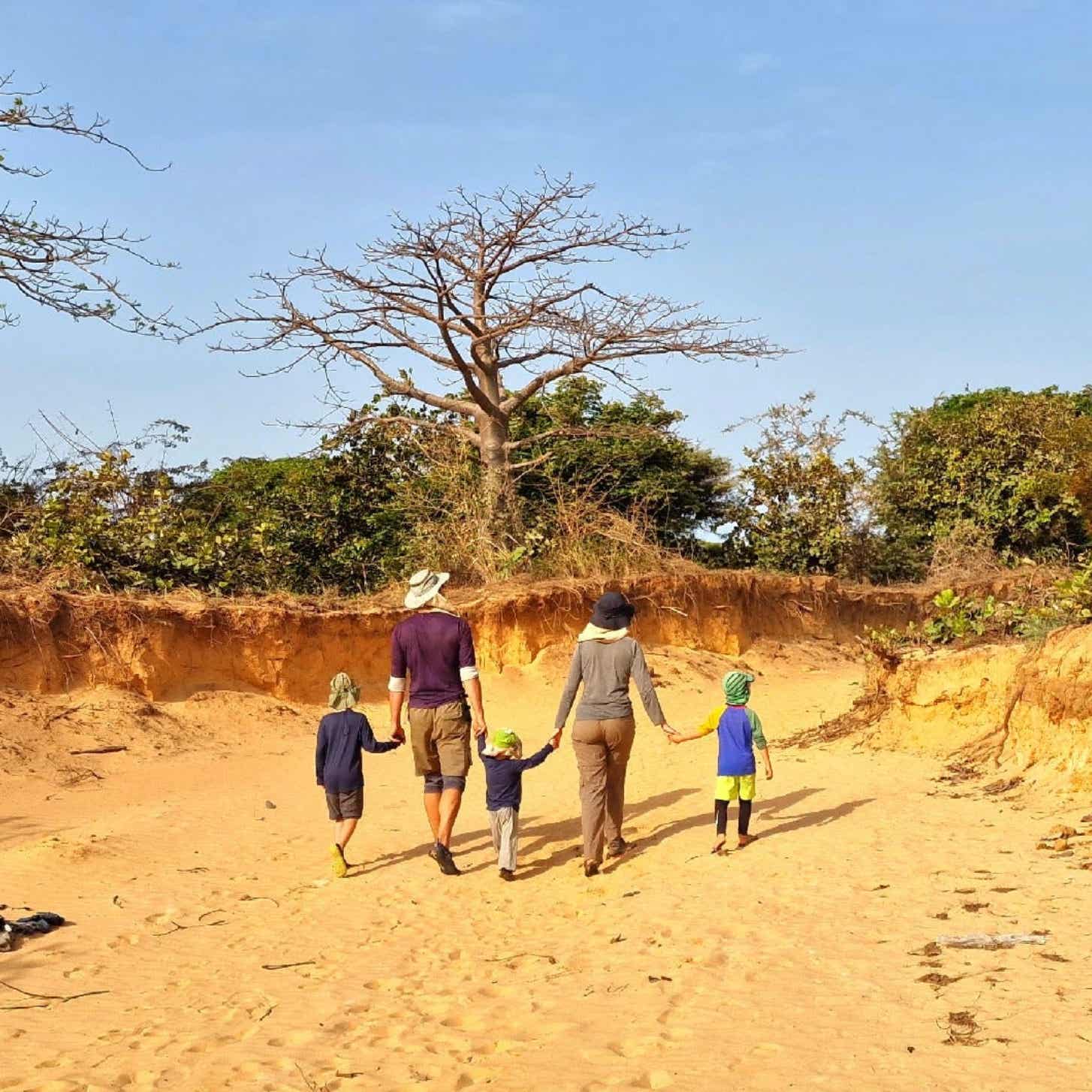
Spending 18 months living with my three children in remote African and South American communities taught me about human health and human bodies in other cultural environments.
I share what I’ve learned about child physical health and development in bi-weekly articles and podcast episodes.
Everything is free, but if you find my work useful and would like to show your support, you can now upgrade – completely optional, always appreciated.
Topics covered
* How is a child’s microbiome associated with their risk of type 1 diabetes?
* How do different frameworks for assessing cardiovascular risk compare, and what do they tell us about the health of young adults in the US?
* How does a person’s birth order affect their risk of different diseases?
* Why might independent mobility reduce a child’s wellbeing?
* How do different types of light affect the risk of shortsightedness in tree shrews?
* Why do children need to be frustrated?
* What does ‘good frustration’ look like for children, and how can we provide it?
* What are the unintended consequences of asking parents of school-age children to cut up grapes?
Recent episodes
Notes
Gut microbiome maturation in early childhood interacts with host genetics to predict type 1 diabetes risk https://www.nature.com/articles/s42255-026-01614-9
“Among 1283 FF-CHAYA participants (mean [SD] age, 22.9 [0.7] years; 54.4% women), 20.7% of participants were classified as Stage 0 CKM (no risk factors), 40.2% as Stage 1 CKM (excess adiposity), 36.2% as Stage 2 CKM (metabolic risk factors), and 2.8% as Stage 3 CKM (subclinical cardiovascular disease or advanced kidney disease).” https://www.ahajournals.org/doi/10.1161/CIRCOUTCOMES.125.013042
“First-borns carry excess risk for neurodevelopmental conditions (other/unspecified pervasive-developmental-disorder (PDD) code group odds ratio (OR) = 0.57, autism OR = 0.74, attention-deficit/hyperactivity disorder OR = 0.93) and immune-allergic diseases (food allergy OR = 0.80, allergic rhinitis OR = 0.91); second-borns for substance abuse (OR = 1.19) and gastrointestinal conditions (gastritis/duodenitis OR = 1.14).” https://www.nature.com/articles/s44360-026-00177-z
“Greater independent mobility was associated with lower wellbeing in children” https://www.sciencedirect.com/science/article/pii/S2666558126001041
“Prevention of myopia in a near-primate by supplemental indigo light suggests a hypothesis for the myopia boom” https://www.cell.com/cell-reports-medicine/fulltext/S2666-3791(26)00416-7
“Should peanut be allowed in schools? Yes” https://pmc.ncbi.nlm.nih.gov/articles/PMC5638466/
“The present findings show that entitlement is the type of frustration intolerance belief that contributes the most to bullying involvement. Interventions targeting irrational entitlement beliefs and reinforcing rational ones could be considered when dealing with adolescent bullying.” https://link.springer.com/article/10.1007/s10942-021-00402-6
“Results indicated that maternal psychological control positively predicts frustration intolerance, and that in turn, frustration intolerance positively predicts school learned helplessness.” https://journals.sagepub.com/doi/abs/10.1177/0143034318775140
“Regarding unhealthy emotions, structural equation modeling (SEM) analyses (model A) indicated that discomfort intolerance and emotional intolerance had a significant relationship with state anxiety, trait anxiety, and depression. The discomfort intolerance and entitlement sub-scales had a significant relationship with state anger and trait anger, while entitlement directly predicted trait anger.” https://journals.sagepub.com/doi/abs/10.1177/0143034318775140
“Tonic irritability was independently associated with concurrent parent-reported temperamental negative affectivity and internalizing and externalizing disorders at age 6 and predicted higher rates of internalizing psychopathology, and suicidal ideation, in adolescence. Phasic irritability was independently associated with concurrent parent-reported temperamental negative affectivity, surgency, and low effortful control, maladaptive parenting styles and practices, and externalizing disorders at age 6, and predicted higher rates of externalizing psychopathology in adolescence” https://pubmed.ncbi.nlm.nih.gov/36029221/
Among youths, the prevalence of irritability ranges from 20–30% under a broad definition to 1–3% for severe chronic forms. https://link.springer.com/article/10.1007/s00787-024-02591-8
“Many parents and schools try to implement a ‘ban’ certain foods (such as nuts) from school premises. However, we do not recommend a ‘no nut policy’ in schools, as it is not possible to guarantee and enforce a nut free zone, as staff cannot monitor all lunches and snacks brought in from home. A free from environment creates a false sense of security and does not safely prepare children for environments where nuts may be present.” https://www.allergyuk.org/schools/for-schools/
Get full access to Growing up WEIRD at guenbradbury.substack.com/subscribe
![How to optimise child frustration [PODCAST]](https://substackcdn.com/feed/podcast/2962061/post/218829463/c0a0f3765026632fd9da9b8a08bf9868.jpg)
Disclaimer
This podcast’s information is provided for general reference and was obtained from publicly accessible sources. The Podcast Collaborative neither produces nor verifies the content, accuracy, or suitability of this podcast. Views and opinions belong solely to the podcast creators and guests.
For a complete disclaimer, please see our Full Disclaimer on the archive page. The Podcast Collaborative bears no responsibility for the podcast’s themes, language, or overall content. Listener discretion is advised. Read our Terms of Use and Privacy Policy for more details.