Liberating Motherhood

Liberating Motherhood
Podcast Description
Mothers are tired of anti-mother misogyny, household labor inequality, and a culture that expects mothers to bear the burdens of its many shortcomings--all without complaint. Mothers are vital to feminism, and have been neglected in feminist discourse for far too long. Mothers are constantly told that political problems are personal--that if we communicate better, mother better, behave better, things will improve. The only path to change is through widespread political change. That's what this podcast is about. Maternal feminism is an important prong of social justice work, and all people interested in a just world should care about what happens to mothers, families, and children.
Podcast Insights
Content Themes
Focuses on maternal feminism, social justice, and family dynamics, with topics including household labor inequality, child advocacy in political climates, and the impact of patriarchal structures on relationships, illustrated through episodes like 'The Patriarchal Playbook' and 'Talking to Your Kids About Sexism.'
When women are overloaded with the endless burdens of household labor, we tell them to go on strike or lower their expectations. But this advice pretends that women are arbitrarily creating work for ourselves, and that if we just hung fewer wreaths or stopped making cookie dough from scratch, everything would be better.
This trivializes women’s labor, and ignores the reality: Women have become the social safety net, doing without pay and without acknowledgment all of the tasks our communities refuse to acknowledge and our governments refuse to fund.
It’s not an accident that women are overwhelmed. In the absence of a real social safety net, the obligations don’t disappear. Kids still need support and advocacy; families still require work. And that work falls almost entirely to women.
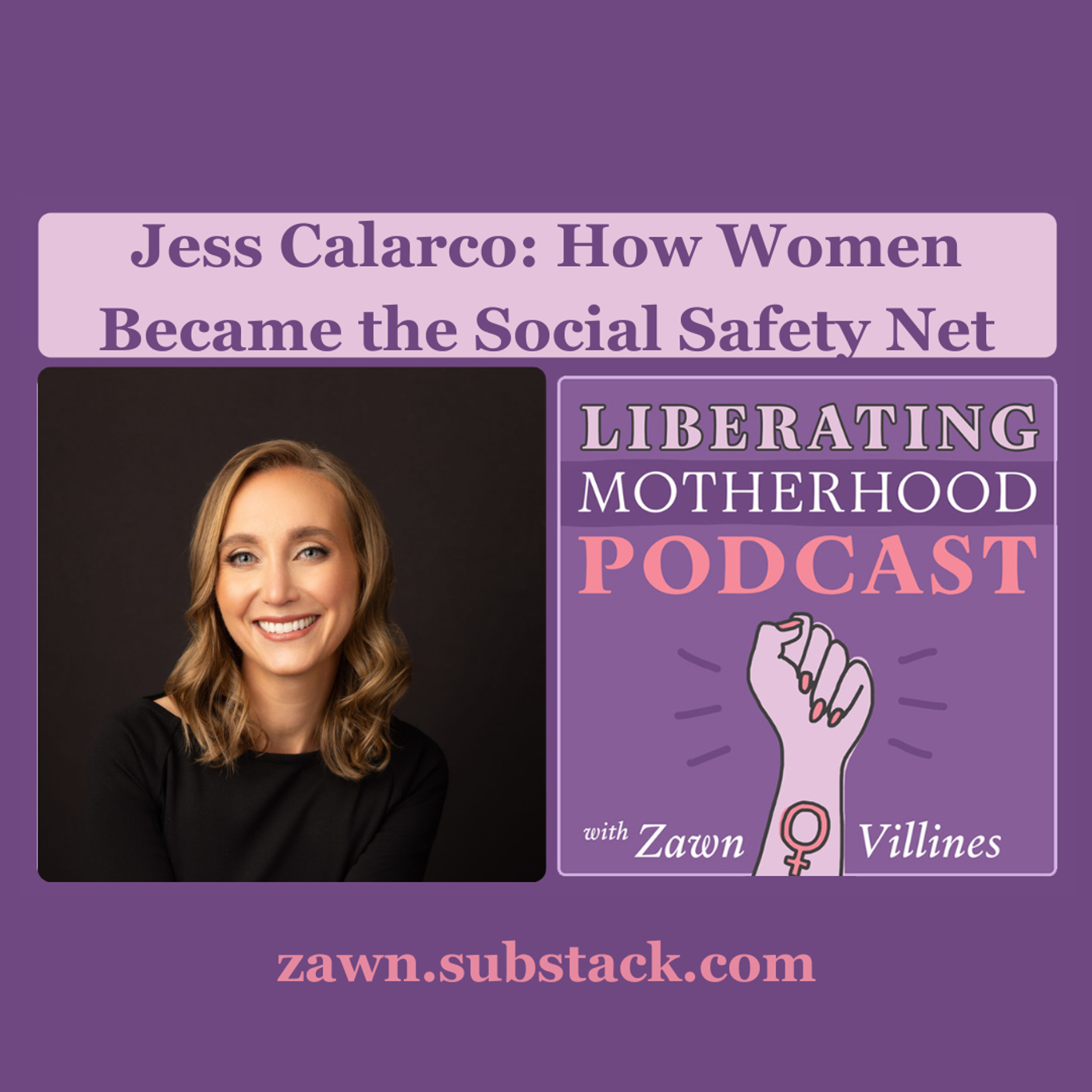
In this episode, sociologist Jess Calarco and I talk about:
How we have transformed political obligations into individual ones, and why we pretend political failings are individual shortcomings.
How we transformed women into an individual and undervalued social safety net.
Why the caregiving never really ends, and how it extends well beyond child care.
The interventions that might finally fix this.
I absolutely love Jess, and I hope you’ll buy her book, Holding it Together: How Women Became America’s Safety Net. You can find her book, all books recommended on the podcast, and an assortment of reading lists on the Liberating Motherhood Bookshop page.
About Jess Calarco
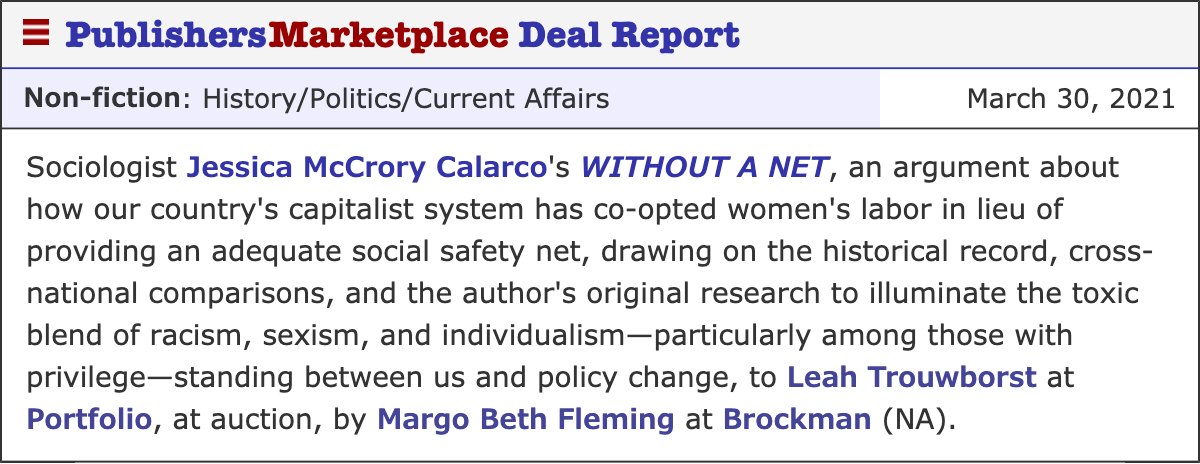
Dr. Jessica Calarco is a professor of Sociology at the University of Wisconsin-Madison, an expert on inequalities in family life and education, and the author of four books, including Holding It Together: How Women Became America’s Safety Net.
Calarco’s latest book, Holding It Together (Portfolio/Penguin, 2024), reveals how we force women to be America’s social safety net, what the weight of that responsibility is doing to women, and why so many Americans believe the myth that we’re doing just fine. The book combines historical and policy analyses with original survey data and vivid portraits drawn from more than 400 hours of interviews with families from a wide range of backgrounds.
Calarco’s first book, Negotiating Opportunities: How the Middle Class Secures Advantages in School (Oxford, 2018), received the Pierre Bourdieu Award for best book in the Sociology of Education. Her book Qualitative Literacy: A Guide to Evaluating Ethnographic and Interview Research (University of California, 2022) is coauthored with Sociologist Mario Luis Small, and won the Outstanding Publication Award for best book in Methodology. Calarco is also the author of A Field Guide to Grad School: Uncovering the Hidden Curriculum.
As an active public scholar and the recipient of numerous early career and teaching awards, Calarco strives to make sociological insights accessible and relevant to broad audiences. She not only publishes in leading sociology and interdisciplinary journals but also writes for high-profile media outlets—including the New York Times, the Washington Post, the Atlantic, Inside Higher Ed, CNN, and NBC News—and offers workshops related to her research and teaching, including workshops aimed at promoting equity and empathy in college and graduate education.
Calarco received a PhD in Sociology from the University of Pennsylvania and a BA in Sociology and Education from Brown University.
Disclaimer
This podcast’s information is provided for general reference and was obtained from publicly accessible sources. The Podcast Collaborative neither produces nor verifies the content, accuracy, or suitability of this podcast. Views and opinions belong solely to the podcast creators and guests.
For a complete disclaimer, please see our Full Disclaimer on the archive page. The Podcast Collaborative bears no responsibility for the podcast’s themes, language, or overall content. Listener discretion is advised. Read our Terms of Use and Privacy Policy for more details.