Catholic Founders

Catholic Founders
Podcast Description
Catholic Founders is where Catholic Entrepreneurs and Business Owners go to learn how to integrate their faith into every aspect of how they run their business and life as a Catholic AND as a Founder.
In modern times, it's become more unclear than ever how to unite our faith with our work. It's even harder when you run a business. However, just as there is a holy way to live, there is a holy way to build and run our businesses.
Fundamentally, our skills were given to us by God so that we may become instruments of His will. These skills are not for our own use. Therefore, to waste or misuse them is a grave thing. This entire project is born out of a deep belief in this truth. www.catholicfounders.com
Podcast Insights
Content Themes
The podcast explores themes such as faith integration in entrepreneurship, the challenges faced by Catholic founders in secular environments like Silicon Valley, and the intersection of technology and spirituality. Episodes discuss topics like the rising presence of Catholicism in tech, the founding story of the Hallow prayer app, and reflections on scriptural teachings that inform business ethics, such as the importance of prayer in decision-making.

Catholic Founders is where Catholic Entrepreneurs and Business Owners go to learn how to integrate their faith into every aspect of how they run their business and life as a Catholic AND as a Founder.
In modern times, it’s become more unclear than ever how to unite our faith with our work. It’s even harder when you run a business. However, just as there is a holy way to live, there is a holy way to build and run our businesses.
Fundamentally, our skills were given to us by God so that we may become instruments of His will. These skills are not for our own use. Therefore, to waste or misuse them is a grave thing. This entire project is born out of a deep belief in this truth.
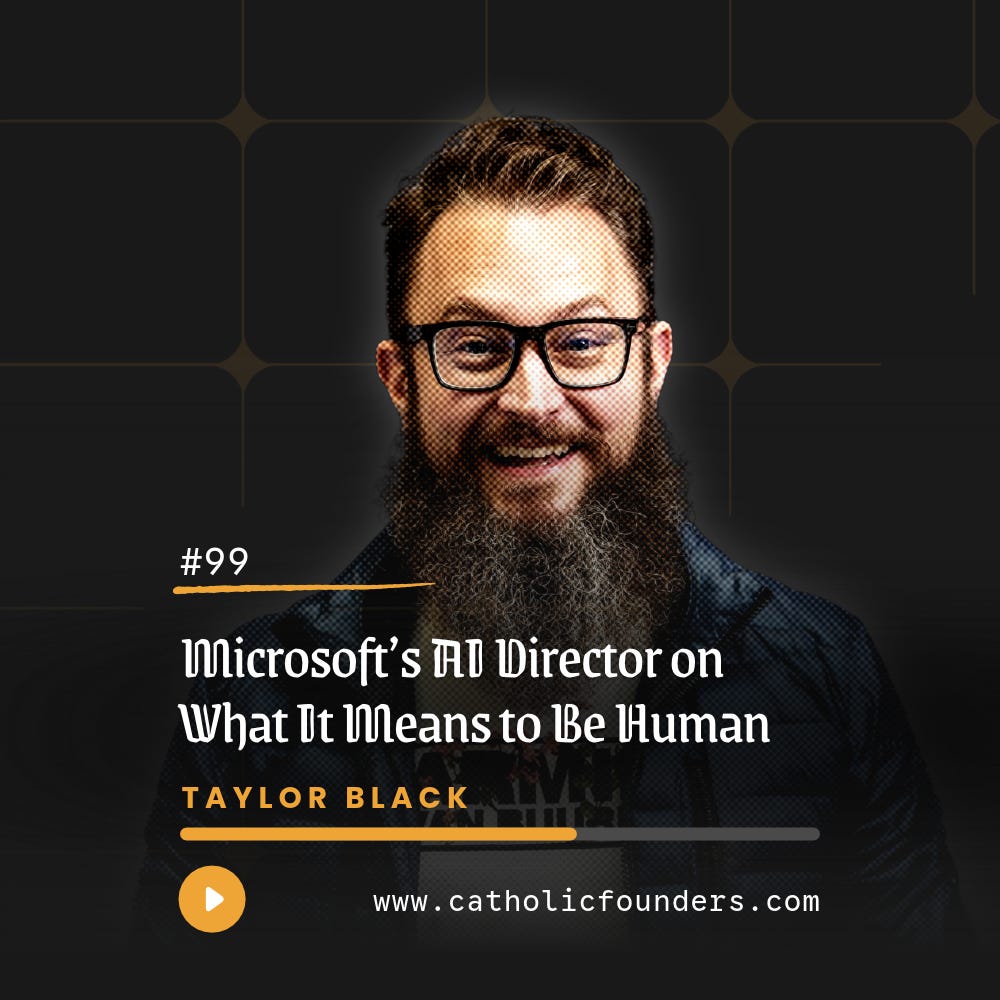
Taylor Black led AI venture programs at Microsoft. Now he’s building for the Church.
Taylor ran operations for a deep-tech venture studio, then built the internal venture studio in Microsoft’s Office of the CTO. A month before this conversation he left to build a venture studio at The Catholic University of America, where he’s the founding executive director of the Leonum Institute. Silas asks him why Catholics stopped building, what AI abundance is actually for, and how he uses AI without losing himself.
In this episode:
• Why a Catholic view of the human person leads you to build different things
• When the Church stopped building, and why “we have souls” isn’t enough in the AI debate
• Product metrics for a “dopamine monkey” vs. a person who is beloved
• Rethinking work, neighborhoods and abundance at a human scale
• Answering the fear that AI creates haves and have-nots
• How he sets up his AI tools to keep the rule of life he wrote in prayer
Core lesson: What you build shows what you believe about people. Build for who they actually are.
Guest links:
Leonum Institute: leonum.catholic.edu
Taylor’s Substack: leonum.substack.com
LinkedIn: linkedin.com/in/blacktaylor
Chapters:
00:21 – Why he left Microsoft’s Office of the CTO, and what a venture studio is (and isn’t)
03:01 – Back to zero-to-one: a venture studio at Catholic University and a consortium of university studios
04:44 – Handing off the one-to-ten phase: a cop-out, or knowing how God made you?
08:38 – His four reasons for building inside a Catholic university, starting with “there’s never been a better time to build”
11:01 – When did the Church stop building? Hospitals, cathedrals, universities, and a “build layer” for the Church
13:49 – Can you build well without a Catholic anthropology? C.S. Lewis’s The Last Battle
16:16 – The body is good: Gnosticism, the Resurrection, and the research Catholics still owe on body-soul unity
20:16 – Why “but we have souls” is a cop-out in the AI consciousness debate
24:05 – Don’t wait for the Pope: Magnifica humanitas, subsidiarity, and builders taking ownership
25:53 – St. Frances Xavier Cabrini and the Church’s long history of new ways to build: “follow that whisper in your ear”
29:05 – Transhumanism vs. theosis: what Silicon Valley gets half right about becoming godlike
36:03 – Product metrics for a “dopamine monkey” vs. a person who is beloved
39:46 – A bigger picture: rethinking work and neighborhoods, with the monastery as a model
47:50 – Is AI pushing people to ask what it means to be human? The pandemic, pay, and the “pocketbook”
52:41 – Will abundance lead to beautiful, human-scale places on its own, or does formation have to come first?
57:23 – Haves and have-nots: answering the fear that AI leaves you behind (“don’t be afraid”)
1:01:47 – His AI rule of life: time goals, a personal CRM, and serendipity from every book he’s read
1:09:14 – The bright line: his tools don’t guide him, they flag when he breaks the rule he set in prayer
1:11:30 – Agents in the background make you less present, and why you should settle yourself before you prompt
1:13:49 – Closing and Rapid Fire
Take our 2026 Community Survey (open through December): survey.catholicfounders.com
Join the Catholic Founders Guild ($10/month or $100/year): grow your business, learn the theology of entrepreneurship, and meet 200+ Catholic founders. join.catholicfounders.com
Newsletter: catholicfounders.com
YouTube: youtube.com/@CatholicFoundersPod
X: x.com/CatholicFndrs
Meetups: luma.com/catholicfounders
This is a public episode. If you’d like to discuss this with other subscribers or get access to bonus episodes, visit www.catholicfounders.com/subscribe
Disclaimer
This podcast’s information is provided for general reference and was obtained from publicly accessible sources. The Podcast Collaborative neither produces nor verifies the content, accuracy, or suitability of this podcast. Views and opinions belong solely to the podcast creators and guests.
For a complete disclaimer, please see our Full Disclaimer on the archive page. The Podcast Collaborative bears no responsibility for the podcast’s themes, language, or overall content. Listener discretion is advised. Read our Terms of Use and Privacy Policy for more details.