Developmental Mastery

Developmental Mastery
Podcast Description
For surprisingly elegant change developmentalmastery.substack.com
Podcast Insights
Content Themes
Key themes include the intersection of love and money, personal growth, cultural programming, and overcoming mental barriers. Episodes explore foundational principles, such as the importance of connection and abundance, and practical strategies for wellness, as seen in discussions about childhood influences and somatic practices.
For surprisingly elegant change
Introduction
Everything you love is a living thing. So why do you keep treating yourself like a device that’s gone wrong?
Watch what happens the moment your lower back gets tight. Some part of you goes straight into engineer mode. Find the faulty part. Isolate it. Apply the fix — a bit more pressure here, a foam roller there, a stretch you read about somewhere, all done with the grim determination of someone debugging a piece of code that refuses to compile.
And here’s what I’ve watched, over and over: people do exactly the same thing with a low mood. Something’s off, so they go hunting for the broken line. Which thought is wrong? Where’s the bug? Override it, patch it, reason your way back to fine. Same move, right? The same little internal mechanic, rolling up his sleeves.
The trouble is, it mostly doesn’t work. Not on the back, not on the mood. And the reason why is a category error so common we almost never notice we’re making it: treating a living thing like a machine.
The mechanic and the gardener
A machine gets fixed from the outside. Something breaks, a mechanic finds the part, replaces it, applies force in the right place, and the thing works again. That’s the whole model. And it’s a great model — for machines.
But you are not that. A body isn’t repaired, it heals. A wound closes itself; you can’t will it shut, you can only keep it clean and get out of the way. A muscle doesn’t get lengthened by force so much as it agrees to let go, when the conditions are right. It reorganises from the inside. Nobody reaches in and does it to it.
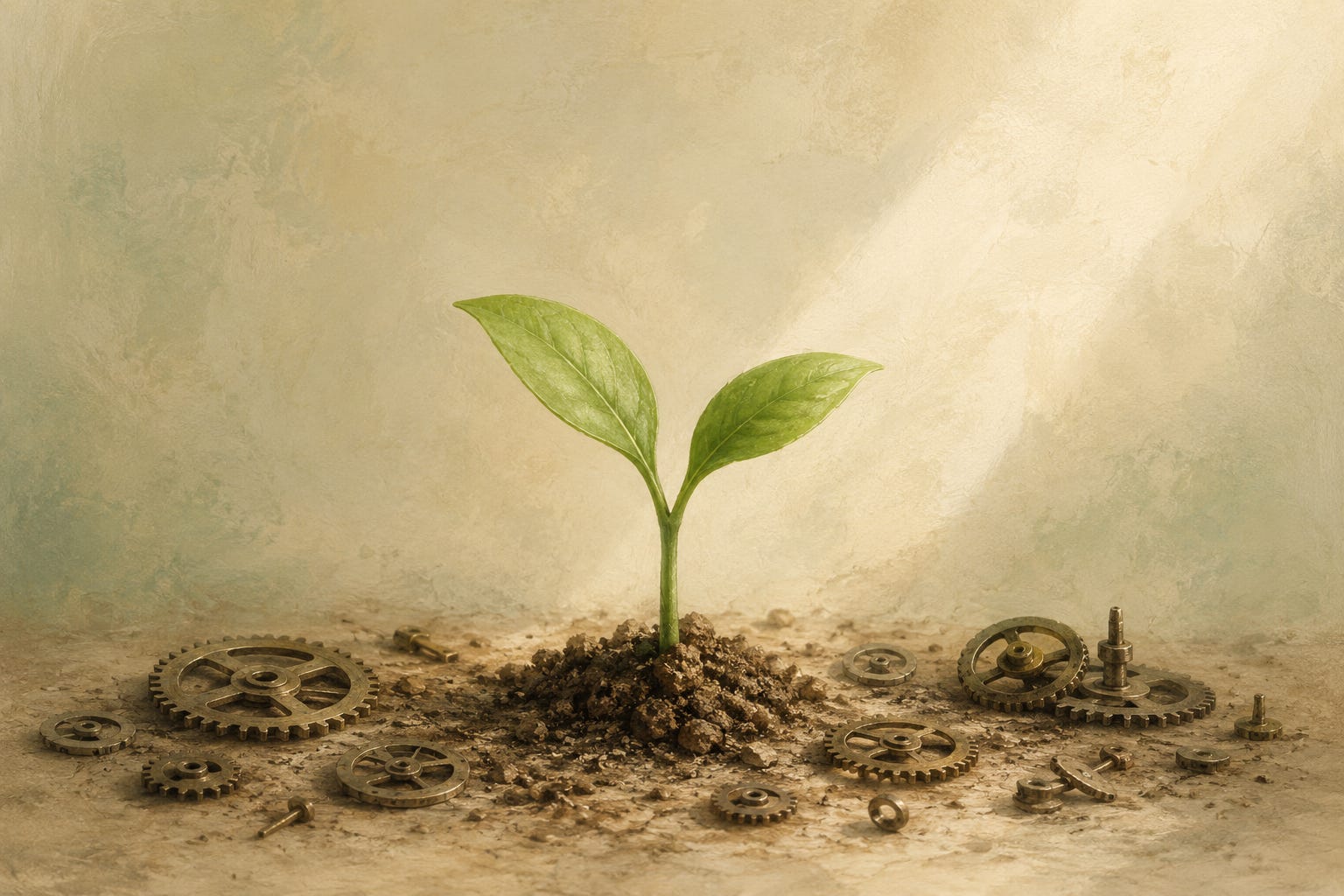
And here’s the thing — your mind is the same kind of thing. Not a machine you debug. A garden you tend. You don’t force a plant to grow by pulling on it, right? (I mean, try it. You’ll have a very short plant and a fistful of leaves.) You give it water, light, decent soil, a bit of time, and it does the growing itself. The growing was never yours to do. It was yours to allow.
Watch it happen in your own body
You can catch this live, in about thirty seconds. Go into a stretch — a forward fold, reaching for your toes, whatever gives you that edge feeling. Now really force it. Grit the teeth, yank yourself down there.
Feel what happens? The muscle doesn’t gratefully lengthen. It braces. It pushes back. Somewhere in you a hand goes up and says no, not like this. The harder you force, the harder it defends. You’re doing the mechanic thing — apply pressure to the faulty part — and the part is treating your pressure as a threat. Which, honestly, it is.
Now try the other thing. Back off a touch, breathe out, let it be safe, stop demanding anything. And often — not always, but often — the tissue just… offers you a bit more. You didn’t take the range. It gave it to you, once you stopped fighting for it.
Now — and this is the whole point of what I’m writing — that is exactly what happens with a belief about yourself. Try to force a new thought on top of an old one. “I am confident. I am confident.” You can feel it bounce off, can’t you? The old thought is still down there with its arms folded, and the minute you stop performing the new one, it snaps right back. Because you tried to overpower it. And nothing alive changes by being overpowered.
But make it safe — get curious instead of forceful, drop the demand, let a different way of seeing things just be available without insisting on it — and it takes root. Quietly. On its own schedule. The body and the mind are not two different systems here running two different rules. They’re one system, and the rule is the same in both: pressure is read as threat, and a threatened thing defends rather than changes.
The man whose hamstrings were “just tight”
A man in one of my groups told me his hamstrings were tight. Not “a bit tight” — tight, as a fact about him, permanent, structural, the way you’d say you’re five foot ten. So I asked him to close his eyes and picture them. How much give was in the mental image? None. Rock solid. And when he imagined pushing further, the picture wouldn’t move an inch, because he was reading it straight off his body and his body was saying this is how it is.
I didn’t ask him to force the muscle. And I didn’t argue with the thought, either — I didn’t tell him he was wrong, or catastrophising, or that “tight” was limiting language. Both of those would’ve been the mechanic, reaching in with a spanner. Instead I asked him to leave the whole thing alone and build a new picture: him in three months, having gently allowed a little more each day. Not yanking. Allowing. How loose is that image?
A lot looser, he said. Straight away.
Nothing physical had changed in that moment. But something had shifted — the conditions had shifted. He wasn’t walking into every stretch pre-loaded with a picture that said I can’t, and if I try I’ll get hurt. He’d stopped fighting a losing argument with himself before he’d even begun. And in my experience that’s very often where the real change actually starts. Not in the tissue. Not in the willpower. In the conditions you set for the living thing to reorganise itself.
So what do you actually do with this?
Mostly you do less. Which is maddening if you’re a fixer — and if you’re reading this, you probably are. The instinct when something’s wrong is to act on it, hard, now. And the invitation is almost the opposite: to become the gardener. To ask, not “what’s the broken part and how do I force it back,” but “what conditions would let this thing sort itself out?”
Warmth instead of strain. Safety instead of pressure. A little patience where you’d normally apply a lot of will. It feels like doing nothing. It’s not nothing — it’s the difference between wrenching and watering.
You are not a problem to be solved. In your body or in your mind. You’re a system to be tended — and living systems, tended well, have a way of doing the changing you’d been trying so hard to force.
This is the whole heart of Get Moving — Flexible Body, Flexible Mind, the next four-session series.
We practise tending instead of fixing — in the body first, because the body is honest and fast and shows you the difference in about a minute, and because what you learn there walks straight into how you handle your mind. If you’ve been gritting your teeth at yourself for a while and quietly wondering why it isn’t working, come and put the spanner down.
Four live sessions
Tuesday 7, Thursday 9, Saturday 11 and Tuesday 14 July,
9am PT / 12pm ET.
Anand
This is a public episode. If you’d like to discuss this with other subscribers or get access to bonus episodes, visit developmentalmastery.substack.com/subscribe
Disclaimer
This podcast’s information is provided for general reference and was obtained from publicly accessible sources. The Podcast Collaborative neither produces nor verifies the content, accuracy, or suitability of this podcast. Views and opinions belong solely to the podcast creators and guests.
For a complete disclaimer, please see our Full Disclaimer on the archive page. The Podcast Collaborative bears no responsibility for the podcast’s themes, language, or overall content. Listener discretion is advised. Read our Terms of Use and Privacy Policy for more details.