Who Killed the Starter Home?
Podcast Description
Have you seen any starter homes for sale lately? Neither have we.
In this podcast, we speak with experts and try to figure out why this humble first home is going extinct. We’ll be exploring if it is the politicians, wielding zoning laws like a murder weapon who killed the starter home? Or maybe the scaredy-cat planners and designers? Or the developers, armed with cookie-cutter plans and corporate indifference? Is it our convoluted tax policy that subsidies homeownership, but puts every tax penalty in the way of creation of the starter homes.
Spoiler alert: it’s probably a little of everything.
We’ll be peeling back the layers of bureaucracy, bad faith, and bad planning, with stops along the way for affordable housing scandals, ADU success stories, and a passionate plea for building code updates. Join us for a conversation that’s part policy deep-dive, part therapy session for frustrated builders, and entirely a love letter to cities that deserve better.
Podcast Insights
Content Themes
The show concentrates on topics related to housing policy, urban development, and affordable housing challenges, featuring episodes examining zoning laws, taxation impacts on homeownership, and innovative strategies for unique local housing solutions.
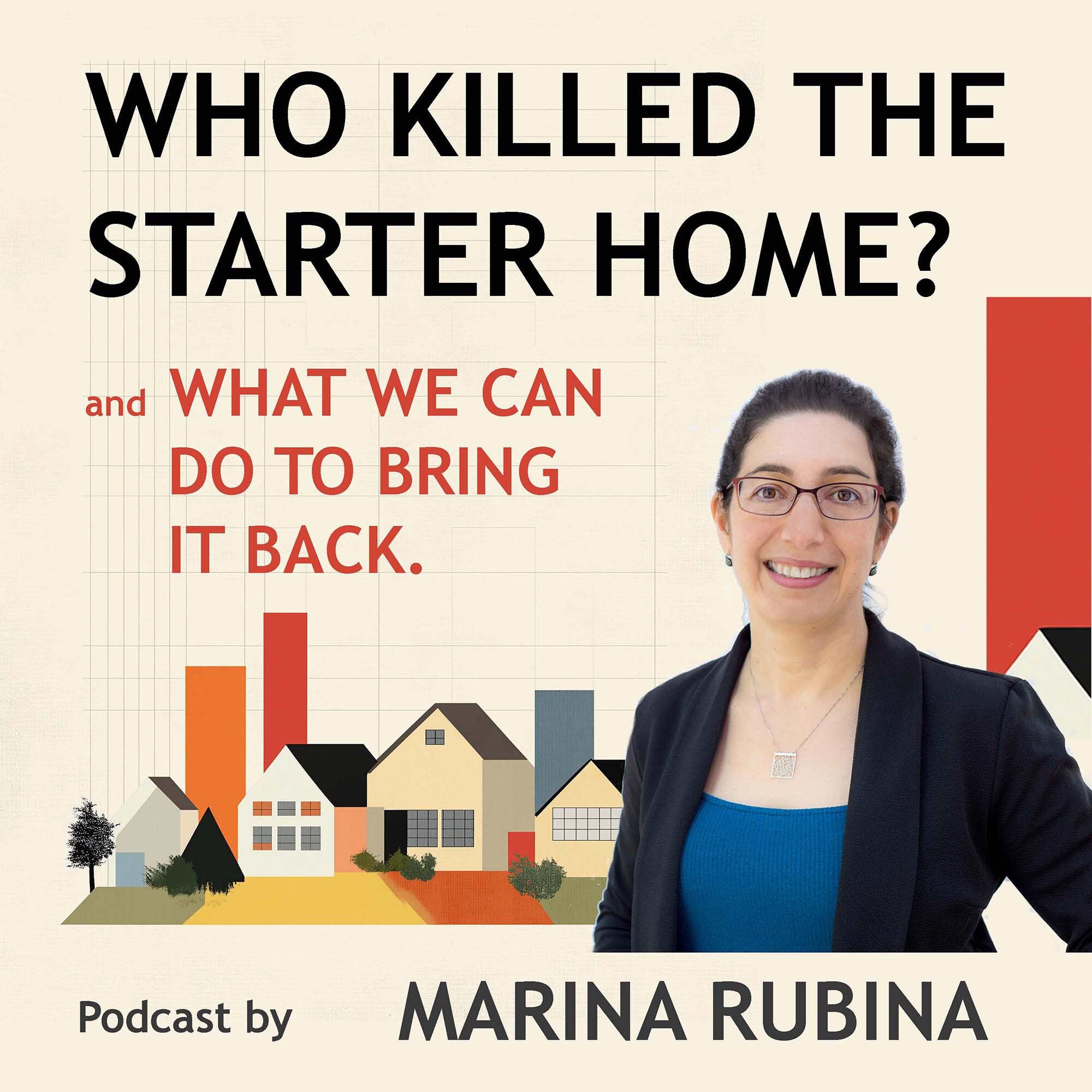
Have you seen any starter homes for sale lately? Neither have we.
In this podcast, we speak with experts and try to figure out why this humble first home is going extinct. We’ll be exploring if it is the politicians, wielding zoning laws like a murder weapon who killed the starter home? Or maybe the scaredy-cat planners and designers? Or the developers, armed with cookie-cutter plans and corporate indifference? Is it our convoluted tax policy that subsidies homeownership, but puts every tax penalty in the way of creation of the starter homes.
Spoiler alert: it’s probably a little of everything.
We’ll be peeling back the layers of bureaucracy, bad faith, and bad planning, with stops along the way for affordable housing scandals, ADU success stories, and a passionate plea for building code updates. Join us for a conversation that’s part policy deep-dive, part therapy session for frustrated builders, and entirely a love letter to cities that deserve better.
In this episode, Professor Richard Green joins us. He’s the Director and Chair of the University of Southern California Lusk Center for Real Estate, and he’s been obsessed with data and cities since he was about nine years old. He’s here with a counterintuitive finding. If you bought a house in the Detroit metropolitan area back in 1987, you did better financially than if you’d bought one in San Francisco and even beat the stock market. Not because Detroit went up more in value. It didn’t. But because the rent you don’t have to pay is income, and that income is worth more in a stable market than a speculative one.
Richard also walks us through the “buy, borrow, die” strategy of the wealthy: borrow cheaply against an asset instead of selling it, invest that money elsewhere, with no need to pay taxes on a sale. Turns out an ordinary homeowner can do a version of that too, just by refinancing smartly when mortgage rates drop. And a fun fact from a hundred and fifteen years ago: a Pasadena newspaper ran complaints about ugly new houses ruining the neighborhood. Those houses were craftsman bungalows that are highly valued landmarks today.

Disclaimer
This podcast’s information is provided for general reference and was obtained from publicly accessible sources. The Podcast Collaborative neither produces nor verifies the content, accuracy, or suitability of this podcast. Views and opinions belong solely to the podcast creators and guests.
For a complete disclaimer, please see our Full Disclaimer on the archive page. The Podcast Collaborative bears no responsibility for the podcast’s themes, language, or overall content. Listener discretion is advised. Read our Terms of Use and Privacy Policy for more details.