The Entropy Podcast

Podcast Description
Welcome to The Entropy Podcast—hosted by principal security architect Francis Gorman. The Entropy Podcast centers on cybersecurity, technology, and business, featuring conversations with accomplished professionals who share real-world knowledge and experience. Our goal is simple: to leave you better informed and inspired after every episode.We chose the name “Entropy” because it symbolizes the constant flux and unpredictability in cybersecurity, technology, and business. By understanding the forces that drive change and “disorder,” we can create better strategies to adapt and thrive in an ever-evolving technology and geo political landscape.
Podcast Insights
Content Themes
The podcast centers around cybersecurity, technology, and business, with episodes exploring specific topics such as the intersection of safety and security in engineering, illustrated by Dr. Bob Oates' insights on the world’s first commercial remotely operated ship project, and discussions on post-quantum cryptography, addressing evolving threats in a digital landscape.
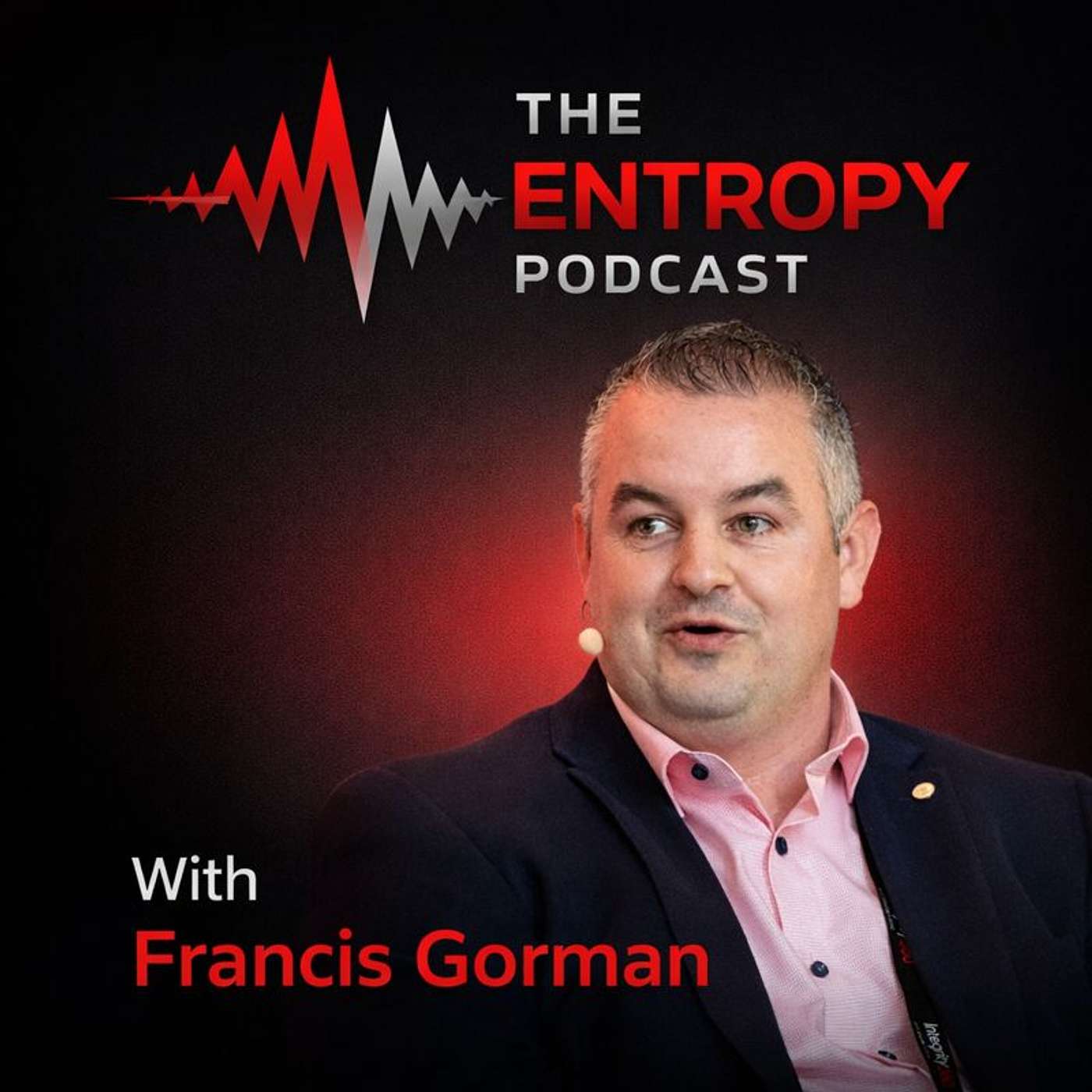
Hosted by Francis Gorman, The Entropy Podcast brings together intelligence community veterans, post-quantum cryptography pioneers, CISOs, business leaders, and frontline practitioners for unfiltered conversations on the threats, complexity, and geopolitics shaping our world.
Past guests include former senior CIA officers, leading cryptographers, digital forensics experts, and security and technology leaders from across financial services, critical infrastructure, and government, voices rarely heard together in one place.
Each episode goes beyond headlines to explore how cyber risk, emerging technology, and geopolitical instability are reshaping the way organisations operate, compete, and defend themselves. Expect candid insight on quantum risk, nation-state threats, AI, espionage, financial crime, business resilience, and the human dimensions of leadership.
Designed for CISOs, board members, founders, technologists, policy thinkers, and the professionally curious, Entropy sits at the intersection of business, technology, and cybersecurity a space for genuine conversations with unique minds, the kind that don’t fit neatly into a press release.
The name Entropy reflects the growing complexity and unpredictability of the systems we depend on, and the discipline required to lead through them.
Disclaimer: The views and opinions expressed on The Entropy Podcast are those of the host and guests in their personal capacity and do not represent the views, positions, or policies of their respective employers, affiliated organisations, or any government body. Guest appearances do not constitute endorsement by the host, and the host’s commentary does not constitute endorsement of guests’ views. Content is provided for informational and educational purposes only and does not constitute professional, legal, financial, or security advice.
One of the topics I cover a lot on this show is post quantum readiness, I believe awareness of this emerging technology is key for a safer world into the future. To support this awareness I have built a free resource to help you explore the world of quantum and learn as you go. You can find it here: www.postquantumready.com
Buy Our Swag:
We now have some slick new swag you can purchase through our Esty store.
https://theentropypodcast.etsy.com
Watch and Subscribe
You can also watch full episodes and exclusive content on our YouTube channel:
www.youtube.com/@TheEntropyPodcast
Achievements
The Entropy Podcast delivered strong chart performance throughout 2025, demonstrating consistent international reach and listener engagement.
- Regularly ranked within the Top 20 Technology podcasts in Ireland.
- Achieved a Top 25 placement in the United States Technology charts, holding the position for one week.
- Charted internationally across multiple markets, including Israel, Belgium, and the United Kingdom.
This performance reflects sustained global interest and growing recognition across key podcast markets.
What happens when we automate more of our work but lose the ability to connect with each other?
Francis Gorman welcomes storyteller, producer and leadership coach Christopher Nelson to The Entropy Podcast to explore why storytelling matters in an increasingly distracted, AI-driven world.
Drawing on his experience behind the scenes of Dragons’ Den and his work with business leaders, Christopher explains how stories capture attention, build trust and help people work together. He introduces PRISM, his practical storytelling framework, and shares how one banking leader used stories of success and failure to change the way his teams connected and learned.
From the hidden cost of a frictionless digital life to the ingredients of a compelling pitch, this conversation explores what it takes to make people care and why human relationships deserve as much attention as the technology transforming our work.
Key Takeaways:
• Individual productivity doesn’t guarantee effective teamwork. Christopher argues that collaboration depends on the relationships we deliberately build.
• Everyday interactions give us opportunities to practise listening, navigating disagreement and understanding other people. Removing social friction can also remove opportunities to develop those skills.
• Use PRISM to structure a compelling story: a Provocative opener, a Relatable individual, an Inflection or challenge, the Struggle, and a Moral or lesson.
• Make storytelling part of your team’s routine. Sharing specific wins and failures can help colleagues learn from experience and recognise each other’s contributions.
• Give people a reason to care. Relatable characters, meaningful stakes and uncertainty about the outcome help sustain attention.
• Turn complex ideas into concrete stories. A clear example can make an abstract business or technical challenge easier to understand.
• A compelling pitch brings the person behind the product into focus. Christopher’s Dragons’ Den experience shows how aspiration and struggle can make a business story memorable.
SOUNDBITES:
“You can't automate human relationships.”
“Productivity happens not just when you're working, but in the spaces between as well.”
“Before you can tell a story, you must first have their attention.”
“Stories are like a value delivery system, and the value in that particular system is the lesson at the end.”
“Being out in the real world was like going to a social competence gym.”
“I think entrepreneur is just another word for storyteller.”
Explore Christopher’s work at storycharged.com.
Follow The Entropy Podcast for more conversations that challenge assumptions, spark ideas and keep you curious.

Disclaimer
This podcast’s information is provided for general reference and was obtained from publicly accessible sources. The Podcast Collaborative neither produces nor verifies the content, accuracy, or suitability of this podcast. Views and opinions belong solely to the podcast creators and guests.
For a complete disclaimer, please see our Full Disclaimer on the archive page. The Podcast Collaborative bears no responsibility for the podcast’s themes, language, or overall content. Listener discretion is advised. Read our Terms of Use and Privacy Policy for more details.