Misguided: The Podcast
Misguided: The Podcast
Podcast Description
Misguided: The Podcast explores how social and psychological forces shape our understanding of the world. Hosted by social scientist Matthew Facciani, the show delves into the latest insights from sociology, psychology, and information science. Matthew shares his own research and engages in thought-provoking conversations with guests from diverse backgrounds. matthewfacciani.substack.com
Podcast Insights
Content Themes
The podcast focuses on themes such as misinformation in media, the psychology behind belief systems, and the societal impacts of digital information. Episodes cover topics like parenting amidst misinformation, examining trust in science through conversations with experts like Kavin Senapathy and Barbara McQuade, exploring how disinformation erodes public trust and proposing solutions for rebuilding it.
Misguided: The Podcast explores how social and psychological forces shape our understanding of the world. Hosted by social scientist Matthew Facciani, the show delves into the latest insights from sociology, psychology, and information science. Matthew shares his own research and engages in thought-provoking conversations with guests from diverse backgrounds.
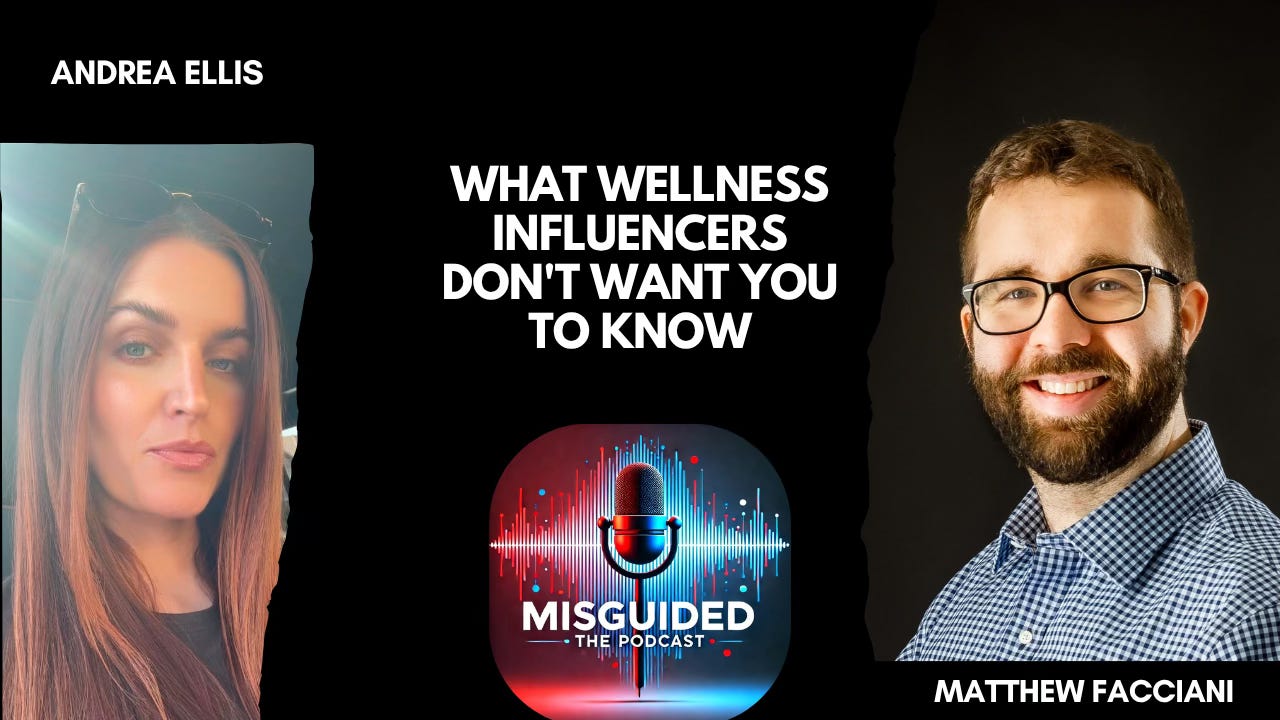
A few years ago, Andrea Ellis was a rising wellness influencer. She was a certified integrative health practitioner, made six figures a year from Instagram alone, and had built a community of followers who trusted her the way you’d trust a close friend. Today, she’s one of the most thoughtful critics of the industry.
I sat down with Andrea for the latest episode of Misguided: The Podcast, and we dive into not just why people fall for wellness misinformation, but the actual business mechanics behind it, and how closely those mechanics mirror the “Big Pharma” boogeyman the wellness world defines itself against.
The wellness influencer economy
People in medical freedom and wellness spaces often portray pharmaceutical companies as a shadowy cabal, accusing them of paying doctors under the table to push medications, hiding side effects, and profiting off sickness.
But as Andrea explained, the wellness influencer economy can involve direct commissions for supplement sales, kickbacks for every lab test ordered, payments for name-dropping a product in a ten-second Instagram story, and very little oversight. Supplement companies still email her offers today, years after she stepped away from the industry. The dollar amounts she described, including thousands of dollars for steering clients toward a certification program and hundreds for a few seconds of screen time, make the “shill” accusation cut both ways.
Faith, identity, and the pipeline
Andrea and I also discussed how the wellness worldview maps onto certain Christian narrative frameworks: a fallen world, forces working against your health and wellbeing, the need to discern truth from deception, and the expectation that living rightly will draw persecution.
Andrea described a pipeline she saw play out in real time during COVID: faith → conservative politics → conspiratorial thinking → wellness, with each reinforcing the others until it became difficult to tell where one identity ended and the next began.
This is something I think about constantly in my own research: the more group memberships and identities someone shares with a source, the more credible that source can feel, regardless of whether the information holds up. When someone’s wellness influencer is also their fellow believer, fellow parent, fellow political ally, and fellow “truth-seeker,” that person’s claims may not get evaluated primarily on the evidence. They get evaluated through trust that was built somewhere else entirely.
What could bring people back
Andrea has watched people find their way out of these belief systems, but never because of one perfect debate or viral debunking. It’s slower than that: a stray thought that doesn’t sit right, a small inconsistency someone can’t shake, or a person outside the echo chamber they still trust enough to hear out.
She called it being a “pebble in someone’s shoe.” Not an immediate conversion moment, just enough friction that, months or years later, it adds up or makes someone more open to listening to new perspectives.
That’s a harder story to tell than the one the wellness world tells. Conspiracy narratives are simple, emotionally satisfying, and built for social media. “Eat well, move your body, sleep enough, and be patient” is true, but it doesn’t sell nearly as well.
I really enjoyed this episode, and I think it provides a great overview of the wellness world while also showing how our identities and belief systems influence what we trust.
You can listen to the full episode here or via the links below. As always, if you find my podcast useful or interesting, feel free to share it with someone who might also enjoy it.
Follow Andrea on Instagram
Keywords: Andrea Ellis, influencers, wellness, religion, social media, media literacy, science communication, health communication
Misguided: The Podcast – Apple Podcasts
Misguided: The Podcast | Podcast on Spotify
This is a public episode. If you’d like to discuss this with other subscribers or get access to bonus episodes, visit matthewfacciani.substack.com/subscribe
Disclaimer
This podcast’s information is provided for general reference and was obtained from publicly accessible sources. The Podcast Collaborative neither produces nor verifies the content, accuracy, or suitability of this podcast. Views and opinions belong solely to the podcast creators and guests.
For a complete disclaimer, please see our Full Disclaimer on the archive page. The Podcast Collaborative bears no responsibility for the podcast’s themes, language, or overall content. Listener discretion is advised. Read our Terms of Use and Privacy Policy for more details.