Decoding Trolls
Podcast Description
Decoding Trolls decodes the meanings inside memes. Decoding Trolls sees any emotion-moving activity of body, speech, or mind as trolling. Trolling others' emotions is what we do as sentient beings. The point is to control it, through getting how it works. www.decodingtrolls.net
Podcast Insights
Content Themes
This podcast focuses on the intersection of internet culture, psychological perspectives on emotions, and current sociopolitical issues. Key topics include the examination of trolling as an emotional activity, the emotional impacts of memes, and critical discussions about socio-political events like the invasion of Ukraine, analyzing the narratives presented by different stakeholders. An example episode discusses the emotional manipulation in political discourse, breaking down the concept of 'demography' in relation to Russia's motives in Ukraine.
Decoding Trolls decodes the meanings inside memes. Decoding Trolls sees any emotion-moving activity of body, speech, or mind as trolling. Trolling others’ emotions is what we do as sentient beings. The point is to control it, through getting how it works.
My new Historical versus Real Russia lens has been tested before.
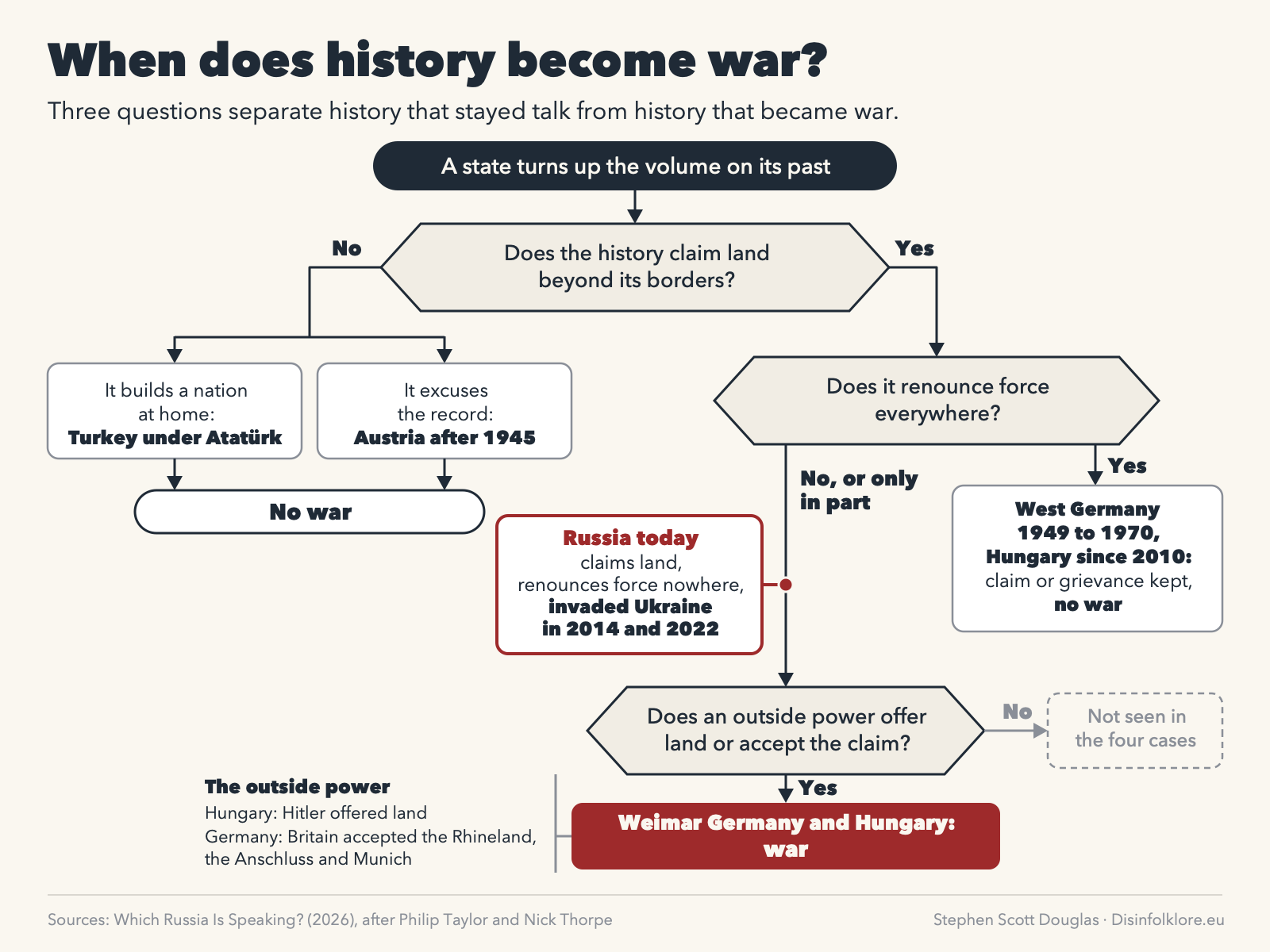
In October 1925, at Locarno, Weimar Germany guaranteed its borders with France and Belgium. But Weimar Germany left its border with Poland open. The Weimar state spent years campaigning about the past. The history it told claimed the land, claimed Poland. Fourteen years later, its army crossed the open border.
“…The limb is gone, but the feeling of the Historical Russia remains. AfD, MAGA, Brexit, Poland’s PiS, France’s National Front and a heap of other backward-looking, oligarch-run democracy-hacking projects engage in History Provocation tactics – nostalgia concealing a will-to-power whose goal is to destroy the post-WWII architecture…”
The Federal Republic, the same core after a far greater defeat, kept a legal claim on the lost east for two further decades. But the Federal Republic renounced force. It acknowledged its crimes from 1951. In 1970, it signed treaties with Moscow and with Warsaw, accepting the post-war borders. After signing the first, that August, Willy Brandt told West Germans on television: “There’s nothing lost with this treaty which has not been squandered away a long time ago.”
That is what the Real Germany sounds like in a core that has lost its empire. That is what we must hear in the Real Russia of the future.
If we want to hear the leaders of the future Real Russia, then we must hear it from them now. We must be looking for that meaning in what we hear around us today. So, by the time the Russian state collapses and becomes Moscow and St Petersburg and a couple of counties around those areas, we will be equipped to help steer it, and to ensure that it remains inside the boundaries of the Real Russia. Whenever it lapses into the Historical Russia discourse, we can help correct it.
The question to put to every voice in Future Russia is Locarno’s. Which borders do you call final? And do you call all of them final?
For their own good, and within the law
If Russia had the power to conquer Ukraine, it would. But it doesn’t. Ukraine will enforce its borders for the decades to come.
So unless Future Russia learns what the Real Russia is, and how to evacuate its brain, its consciousness and its national consciousness of this Historical Russia fallacy, the Ukrainians will enforce it. They will be fully within their rights under the law. They will enforce it using tens of thousands of drones every time Russia strays over its borders, in search of revenge, or some historical Russian troll.
What I’m prescribing today is a change in mind and understanding. It is metanoia, in Yakubova’s speech. It is for their own good. It is for the good of humanity, and the good of European peace and security. And it is all within the law.
Respect your borders. Don’t invade other countries. Don’t fill your population with nonsense about the past. Especially when that nonsense will, in due course, end up persuading them to participate in unlawful invasions of other countries, and the deaths of millions of people, since February 2022.
Why we need to start now
The reason to learn the difference now, before Future Russia arrives, is that many Westerners are already hypnotised by the Data-Resistant Archetypes.
The archetype of Russia as a great power is a phantom limb. It’s like when you lose a leg or an arm. For months afterwards, you try to move it. You try to pick something off the shelf, or you try to walk, and you can’t. It’s gone. That is the Historical Russia.
The Historical Russia is still in our information space. As the Syrian regime began to collapse in the winter of 2024, the same IR (International Relations) experts who had not seen the end of Syria coming were urging Ukraine to concede territory to an unbeatable Russia. They still are.
The limb is gone. The Historical Russia is dead. It’s in the grave. All that is left is an idea of the Historical Russia. That idea must be smited and replaced with the Real Russia idea. That is the purpose of this piece.
The limb is gone, but the feeling of the Historical Russia remains. AfD, MAGA, Brexit, Poland’s PiS, France’s National Front and a heap of other backward-looking, oligarch-run democracy-hacking projects engage in History Provocation tactics – nostalgia concealing a will-to-power whose goal is to destroy the post-WWII architecture.
The History Provocation
Historical Russia knows how to work on that feeling. It’s like an AI agent coming to infect your minds, our minds, the minds of our countries, and our feelings of security. Then it comes over the borders and kills people, and does horrific things, all as an instrument of history. Its instrument is history, brainwashing.
I call it the History Provocation. A state talks about the past, loudly and for years, until its target, and everyone watching, are arguing about the past too. Before you know it, we’re fighting over stuff which isn’t even true. Or if it is true, it doesn’t matter.
What matters today is our future, and building and developing our human communities, educating our children, and building safe communities and a knowledge economy.
It doesn’t matter if the history we’re arguing about is stolen, invented, or even perfectly true. What makes it a provocation is what it does to us and our minds. It sets the agenda. The History Provocation pulls attention away from the present. The History Provocation gives the state’s surrogates, the Historical Russia’s surrogates, a part to play.
In October 2025, I put it bluntly: Putler’s “history stuff is just a way of establishing character for his surrogates and to hypnotise”.
The record of the last History Provocation
The record of the last History Provocation is in the European Union’s own database of Russian disinformation. “Ukraine is an artificial state created by the Russians”, 9 June 2016. “Ukraine has never existed as an independent country”, the next day. “Ukraine is not a real state because it has no real territory, no single language, single economy and single population”, September 2018. “Ukrainians and Russians are one people”, on the day Putler’s essay on the subject appeared, in July 2021.
On 28 February 2022, four days into the invasion, “Russians and Ukrainians are one people” was offered as a reason to murder hundreds of thousands of native Russian-language-speaking Ukrainians. Supposedly, in order to protect them.
Of course, the Historical Russia is nonsense, from start to finish, as a casus belli.
Some in the West read the warning
Some in the West read the warning. I was one of them. At the beginning of January 2022, Germany’s chancellor’s advisers were some others. They met four leading experts from Germany on Russia. Die Zeit reconstructed the meeting that June.
One expert found the questions very strange. Chancellor Scholz and his people were “not particularly interested in the current troop build-up. Instead, they asked about Russian colonialism, Putler’s politics of history and Russian fascism.”
In mid-February, Chancellor Scholz was flying between Kyiv and Moscow to try and stop the war. In front of journalists, he kept returning to what Die Zeit called “Putler’s historical treatise”. He kept wondering whether Putler was concerned not with the Donbas or NATO at all, “but rather with an imperial project”.
He was right to read the history. But he was very slow in understanding what Historical Russia means. He read it far too late. Years too late. Hundreds of thousands and millions will die because of that failure of cognition.
That is the cognitive failure I am trying to address, by inserting into our minds today this distinction between Historical Russia and Real Russia.
Two ways to meet a History Provocation
There are two ways to meet a History Provocation. One is to read it as a statement of intent. The other is to argue with it.
Every group of people that answers “one people” by debating the baptism of Rus’ in 988 has taken the road of Historical Russia and historical provocation. The argument can be won on the facts. It can be lost on the agenda.
In Future Russia, Historical Russia will come to Western capitals with maps, anniversaries, grievances, marches and complaints. It will ask to be understood. The empathetic amongst us will surrender our empathy to them. We will try to understand: “Oh, so 988. Oh, 1433.”
But the useful question will not be whether this history is true. The useful question will be: which Russia is speaking? If it is Historical, revanchist Russia speaking, then we must not entertain this nonsense for a second.
After Real Russia has reasserted itself, or indeed asserted itself for the first time in world history. After, for example, it has done what Germany and Japan did after their crimes during the Second World War. Then we can have nice chats about history.
But it will be several centuries before the Real Russian will be able to talk about history without catching themselves in the sentence itself. Without acknowledging publicly that they are speaking from a Real Russia perspective, and that they are not lapsing back into the Historical Russia doctrine.
An empire falls, and Ukraine rise
Ukraine knows how this story usually runs. We should listen to Ukraine, who were occupied by Russia for over a century.
So if we want to understand Russia, we should not be speaking to Western experts who fall for the Historical Russia troll. They are fully able to explain what happened in 988 and 1233, but they actually have no idea of the true and contemporary Ukraine.
An empire falls, and Ukraine rises. The empire recovers, and Ukraine is swallowed again. This is the cycle.
The Ukrainian People’s Republic rose in 1917 out of the wreck of the tsars’ Historical Russia empire. It fell to the new reboot of Historical Russia that the Bolsheviks rebuilt.
As we know now from historical sources, the Bolsheviks used the idea of a world revolution, and the idea of moving towards socialism and communism, as a mask. They knew they needed to mask the continuity of the ancien régime, and of the security and securocrats that persisted into the Bolsheviks. So they came up with this communist ideology to troll Ukrainians, and the rest of us, into thinking this was a plucky metanoia, a sincere attempt to build a workers’ paradise. In fact, all it was was a cynical continuity of what had come before.
Independence for Ukraine came again in 1991, out of the Soviet collapse. In 2014, and in 2022, the rebuilders came back. Those rebooters, the Historical Russians, came back again and again. They keep coming back. They will keep coming back until we can understand this distinction between Historical Russia and Real Russia, and the poison that Historical Russia actually is.
Historical Russia disguises itself as immanences in memes, and ideas, and people, and in our own minds, in fact all the time. It does this so that it can recreate and reboot itself, rather than engage in the kind of metanoia that Japan and Germany engaged in after the Second World War.
After the next collapse
Future Russia will be another collapse. The danger after every collapse is in the rebooting or the metanoia. Ending the pattern is the historical task of Real Ukraine. Thank God Ukraine has the power to do it. But we must help it through understanding. Every state that will be born out of Russia’s collapse itself must rebuild itself as a result of metanoia. Not just a reboot.
Historical Russia will be ended in heads before it is ended on maps.
In February 2026, I put it this way: “The war of archetypes is permanent. It requires permanent counter-archetyping.”
The archetype of Historical Russia must be smited wherever we see it. Only the Real Russia should be allowed to live in our minds.
The war of archetypes is permanent. It requires permanent counter-archetyping.
I’m trying to equip us for this today.
An apparent contradiction
My own intellectual project is mainly focused on recentring Ukraine in the story of humanity, in accordance with what history and archaeogenetics and archaeolinguistics today help us understand. Those before 2015, for instance, could not possibly have understood it. In July 2024, I put it in one line: “My core project: re-centring Ancient Ukraine in humanity’s mental models.”
This can look like a contradiction. I’m banning Historical Russia, but I’m advocating in favour of ancient Ukraine. I’m saying Future Russia must leave its history alone and live on a map. But on the other hand, I’m allowing Ukraine, and I’m advocating for Ukraine, not to do the same.
Recentring Ukraine is not a claim on anyone’s land. It’s a claim on our attention. The difference between the two, between Historical Russia and recentring ancient Ukraine in our minds, is the difference between Historical and Real.
Songs, and a state
The narrow version of my intellectual project, Finding Manuland, affords Ukraine what every sovereign culture already has.
In 1777, Herder asked where Germany’s Shakespeare was. As I have written: “The modern state was created after Herder’s 1777 plea to unite the German tribes behind a set of stories (folklore, and more accurately folk songs) typifying Germanness. The Brothers Grimm, Goethe, and later Wagner answered that call. And 90 years later, the first unified German state was created. Identity is wholly a function of stories.”
Herder was talking about songs which contained the stories.
The same work made most of the states that we today take for granted. “You see, most European states alive today are a function of the national consciousness, wrought from the folklore collectors’ work, inspired by Ossian, Herder, the Brothers Grimm,” I wrote in November 2024. “States which had never existed before (Greece, Finland, Germany, Ireland, Italy, Belgium) were all created out of this work.”
Ukraine is one of them. Its songs and its poets, Taras Shevchenko first among them.
I stayed on Shevchenko Boulevard on my first night in Kyiv. I wondered about him. Because I saw the name, I then researched him. He is for Ukrainian nationalism what W. B. Yeats is for Ireland. What Shakespeare is for England. What Herder and Goethe are for Germany. Every country has their Shevchenko.
Taras Shevchenko, of course, was born a slave. He was only freed when he managed to convince a group of rich Muscovites that he, a Ukrainian, was so special that they should pay to emancipate him.
Taras Shevchenko, first among them, made a nation of a people the empire called a province. As Timothy Snyder has written: “The earliest articulation of Ukrainian patriotism by Russian subjects came from the left bank of the Dnipro River, from the new university at Kharkiv in the 1820s and the 1830s.”
In August 2022, Russia shelled Kharkiv in order to liberate the native Russian-language-speaking Ukrainians living there. I wrote that by destroying the buildings of the university where the idea of a modern Ukraine, which contains Russian identity, was born, Muscovy could not turn back time. It was too late.
They cannot return to the Historical Russia. And we must not let them return to the Historical Russia. That’s why we must learn to see the Real Russia.
Parity of esteem
From the first days of the full-scale invasion, my mission was, in the words I used later, “to campaign for parity of esteem between Ukraine and other modern nation states which have won the monopoly game of nation statehood by fair means or foul.”
Ukraine was a founding member of the United Nations. It signed the UN Charter in its own right as a sovereign state in 1945.
On the eightieth anniversary of D-Day, in June 2024, I wrote of Ukraine taking its rightful place “on the basis of equality and parity of esteem” among the great European peoples who, in the post-World War II legal order, became “sovereign, secure and prosperous nation states”.
Positive nationalism
That is positive nationalism. The collectors of the nineteenth century were recording a culture that existed. As I put it in 2024, “the collection of folktale songs during the 18th and 19th centuries was a good faith attempt to record actual existing culture.” It gave peoples a voice. And in the end, a state.
Its counterfeit, Disinfolklore, came later. Disinfolklore takes the collectors’ tools and uses them to plant a negative identity. An enemy, a grievance, a lost land.
Disinfolklore is the narrative mode that Historical Russia uses. Real Russia will use Infolklore.
Positive nationalism at work
Ukraine today is positive nationalism at work. A whole society is mobilised against an unlawful invasion. Soldiers and medics, drone makers in garages, volunteers weaving camouflage nets, teachers holding lessons underground in Kharkiv’s metro, farmers clearing mines from their own fields.
Ukraine is exercising the right of self-defence that Article 51 of the UN Charter recognises. Ukraine’s aim is not a lost province. It is not Historical Ukraine.
As I said in March 2026: “Ukraine has one strategic goal in this war: to destroy Russia’s capability to invade Ukraine again, permanently.” Part of Russia’s capability is its promotion of Russkiy Mir, or the Historical Russia fallacy. That fallacy is always used, and has been used for centuries, to justify going into other people’s lands and murdering them.
Ukraine’s soldiers are dying for a free and sovereign Ukraine, not for a map of lost provinces and Historical Russia, or an Historical Ukraine.
A sovereign country does not wait to be rescued. Allies can help. Allies should help far more than they have. But allies cannot be Ukraine’s state for it. Ukraine is doing it for itself, with its own drones, its own long-range strikes, its own defence industry.
True history, and human rights
When positive nationalism reaches for history, it reaches for true history. But even true history does not decide how we see today.
True history, what I call real history, does not override the post-war legal order, or the protection of human rights and dignity which each of us is afforded as a function of being human. They are, after all, universal.
The idea of universality of human rights was theorised by the Ukrainian international lawyer Hersch Lauterpacht. He later taught at my university, Cambridge University, after graduating from Lviv University. It was Hersch Lauterpacht, Sir Hersch Lauterpacht in the end, who wrote The Rights of Man in 1945. He argued that human rights should be afforded universally.
Sovereign democracy cannot stand
This goes back to when Surkov talks about sovereign democracy. He asserts, for Historical Russia, the right to curtail those living subject to Historical Russia’s laws: their right to participate in decision-making.
But this cannot stand. This cannot be. It’s conceptually impossible to justify this, because the vision of Hersch Lauterpacht, the Ukrainian international lawyer, was accepted by the international community after World War II. His vision was for human rights protected by law, which applied universally to all humans. It was even accepted by Russia, and signed into treaty by Russia.
And yet, the Historical Russia troll enables Russia to try and assert that its municipal law can trump international law. But this cannot stand. That is another clue for those arguing for Historical Russia.
The Real Russia of the future must adhere to international law, strictly, or they will be punished for it by Ukrainian drones. It is so much easier to do what Japan and Germany did after World War II. To withdraw from the lands they purported to occupy. To try and make good on their crimes. To try and build up communities and societies within their lawful borders that the rest of the world envies.
That is the challenge for the Real Russia, the future. That would be, and is, the essence of positive nationalism. I said it plainly at the end of 2024: “What matters is the international rules-based order as established” in the wake of the Holocaust.
Six thousand years
That was the narrow version. This is the wide version of my project, Finding Manuland.
Manuland is what I call “an imaginary community radiating around the hub of the modern state of Ukraine, stretching from India to Ireland”. I gave it that name in the autumn of 2021, as I passed a warehouse in northern France with the word Manuland written on it. I was on my way back to Ukraine from the last leave I would take before the full-scale invasion.
The story Europe told itself
For three centuries, Europe told itself a different story than the story I tell in Finding Manuland. The origins of Indo-European languages and its gods were placed in India, or in the German forests, or in Greece and Rome.
You can listen to my Finding Manuland podcast on PowerofMana.net, on the Atlas series, which I began recently. There are five introduction episodes, or the series on which came first, Manu or Mannus.
The mental models of our culture, our Indo-European culture, placed it in Greece, or in the German forests, or in Rome, or India. These mental models were built long before archaeogenetics. And they were built in good faith.
“The idea that Western culture was founded in ancient Greece or ancient Rome has been relentlessly promoted, and in good faith.” I wrote that in March 2026. “Ancient Greece is just one daughter of Indo-European culture, privileged because we have amazing written records.”
Soviet archaeology added a layer of its own. As I wrote in 2025, Soviet archaeology “managed to troll many linguists, archaeologists, archaeogeneticists, historians and Comparative Mythologists/theologians into using formulae like ‘Steppe Ancestry’, ‘Southern Russia’, or ‘Pontic Caspian Steppe’” for the Ukrainian homeland of all living Indo-European languages.
Halle and the Nebra moon disc
In early February 2022, days before the full-scale invasion, I was on my way back from Ukraine. I visited the museum at Halle, home of the Nebra moon disc.
Germany’s president, Steinmeier, had spent years trolling Ukraine into surrendering occupied Luhansk and occupied Donetsk to Russia. He did it under the guise of allowing Russia to hold elections in these occupied territories, in exchange for peace. Steinmeier had spent years on the Ukraine issue. In 2022 he was still writing, in the introduction to an exhibition guide on the Nebra Sky Disc, that all Indo-European languages, including the Germanic, had emanated from “southern Russia”, instead of Ukraine.
That is the Historical Russia occupying the minds of our leaders. I think President Steinmeier today would have a different answer to that. But people like him did not see through the Historical Russia troll. The cost is the graves of hundreds of thousands of innocent Ukrainians, and indeed of over a million Russians, in Ukraine.
Where the story begins
The ancient DNA studies of the last two decades now say where the Indo-European story begins. Every living Indo-European language goes back to the Yamna. The land that nourished the Yamna is south-eastern Ukraine, on the lower Dnipro, at Mykhailivka village, on the right bank. It is just across from Enerhodar, Europe’s largest nuclear power plant, which the Ruschists are brutally occupying as I speak to you today.
“More than half of humanity today speaks languages which were first spoken in south-eastern Ukraine, around where the Ruschists blew Nova Kakhovka dam.”
Many great Indo-Europeanists, and their colleagues before the archaeogenetic evidence, had been willing to count today’s Russia as part of the Indo-European homeland. But I’m with one of the greatest researchers into the origins of the Germanic language, including English: Don Ringe, at Penn. Penn is where my grandfather went to university. “Only Ukraine makes sense,” as Don Ringe said, long before the archaeogenetics demonstrated the truth of this.
I have taught myself to “dance in my mind between 6,000 years”, from the time the Yamna grew up inside ancient Ukraine to the present day, from Ireland to India. But the mental models we have been taught to imbibe go back through Rome, to Greece, and maybe to Egypt. Or maybe, if we know a bit about India, we’ll go back to India’s Indo-European history, which begins around 1200 or 1300 BCE.
However, we can change our mental models and give it a time span of 6,000 years. That is the 2,000 years into the common era, and back to the 4,000 years when the Yamna first spoke the predecessor language of all of today’s living Indo-European languages, and cultures, and religions. That is a much bigger time span than we’re used to. And it’s a time span that begins and ends on the steppe of Ukraine.
A daughter of that steppe
Rome is a daughter of that steppe. “Ancient Rome is Ancient Ukraine’s daughter culture.” So is Greece, one of the amazing daughter cultures. So is Celtic Ireland, the Germanic north, England, Vedic India.
When I began this work, I put it this way: “All roads may well lead to Rome, but they continue eastwards on from Rome, through Athens to ancient Ukraine.”
Even the faith that Moscow’s church claims as its own arrived in Indo-European language. The New Testament was written in Greek. Greek is a daughter language of the language first spoken by the Yamna, in Mykhailivka village, in 4000 BCE. As I wrote in 2023, “Greek was the lingua franca in the Roman occupied land of Judea, where Christ lived and taught at the time of Christ.” Rome was another Indo-European culture. Ancient Ukraine is the beginning of our history.
Chornomorsk
Chornomorsk is just east of Odesa. The Russians are bombing it relentlessly. It is thought to be the meeting point of the Yamna and Usatovo communities. Out of that encounter is believed to come all of the Italic, Celtic and Germanic language families, cultures, religions, ideas, words and meanings.
It never fails to amaze me. I long to go back to these places now, with the knowledge of how all of our forebears began our time there.
So when I talk about re-centring Ukraine, I’m talking about the true history. We now know it through modern, scientific, methodologically kosher archaeogenetics, linguistics, archaeology, theology and the rest.
Rome is not a licence
Of course, none of this licenses modern Ukraine to anything, any more than Rome licenses modern Italy, or modern Greece, to anything.
In April 2022, while France hesitated over Crimea, I made the point as a joke: “Perhaps Italy could take Amiens? It’s basically Rome.”
Nobody in Rome thinks the Caesars gave Italy a claim on Amiens, or that Pericles gives Greece a claim on Sicily. The glory of the ancients belongs to all their descendants. The glory of the ancients belongs to the land that raised them. It confers nothing on today’s army.
Ukraine on its own terms
This wider lens, which I talk about in my Finding Manuland project, applies to Ukraine on its own terms. Not only as Russia’s mirror.
An Historical Ukraine is possible too. An Historical Ukraine would treat the 6,000 years as a title deed, like Russia treats its Historical Russia as a title deed and a casus belli.
An Historical Ukraine would look east to the Kuban, to the country around Kursk and Belgorod, perhaps even to India, to Ireland. These are places where Ukrainian, or ancient Ukrainian’s proto-Indo-European daughter languages, have long been spoken. It would call them lost provinces. It would turn Ukraine’s suffering into a doctrine. An Historical Ukraine would keep an enemy forever to explain its present.
In September 2022, I wrote: “Muscovy’s rather lucky that President Zelensky is strong enough to ensure Ukrainians settle for ejecting Ruschia from within Ukraine’s 1991 borders.” In the same post, I wrote: “Some voices call for the restoration of Ukraine’s historical lands.”
Ukraine’s government has held to the 1991 borders through the whole war. That is the Real Ukraine speaking.
On the record, Real Ukraine keeps its history true, the terrible parts with the glorious. That is because true history is the only kind of positive nationalism we can use.
Real Ukraine
So this is Real Ukraine. It holds 100 per cent of its sovereign territory, Crimea included. It has won a war against a country that once covered a sixth of the world’s surface.
Ukraine holds the stories it has earned by smiting Russia. On the anniversary of Russia’s retreat from Zmiinyi, Snake Island, I wrote: “Immanent in Ukraine is the Mana of the whole of your Indo-European civilisation.”
The oldest Indo-European story of all is the herdsman Trito winning back his stolen cattle, and “in every iteration of the story since 1,200 BCE Trito ALWAYS wins.”
In a hundred years, children in Muscovy will be told: “Don’t go west of the Don. Dragons live there.”
Real Ukraine holds its place as the land that nourished the Yamna. Their language, culture and religion now live in the minds of more than half of humanity, across the whole space between Ireland and India.
That place is territorial, not ethnic. It’s a ground shared by all of us who descend from it, whether we have ancient Ukrainian genes in us, as most of us do, or we simply speak the language.
If you can understand this, in the language I’m speaking, or writing, then you too are part of that inheritance. You own it no more or no less than any of today’s Ukrainians.
The test of the History Provocation
Put it to the test of the History Provocation. What makes history a provocation is what it does.
Historical Russia’s history claims its neighbours’ lands. It names an enemy. It drags every audience back into the past.
Real Ukraine’s 6,000 years claims no one’s land. Real Ukraine needs no enemy. They ask for parity of esteem. That is the whole difference.
The job of Real Ukraine is the job of every real country: to build its future. Its economy, its human capital, its universities, its engineers, the farms of its black earth, the young people who will come home when the war is won.
Real Ukraine rests on the people who get up every morning and build it: engineers, farmers, shopkeepers, programmers and teachers.
The deep past is there to be proud of, to be studied, to be visited. It’s not there to be fought over in a trench.
If Russia wants to argue on history’s ground
Suppose Future Russia still wants to argue on the ground of history. Future Russia will lose there, too.
“’Russia’ takes its name from the Kyivan Rus’, centred on the ‘Ancient City’ of Kyiv,” as I wrote in March 2022. Moscow’s claim to be the Third Rome is ironic “when we discover that in ancient Ukraine is the origins of the actual First Rome.”
An imported church
Even Moscow’s church turns out to be imported.
In 2021, the historian Ievgeniia Sakal completed a doctoral thesis at Yale, The Imported Church. It “shows that the key texts of the Russian Orthodox Church were rarely Russian in origin. The Russian Church coopted texts of late Byzantine origin, texts produced by Ukrainians and Belorusians”, like my ancestors, “and texts produced by Catholics and Protestants in the West.”
Having faced “a legitimate and sophisticated Ukrainian Church”, she writes, the Russian Church “was forced to adopt the scholastic culture of the Ukrainian Church”.
Byzantium, the Ukrainians, the Belarusians, the Catholic and Protestant West. Every source it borrowed from is Indo-European. So is the language of its scripture.
How the game ends
So if Future Russia still wants to play the game of Historical Russia, Future Russia should know how the game ends. Historical Russia is Ukraine.
Rus’ was Kyiv’s name long before it was Moscow’s. The Moscow that calls itself the Third Rome took its church learning from Kyiv. The history of the land of Ukraine runs far deeper than the Rus’.
Ancient Ukraine is the matrix of every living Indo-European language, religion and culture. It is the matrix of the Greek in which the Gospels reached the world, and of much that Christianity carried across Europe.
On history’s ground, Ukraine wins, and wins everything.
But that is not the ground we argue on. We argue on what is real today: sovereign territory, the law, the record, building our communities. How much can we develop, and teach our young to survive in a knowledge economy? That is the ground we argue on.
The longer view of history is not a title deed. It’s the story of all of us.
The bones of Potemkin
On the 1st of October 2022, I wrote that “the real Potemkin is buried in Kherson”.
Today Kherson is under the most catastrophic drone safari. It is run by the very Russians who claim they arrive in Kherson to liberate its native Russian-language-speaking Ukrainians, who mostly live there.
And yet, as documented by many journalists and by the United Nations, up to 3,000 people are hunted by drones and murdered. Babies, small children, women. Buses, bus drivers. Doctors, medics, hospitals, ambulances. The woman herding her goats at sundown, as she had done for decades. They are used for training by the Russians.
We’ve seen the videos. The videos exist. They’re undeniable. The Russians publish them themselves. The Ruschist state publishes them itself.
That is the city where the real Potemkin is buried. Or was buried.
In October 2022, I wondered whether he would still be there when the Russians left. They did leave, around that time. They retreated. He was not there.
On the 3rd of November, the New York Times reported from Kherson. The occupation administration had already gone. The New York Times said: “They even took the bones of Prince Grigory Aleksandrovich Potemkin.”
Listen to those Historical Russian words, repeated by people like Putin to hypnotise people.
They took the bones of Potemkin, “the 18th-century commander who helped Catherine the Great conquer southern Ukraine.” Catherine was German, not even Russian.
Eight days later, Ukraine was back in Kherson.
Historical Russia left the city carrying its history in a box. A bunch of bones of Potemkin.
Ukraine kept, and will always keep, the city. The steppe around it that nourished the Yamna 6,000 years before. The long Dnipro River, the Don, the Donets, the Dniester and the Danube.
Future Russia will have to decide which it wants to be: the Russia that carries the bones, or the Russia that lets them go.
Continued from:
Get full access to Decoding Trolls at www.decodingtrolls.net/subscribe
Disclaimer
This podcast’s information is provided for general reference and was obtained from publicly accessible sources. The Podcast Collaborative neither produces nor verifies the content, accuracy, or suitability of this podcast. Views and opinions belong solely to the podcast creators and guests.
For a complete disclaimer, please see our Full Disclaimer on the archive page. The Podcast Collaborative bears no responsibility for the podcast’s themes, language, or overall content. Listener discretion is advised. Read our Terms of Use and Privacy Policy for more details.