Stress Navigation

Stress Navigation
Podcast Description
Stress is complex and multifaceted and we all experience it in our daily lives. In this podcast we talk to experts about stress and its relation to health & disease, theories, and technologies to measure it. We tackle the topic from various angles: physiology, emotion, cognition, behaviour and context.
-
Stress is complex en veelzijdig en we ervaren het allemaal. In deze podcast spreken we met verschillende experts over stress. We bespreken de laatste ontwikkelingen op het gebied van stressonderzoek en benaderen stress vanuit vijf componenten: fysiologie, emotie, cognitie, gedrag en omgeving.
Podcast Insights
Content Themes
The podcast covers a range of topics surrounding stress and its intricate link to health and disease. Episodes explore themes such as the biological basis of stress, its influence on obesity, the disparities in mental health outcomes, and the latest technologies for stress measurement. For instance, guests spotlight the relationship between chronic stress and obesity, as discussed by Liesbeth van Rossum, and the complexity of mental health challenges presented by Brenda Penninx.
Stress is complex and multifaceted and we all experience it in our daily lives. In this podcast we talk to experts about stress and its relation to health & disease, theories, and technologies to measure it. We tackle the topic from various angles: physiology, emotion, cognition, behaviour and context.
–
Stress is complex en veelzijdig en we ervaren het allemaal. In deze podcast spreken we met verschillende experts over stress. We bespreken de laatste ontwikkelingen op het gebied van stressonderzoek en benaderen stress vanuit vijf componenten: fysiologie, emotie, cognitie, gedrag en omgeving.
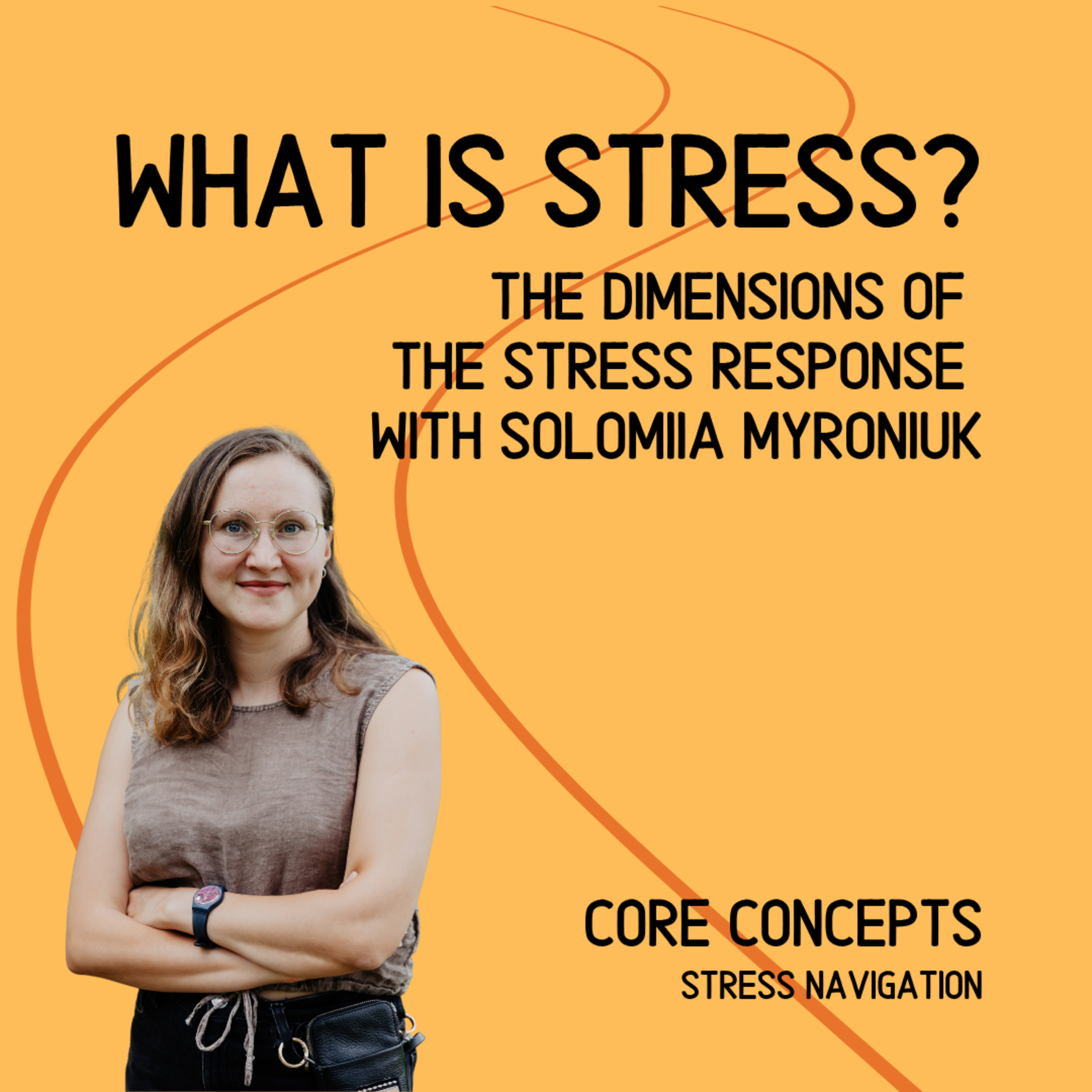
In this episode of Core Concepts, we dive into the stress response. In other words, what happens to us after we encounter a stressor.
Within Stress in Action, the stress response is a central concept of our research but also a broad and complex one. Solomiia Myroniuk, a PhD candidate at the University of Groningen, explains that while we cannot directly measure “the stress response” as a whole, we can measure its different components. She takes us through four key components of the stress response: cognitive, affective, physiological, and behavioural. Importantly, these components do not always have clear boundaries. They can overlap, both conceptually and in the way they are measured in research.
A major focus of Solomiia’s work is disentangling this overlap and improving the precision of stress-response measurement. As she explains, “When we measure (the stress response) we need to be precise to know exactly what we are measuring and to communicate this to other researchers.”
We also discuss coping, how it relates to the different dimensions of the stress response, and some of the challenges involved in studying these processes.
Interested in hearing more about the stress response?
- Listen to the episode with Bertus Jeronimus: https://open.spotify.com/episode/6rux0T5e7t4kaZ8F02jh2k?si=lN5foCR_Qi-WjaiPEF80Cw
- Listen to the core concepts episode with Malin Meyer on Stressors: https://open.spotify.com/episode/2jMky3bxrIw7NJeec9D2hf?si=BOv6PTCqRjm7o4K2Na5kJA
- Read more about Stress in Action: https://stress-in-action.nl/
Credits:
Host: Kiera Drake & Marcos Ross
Production: Anouk Weverling
Supported by: Merel van den Berg, Kiera Drake, Camen van Klaren, Marcos Ross and Myrte Schoenmakers
Music: Marcos Ross
Disclaimer
This podcast’s information is provided for general reference and was obtained from publicly accessible sources. The Podcast Collaborative neither produces nor verifies the content, accuracy, or suitability of this podcast. Views and opinions belong solely to the podcast creators and guests.
For a complete disclaimer, please see our Full Disclaimer on the archive page. The Podcast Collaborative bears no responsibility for the podcast’s themes, language, or overall content. Listener discretion is advised. Read our Terms of Use and Privacy Policy for more details.