A History of Marketing
A History of Marketing
Podcast Description
A podcast about the stories and strategies behind the campaigns that shaped our world. Featuring conversations with top CMOs, marketing professors, authors, historians, and business leaders. marketinghistory.org
Podcast Insights
Content Themes
The podcast covers pivotal moments in marketing history, significant figures, and influential campaigns, with episodes exploring topics such as the origins of advertising from ancient times, the shift towards modern branding, and deep dives into specific figures like Philip Kotler, Edward Bernays, and David Aaker, reflecting on their impact on contemporary marketing practices.
A podcast about the stories and strategies behind the campaigns that shaped our world. Featuring conversations with top CMOs, marketing professors, authors, historians, and business leaders.
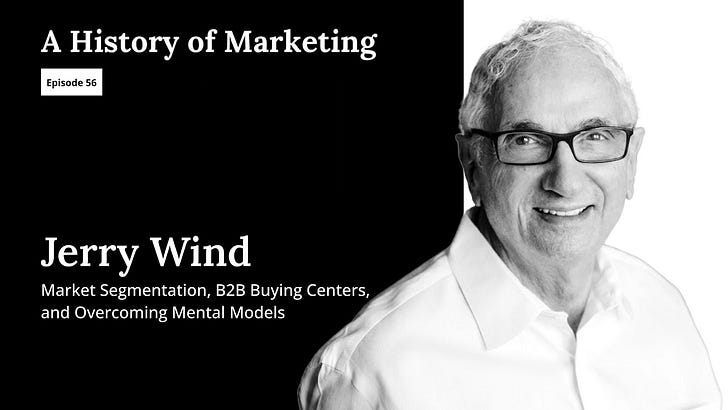
A History of Marketing / Episode 56
Yoram “Jerry” Wind has spent six decades at the frontier of marketing. He has won virtually every major award a marketing scholar can receive, and his CV is more than 100 pages long.
In B2B marketing ,the shift from single leads to buying groups is framed as a new revelation (see my interviews with Kerry Cunningham & Jon Miller). But Jerry Wind mapped organizational buying centers in 1966 and developed the BuyGrid model in 1967.
I was almost angry when I discovered this. “We’ve all known about buying centers since 1966, and marketers are still chasing individual MQLs?!” I had to ask Jerry about this directly. It’s where we kick off our conversation.
We then shift gears to one of my all-time favorite case studies: Courtyard by Marriott.
Like Moneyball, it’s a case study of taking on the old guard (hotel industry veterans trusting their gut) and using data (conjoint analysis on traveler preferences) to build a modern system. Jerry and his collaborator Paul Green used marketing research to reshape the physical world, creating hotel layouts and room designs we still see today.
Jerry’s foresight is just as impressive. More than 10 years ago, he was writing and presenting on AI and its coming impact on marketing and education. Last year, at age 87, he published Creativity in the Age of AI.
We also cover:
* The RAVES framework and balancing cognitive data with emotional appeals
* Why the CMO role must evolve to orchestrating all customer touchpoints
* How to spend a career challenging mental models
* Why most marketing lectures fail and how to fix them
For me, this conversation felt like a return to form for the podcast. It’s in a class alongside my interviews with legendary professors like Philip Kotler, David Aaker, Jag Sheth, and George Day.
I learned a lot from Jerry, and I find his prolific career inspiring. I hope you like it too.
Listen to the podcast: Spotify / Apple Podcasts
Special thanks to Xiaoying Feng of Syracuse University for reviewing and editing transcripts for accuracy and clarity.
In case you missed it, play the “Date the Ad” marketing history game. Learn more.
The Wharton School in 1967: Bridging Theory and Real-World Practice
Andrew Mitrak: I want to start right at the beginning of your career as you were entering the field of marketing. Can you describe the scene of what marketing looked like as a field back in 1967 around the time you first joined Wharton?
Jerry Wind: Marketing was a little different, but it was the beginning of kind of what we see today. And I think one of the great things about Wharton is Wharton had the orientation that we still have, which is marketing theory and methodology has to have practical value. It started with Wroe Alderson, who was basically the founder of this practical approach to marketing. And with Paul Green, who really was the main figure in the Wharton marketing since the early ‘60s, but he joined the department. I joined in January ‘67, primarily because of Paul Green and Ron Frank. I liked their orientation and approach, and at the time Wharton Marketing also had the Marketing Science Institute that was actually launched because of the work of Wroe Alderson, that convinced Scott McCabe from Scott Paper to start an institute that will bring industry to academia and academia to industry. When I joined Wharton, I almost immediately joined some of the projects at the Marketing Science Institute. So the environment at Wharton was really a little different than the rest of the field. We were very much, especially because of the influence of Paul Green, focused on new methodology. Reavis Cox was still at Wharton at the time and he was kind of one of the leaders in the marketing theory area. I think it was an ideal place to be in. It probably was the most advanced of most of the other marketing departments at the time.
Andrew Mitrak: One of the names you mentioned a couple of times, I was wondering if you’d bring him up, is Wroe Alderson, because I did a whole episode on Wroe Alderson. I interviewed his son, I interviewed Stan Shapiro, and I interviewed a scholar named Ben Willis Croft who had studied the life of Wroe Alderson. I think Wroe would have probably just passed away in 1966, right before you joined.
Jerry Wind: Correct. I never met him. All I know about him is really through Paul Green.
The Influence of Wroe Alderson
Andrew Mitrak: Could you speak to him as a figure? Because it seems like he’s one of those figures who had a lot of influence in marketing, but kind of—I don’t want to say he was forgotten, we’re talking about him here, but his impact, maybe because he passed away right in the 1960s as marketing was taking off and growing as a field. I’m wondering if you have any comments or would want to speak more on his influence.
Jerry Wind: Well, Wroe actually had a consulting firm, was very active, and it’s still very insightful to read—I think it was called Cost and Profit, the short publications that he issued. He really influenced a lot of us, definitely Paul Green, who then influenced the rest of Wharton marketing and the field. It also legitimized to a large extent consulting. For many years, consulting was viewed as: you could say you have one day a week you could do some consulting. Most of the consulting people did was really lecturing to industry. Lecturing is not really consulting. The real consulting that Wroe epitomized, and that Paul Green and I did a lot over the years together, were actually solving business problems. A lot of the developments in marketing over the years, especially on the methodology side, came because we had to solve problems of real companies who faced them. Conjoint analysis, multidimensional scaling—all of these are great examples of developments that came because of needs of industry and the need to address specific problems.
Organizational Buying Behavior: The Buygrid Model and the Buying Center
Andrew Mitrak: That actually is a nice segue to organizational buying behavior. This is one of the topics you researched. For context, I am a marketer and I’ve almost always worked in B2B marketing. The way that organizations buy is really interesting, and I think that the way things are sometimes set up and measured today are flawed and don’t really take into account the dynamics of organizational buying behavior. I want to start just by asking you about that and why did you start researching it? What was the scene of the status quo of the way people thought about the way organizations buy, and how did your research help change that?
Jerry Wind: I started because, first of all, I was curious. It was curiosity as to: how do organizations buy? How do they make the buying decision? The literature at the time was not very helpful. Luckily, one of the faculty at Stanford at the time was Bob Davis, who chaired my dissertation committee, who also worked as vice president at Varian Associates, which was an industrial firm. In discussions with him and with Ron Frank and Bill Massy, who were basically the lead faculty at Stanford, Bob Davis suggested, “Why don’t you start speaking with some of the people at Varian and get a feel for what’s happening?” That led to actually studying them and studying another company, Motorola, that had major operations in Las Vegas at the time. So the motivation was fundamentally: how do they buy? How do organizations buy? How do they make the buying decision? Since very little was known at the time, I thought it was a bright field to start, and it was a great start. Also, it reinforced the belief that was developed later on when I moved to Wharton of the importance of working with industry.
Andrew Mitrak: Did you visit Las Vegas and Motorola in the late ‘60s or early ‘70s?
Jerry Wind: Spent a lot of time. This was in the ‘60s. I worked on the dissertation from primarily late ‘64, ‘65, and ‘66. I got it from Stanford. My doctorate at Stanford was two years; it was ‘65–’66.
Andrew Mitrak: What was Las Vegas like in the ‘60s? Was there …
This is a public episode. If you would like to discuss this with other subscribers or get access to bonus episodes, visit marketinghistory.org
Disclaimer
This podcast’s information is provided for general reference and was obtained from publicly accessible sources. The Podcast Collaborative neither produces nor verifies the content, accuracy, or suitability of this podcast. Views and opinions belong solely to the podcast creators and guests.
For a complete disclaimer, please see our Full Disclaimer on the archive page. The Podcast Collaborative bears no responsibility for the podcast’s themes, language, or overall content. Listener discretion is advised. Read our Terms of Use and Privacy Policy for more details.