How did it make sense?

How did it make sense?
Podcast Description
'How did it make sense?' explores the local rationality of those involved in doing what they did. Each podcast lasts about 45 mins and aims to follow a similar format. Initially, we will look at the 'first story' which is normally scant in details and triggers an emotional response, and then we will look at the 'second story' that looks at the goal conflicts, the ambiguities, the assumptions, the tensions, and the trade-offs that led to those involved doing what they did. This context-rich story is the one that learning opportunities come from, not focusing on the counterfactuals that often arise from 'first stories'.
The goal is to encourage you to look deeper at the socio-technical system presented by the guests and how we can make improvements by abstracting from the multiple domains discussed in the podcast to the our own domains.
Podcast Insights
Content Themes
The podcast covers themes centered around organizational safety, human factors, and decision-making in high-pressure environments. Specific episodes address topics such as the complexities of workplace safety in the mining industry, the risks associated with software testing, and the psychological factors behind decision-making during crises. For example, Episode 14 investigates the implications of incomplete software testing during the CrowdStrike outage, highlighting how trade-offs between speed and safety impact outcomes.

‘How did it make sense?’ explores the local rationality of those involved in doing what they did. Each podcast lasts about 45 mins and aims to follow a similar format. Initially, we will look at the ‘first story’ which is normally scant in details and triggers an emotional response, and then we will look at the ‘second story’ that looks at the goal conflicts, the ambiguities, the assumptions, the tensions, and the trade-offs that led to those involved doing what they did. This context-rich story is the one that learning opportunities come from, not focusing on the counterfactuals that often arise from ‘first stories’.
The goal is to encourage you to look deeper at the socio-technical system presented by the guests and how we can make improvements by abstracting from the multiple domains discussed in the podcast to the our own domains.
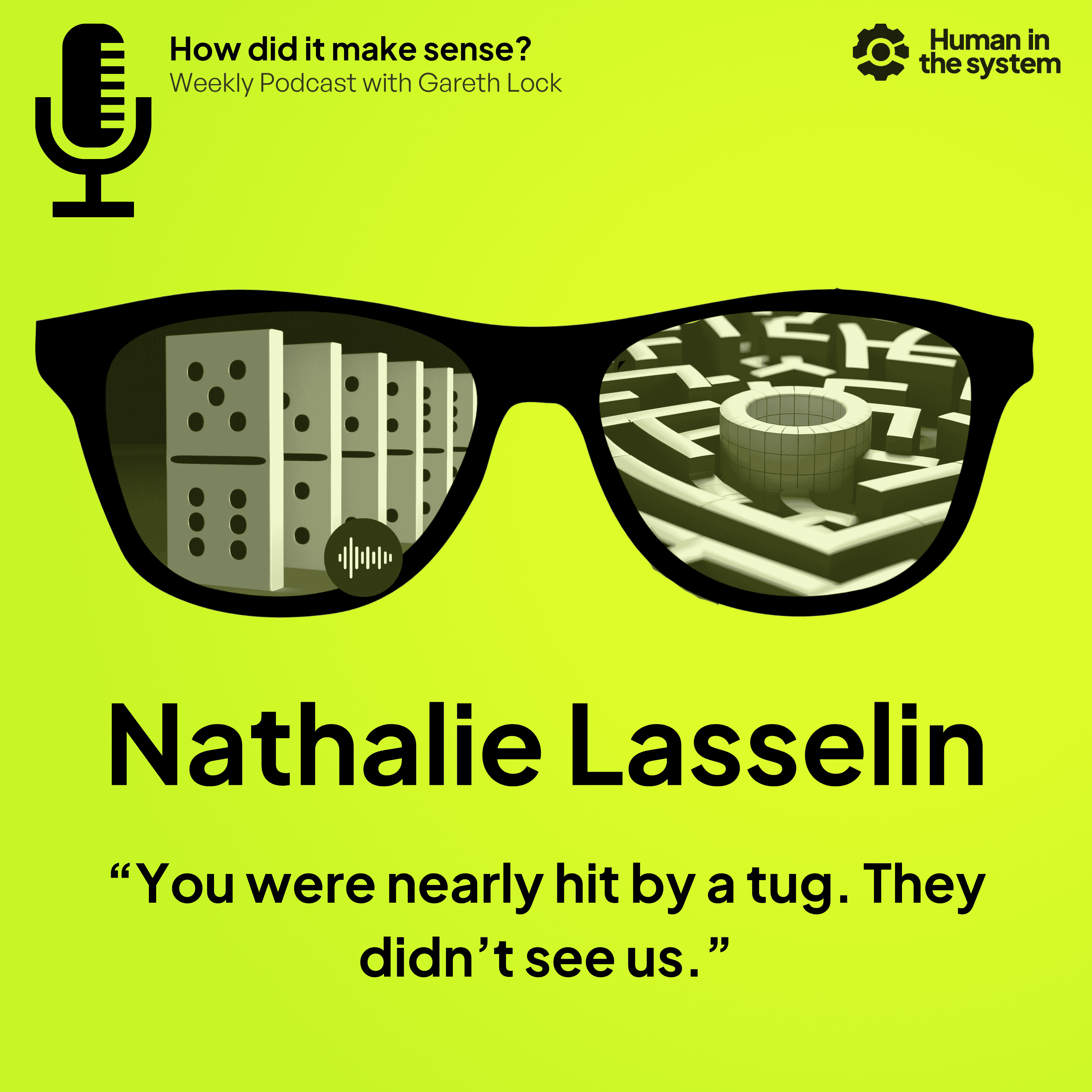
On today’s episode of How did it make sense I am joined by Nathalie Lasselin, a filmmaker, technical diver, explorer, and someone who dives where most people wouldn’t even go looking.
Nathalie’s story starts with an ambitious expedition called Urban Water Odyssey, a 44-mile dive along the St. Lawrence River with a large support team. The plan was meticulous, the team trained, and everything seemed under control, until the dive ran late, the river got busy, and night fell. When Nat surfaced, she was struck by a boat, and only then did the team realise a tugboat was approaching. They pushed her out of the way, but the near-miss revealed a gap in the operation: no dedicated lookout, broken communication, and the kind of task overload that makes obvious risks invisible.
What makes this episode powerful is not just the incident, but the deeper learning behind it. Nat breaks down how the expedition’s delays created cascading failures, how people’s perception of risk changes under pressure, and how the team culture their focus, trust, and ability to respond saved her life. This conversation is a reminder that you can’t design risk out of real-world operations; you can only build resilience and a team that can fail safely.
Find Nathalie here:
Website : www.aquanath.com
Non profit organisation : www.aquasubterra.org
Facebook: https://www.facebook.com/NathLasselinofficialpage/
Linkedin: https://ca.linkedin.com/in/nathalie-lasselin-72419721/en
Instagram: @aquanathstudios
Vimeo: https://vimeo.com/aquanath
Chapters
0:00 Start of the story: Urban Water Odyssey
1:20 The dive runs late and conditions worsen
2:40 Nat surfaces and is hit by a boat
4:00 The tugboat appears: “They didn’t see us”
5:20 What went wrong: no lookout & communication failure
7:00 The role of team culture in the rescue
8:40 The bigger lesson: resilience and failing safely
10:00 Recommended reads and mindset resources
Connect with Gareth:
Transforming teams. Unlocking human potential.
Using principles from Human Factors (HF), High-Reliability Organisations (HRO), and Human and Organisational Performance (HOP), we develop and deliver highly immersive and impactful programmes using the High-Velocity Learning LAB (HVLL) concept. We give you the know-how, the tools and the support to make results stick and empower your people to achieve the extraordinary. We help you answer the question “How do we uncover those hidden stories in our organisation?”
Find us on Youtube – https://www.youtube.com/@HITS-HDIMS
Disclaimer
This podcast’s information is provided for general reference and was obtained from publicly accessible sources. The Podcast Collaborative neither produces nor verifies the content, accuracy, or suitability of this podcast. Views and opinions belong solely to the podcast creators and guests.
For a complete disclaimer, please see our Full Disclaimer on the archive page. The Podcast Collaborative bears no responsibility for the podcast’s themes, language, or overall content. Listener discretion is advised. Read our Terms of Use and Privacy Policy for more details.