Aggressively Human: Online Business in the Age of AI, Algorithms & Automations
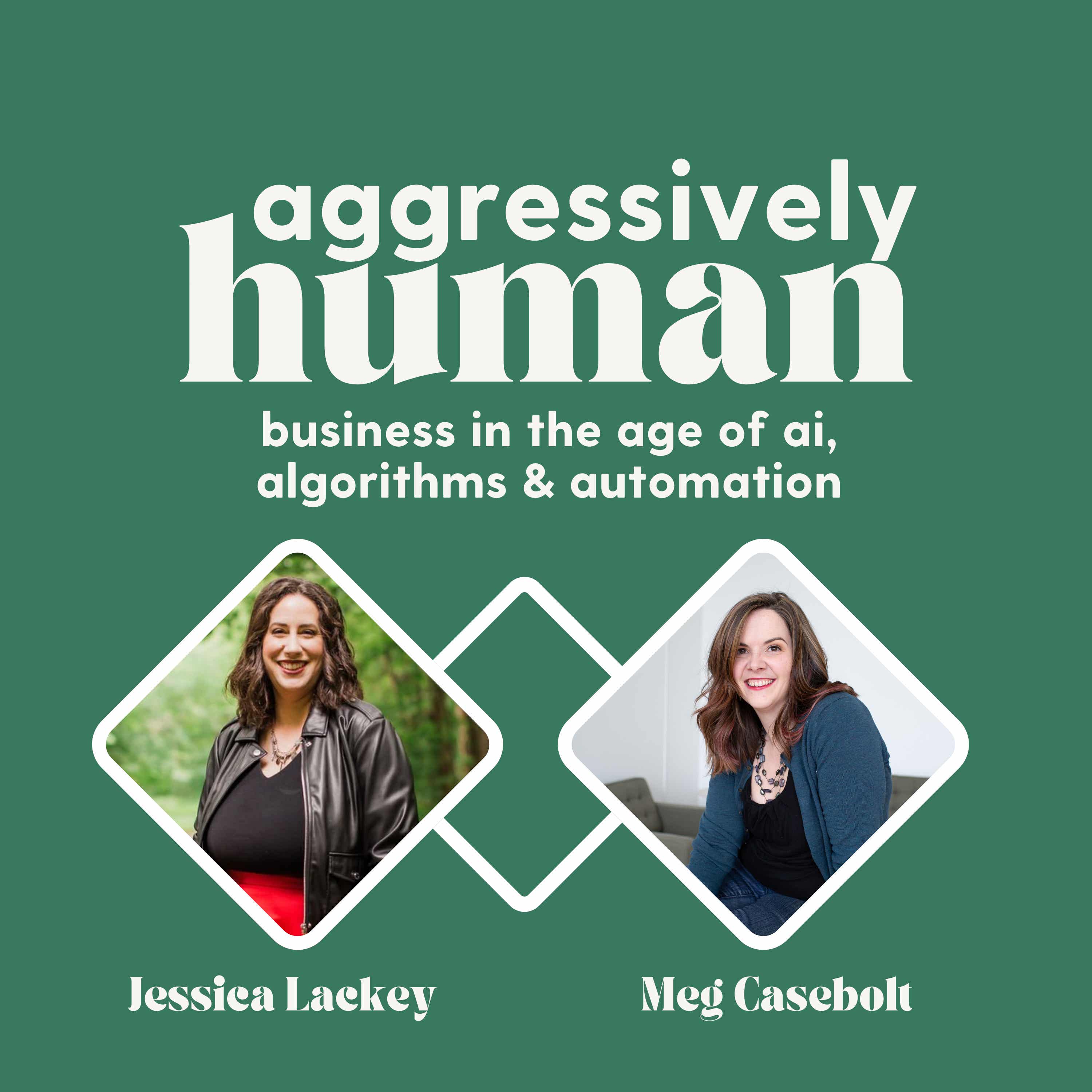
Aggressively Human: Online Business in the Age of AI, Algorithms & Automations
Podcast Description
In a world focused on more: more content, more followers, more marketing, more scale, more noise… we’re facing less trust, less contact, less reach.
We’re drowning in AI-generated slop, being pitch-slapped by “personalized” email funnels that couldn’t be farther from authentic, and struggling to be seen by a pay-to-play algorithm.
It’s never been easier to create and connect more cheaply and at more scale, with less trust and more skepticism.
But for experts and service-based businesses? We’re seeing the pendulum swing back.
The answer isn’t to play by these trends. It’s to be **aggressively human.** aggressivelyhuman.substack.com
Podcast Insights
Content Themes
The podcast focuses on themes such as the human element in business amidst automation, community building, and marketing ethics, with specific episode examples exploring topics like the significance of dialogue in audience engagement, the power of community over commodities, and human-centered podcasting approaches.

Aggressively Human is a podcast about building expert-led businesses around expansion, not extraction.
Hosted by Meg Casebolt and Jessica Lackey, the show explores what happens when conventional business advice meets the reality of the people who actually have to live with its consequences.
We talk about sustainable growth and business models, marketing and algorithms, AI and automation, expertise and authority, mental health and capacity, relationships, and the choices underneath all of it: What are you optimizing for? What do you gain? What does it cost? And does the tradeoff make sense for the actual humans involved?
We’re not here to prescribe a new set of rules for running your business. We’re interested in helping independent experts make thoughtful decisions about what to grow, what to automate, what to protect, and what they want their businesses to make possible.
Because your business should support your life. Not the other way around.
Most of the conversation about AI and writing is stuck on whether it can write well. Samantha Pollack thinks that’s the wrong question. The one that matters for your business is whether it can write like you, and whether you’d recognize your own voice if you saw it.
For the second episode in our series on voice, we welcome back developmental editor and writing coach Samantha Pollack. Sam runs Indie Copy Studio and works with business owners, authors, and academics who share a healthy side-eye for anything artificial, and she explains what developmental editing looks like when it’s applied to sales pages and emails instead of manuscripts. Her answer to “how do I know what I sound like?” is refreshingly unglamorous: you have to write a lot before you can hear it.
We talk about why writing to format is how the internet got so much slop long before AI showed up, and the difference between writing to get something from your reader and writing to give them something. Sam also makes the case that reading fiction, and even Hamlet, might be the most useful homework a business owner can take on.
* Why “is AI good at writing?” is the wrong question, and what to ask instead
* What a developmental editor actually does, and how that applies to a sales page
* Why you can’t find your voice before you’ve written enough to see it
* Spotting a writer’s signature quirks, and knowing when they tip over into a gimmick
* Writing as craft vs. writing to format: how LinkedIn templates and 2016-era copywriting formulas gave us slop long before AI
* Free-writing prompts that get you out of outcome mode (starting with “tell me the story of an object on your desk”)
* Writing to get vs. writing to give, and the “empathy switch” that keeps flipping mid-draft
* Why reading outside the business bubble, especially fiction, makes you a better business writer
* Why “I only use AI to edit” is riskier than it sounds if you don’t know how to edit
“There are people who will be like, ‘I don’t use AI to write, I just use it to edit.’ And that makes my little editor heart cry, because if you don’t understand how to edit writing, you’re not gonna be able to discern whether or not AI did a good job. And in your mind you’ll be like, ‘Oh, this looks fine,’ because objectively it will look fine. It will be grammatically correct, it will have some kind of varied rhythm. It’s just gonna feel flat and hollow because it isn’t basing anything on a feeling. When you read writing, it creates a feeling. And that’s why AI writing sounds like AI writing, because you don’t feel anything when you read it.” – Sam
About our Guest
Connect with Us
This is a public episode. If you would like to discuss this with other subscribers or get access to bonus episodes, visit aggressivelyhuman.substack.com

Disclaimer
This podcast’s information is provided for general reference and was obtained from publicly accessible sources. The Podcast Collaborative neither produces nor verifies the content, accuracy, or suitability of this podcast. Views and opinions belong solely to the podcast creators and guests.
For a complete disclaimer, please see our Full Disclaimer on the archive page. The Podcast Collaborative bears no responsibility for the podcast’s themes, language, or overall content. Listener discretion is advised. Read our Terms of Use and Privacy Policy for more details.