The MILCOM Founders Podcast
The MILCOM Founders Podcast
Podcast Description
Championing and celebrating veteran founders through weekly conversations. Each episode features military entrepreneurs sharing their journey from service to success, uncovering real strategies for business growth, capital raising, and applying military leadership in the private sector.
Podcast Insights
Content Themes
The podcast focuses on themes such as entrepreneurship, business growth strategies, and the application of military leadership principles in civilian business contexts. Episodes include topics like funding approaches for startups, as seen in the discussion with Dr. Trillitye Paullin on transitioning from military service to launching a global telehealth service, and strategies for creating a gratitude-driven workplace culture shared by Austen Brower.
Championing and celebrating veteran founders through weekly conversations. Each episode features military entrepreneurs sharing their journey from service to success, uncovering real strategies for business growth, capital raising, and applying military leadership in the private sector.
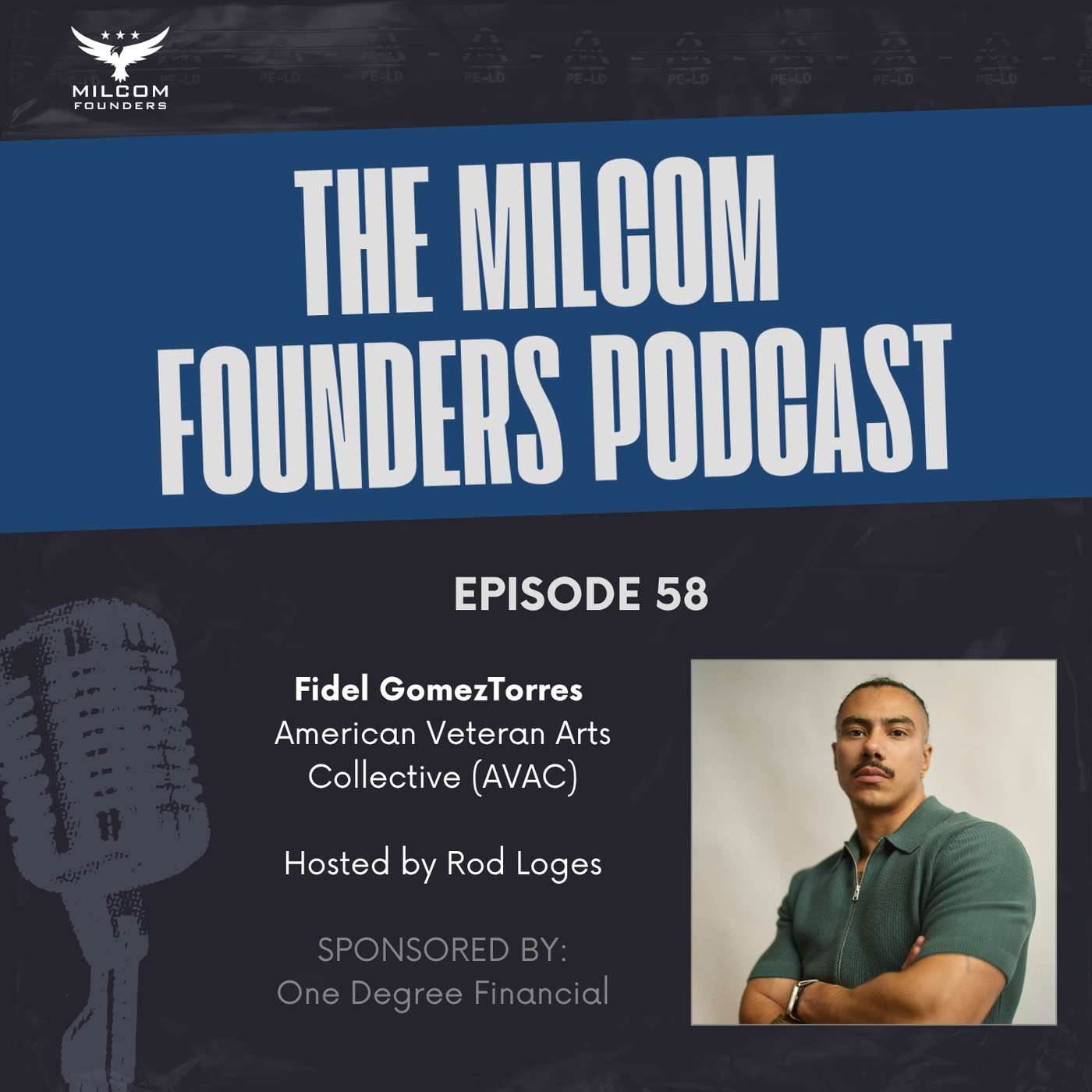
MilCom Founders Podcast, Episode 58: Building Workforce Pathways from Military Service into the Creative Economy with Fidel GomezTorres
Join host Rod Loges and guest Fidel GomezTorres as they explore how a Navy Seabee veteran turned his experience in logistics and community building into the foundation for the American Veteran Arts Collective (AVAC), a nonprofit creating workforce pathways for veterans and military-connected families into the creative economy. Fidel shares how he arrived in Washington, D.C. during a period of significant federal workforce disruption and recognized a gap between the 30,000 veterans living in the district and a $15 billion creative economy that rarely engaged military talent.
In this episode:
- Fidel describes his decision to join the Navy after 9/11, driven by a sense of duty rooted in his immigrant background and a family culture of sacrifice, and how he was assigned as a Seabee builder, a role he had never considered before enlisting.
- He reflects on the difference between inspiration and motivation as leadership models, explaining how the military replaced the elusive, creative-world idea of inspiration with disciplined commitment, and why that shift shaped how he approaches building an organization today.
- Fidel shares how his first post-military job as an executive assistant to a fashion CEO in New York City revealed that veterans carry logistics and leadership skills that creative sector employers value but rarely know how to recruit for.
- He explains the founding of AVAC as a direct response to the wave of federal job losses affecting veterans in the D.C. metro area, and how he identified the creative economy as an underutilized pathway for veteran employment and economic mobility.
- The conversation covers AVAC’s pilot program with the Veterans History Project at the Library of Congress, where targeting eight to ten participants produced sixteen, doubling the goal and validating both veteran interest in the creative sector and cultural institutions’ appetite for military talent.
- Fidel describes AVAC’s three-track measurement system, which captures feedback from veteran participants, cultural partners, and an independent field observer with no connection to either the military or the arts, as a way to surface what those inside the room cannot see.
- He explains how post-pilot feedback led directly to the creation of AVAC’s workforce fellowship, a structured mechanism designed to remove financial pressure from veterans engaged in the program and improve the quality of impact data collected.
- Fidel addresses the challenge of making AVAC’s mission relevant to people who do not identify with either veterans or the arts, arguing that veterans employed across more sectors means more resilient labor markets and stronger communities, regardless of personal connection to the cause.
- The episode closes with Fidel outlining AVAC’s next phase: moving from pilot delivery into capitalization, proving repeatability, and eventually scaling the model to cities with large veteran populations and strong creative ecosystems, including Dallas, Houston, and San Antonio.
Key takeaways:
- Discipline is a more reliable engine than inspiration. Motivation means doing what needs to be done whether or not you feel ready, and that consistency is what allows founders to build before the vision is fully proven.
- Proof precedes scale. Fidel deliberately treated AVAC’s first year as a pilot year, resisting the pull toward expansion until the core thesis was validated by real participant outcomes and institutional response.
- Reserving space for discovery is not optional. The fellowship, one of AVAC’s core program features, did not exist before the first pilot. It emerged only because Fidel built in room to learn rather than locking the model down in advance.
- The field observer role is worth stealing. Bringing in someone with no stake in the outcome and no prior connection to the population or the sector produces feedback that insiders, no matter how thoughtful, are structurally unable to generate themselves.
- Veterans bring transferable value that the creative economy has not yet learned to recruit for. The gap is not a talent gap on the veteran side. It is a translation and awareness gap on the employer side.
- Community building starts with genuine curiosity about worlds outside your own. Fidel credits the military with teaching him to find common ground across difference, and names that skill as the foundation of everything AVAC does to connect two communities that have rarely shared a table.
- Making the business case matters as much as making the mission case. Social impact organizations that can articulate economic returns alongside human outcomes are better positioned to survive funding environments where feel-good is no longer sufficient.
Guest: Fidel GomezTorres, Founder and Executive Director of the American Veteran Arts Collective (AVAC), U.S. Navy veteran
- LinkedIn: https://www.linkedin.com/in/fgt023/
- Website: https://americanveteranarts.org/
Fidel GomezTorres is the Founder and Executive Director of the American Veteran Arts Collective (AVAC), a nonprofit building workforce pathways for veterans and military-connected families into careers across the arts, culture, and creative economy. An incubator-backed entrepreneur, Georgetown University graduate student, and George W. Bush Institute Stand-To Veteran Leadership Program Scholar, his work sits at the intersection of public policy, workforce development, veteran advocacy, and the creative economy. Through partnerships with cultural institutions, public agencies, and employers, he is developing a scalable model that helps veterans translate military leadership into meaningful civilian careers while strengthening the institutions they serve. His work explores how credibility, strategic partnerships, and mission-driven leadership can help founders build organizations that create lasting public value.
The MilCom Founders Podcast champions and celebrates military community business founders. Each episode brings practical insights from successful veteran entrepreneurs.
Sponsored by One Degree Financial www.onedegreefinancial.com
Take our Financial Clarity Self-Assessment. 16 questions. You’ll know where your weak spots are and what to work on first: https://bit.ly/4xp7jnq
Want to support veteran entrepreneurs? Donate to the Dick Loges Veteran Entrepreneur Scholarship Fund: https://bold.org/funds/dick-loges-veteran-entrepreneur-fund/
Disclaimer
This podcast’s information is provided for general reference and was obtained from publicly accessible sources. The Podcast Collaborative neither produces nor verifies the content, accuracy, or suitability of this podcast. Views and opinions belong solely to the podcast creators and guests.
For a complete disclaimer, please see our Full Disclaimer on the archive page. The Podcast Collaborative bears no responsibility for the podcast’s themes, language, or overall content. Listener discretion is advised. Read our Terms of Use and Privacy Policy for more details.