Thinking in Dark Times. A Podcast from Ukraine

Thinking in Dark Times. A Podcast from Ukraine
Podcast Description
A philosophical and cultural podcast from Ukraine. By Volodymyr Yermolenko, Ukrainian philosopher and writer. I live and work in Ukraine, doing both intellectual and practical volunteering work in the context of the Russian invasion against Ukraine.
I try to see the light through and despite the darkness.
Support my work at: https://www.patreon.com/c/thinking_in_dark_times
Podcast Insights
Content Themes
The podcast delves into themes of philosophy, culture, and political discourse, with a focus on the current state of democracy and autocracy, illustrated through episode topics such as Anne Applebaum's exploration of autocracies and the fragility of democracies, along with discussions on Ukraine's pivotal role in global philosophical dialogue.
A philosophical and cultural podcast from Ukraine. By Volodymyr Yermolenko, Ukrainian philosopher and writer. I live and work in Ukraine, doing both intellectual and practical volunteering work in the context of the Russian invasion against Ukraine.
I try to see the light through and despite the darkness.
Support my work at: https://www.patreon.com/thinkinggg
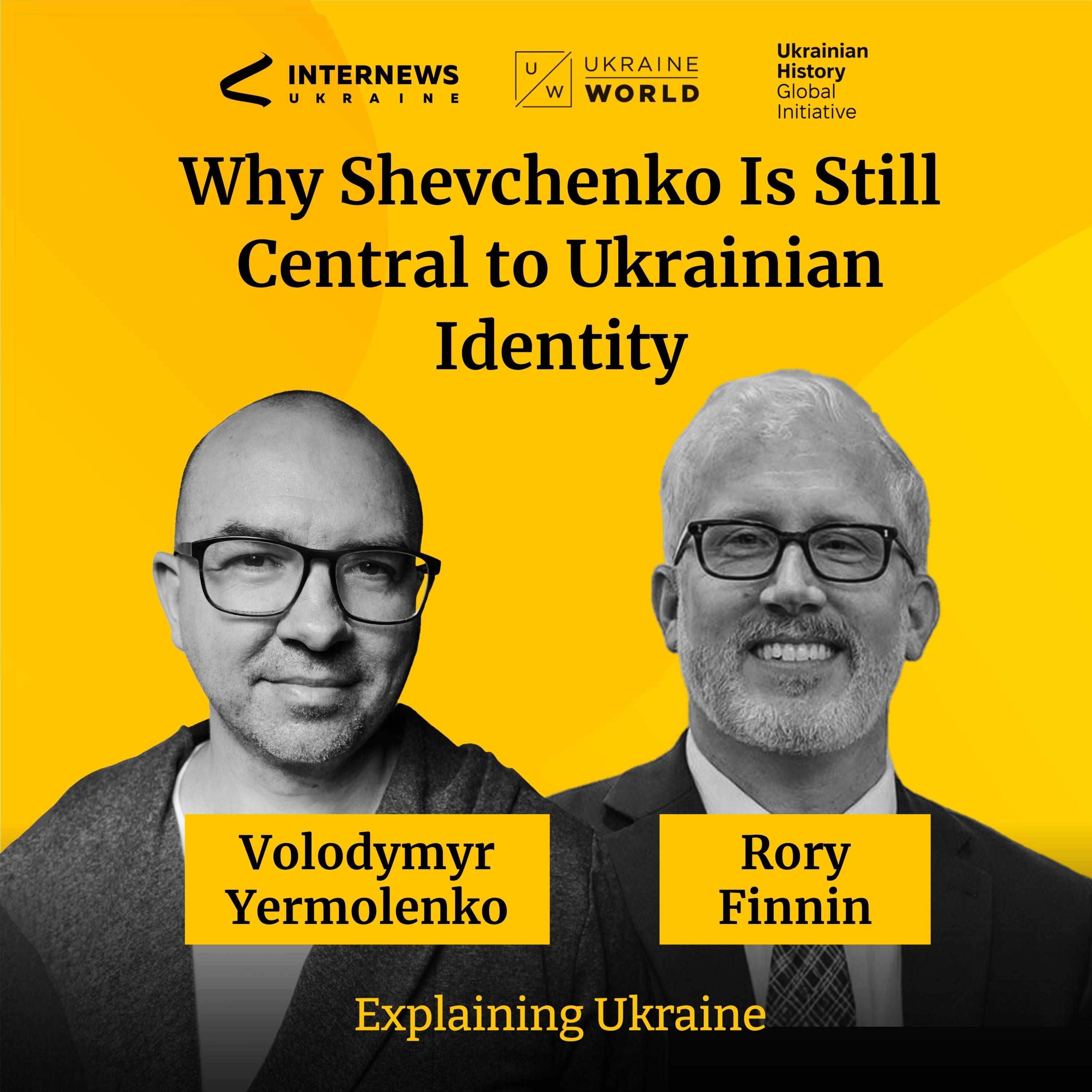
Why does Taras Shevchenko remain the central figure of Ukrainian culture? Why is a poet who lived in the 19th century still perceived in Ukraine almost as a contemporary?
How does Shevchenko’s understanding of time and history differ from our present-day perspective, so focused on the immediate moment and often lacking the depth of historical memory? And how did he articulate powerful anticolonial ideas as early as the 19th century — particularly through his empathy and solidarity with other oppressed peoples?
This is the Thinking in Dark Times podcast.
***
Host: Volodymyr Yermolenko, a Ukrainian philosopher, editor-in-chief of UkraineWorld, and president of PEN Ukraine.
Guest: Rory Finnin, the Notre Dame Collegiate Mission Chair in Ukrainian Studies and Global Affairs and director of the Ukrainian Studies Hub at the University of Notre Dame. He is a scholar of Ukrainian culture, literature, and identity, and the author of the award-winning book Blood of Others: Stalin’s Crimean Atrocity and the Poetics of Solidarity.
***
Explaining Ukraine is a podcast by UkraineWorld, an English-language media outlet about Ukraine brought to you by Internews Ukraine.
We thank the Ukrainian History Global Initiative for helping us to organize this conversation.
***
Listen on various platforms: li.sten.to/thinkinggg
UkraineWorld: ukraineworld.org/en
***
SUPPORT:
You can support our work on www.patreon.com/c/thinkinggg
Your help is crucial, as we rely heavily on crowdfunding.
You can also contribute to our volunteer missions to frontline areas in Ukraine, where we deliver aid to both soldiers and civilians.
Donations are welcome via PayPal at: [email protected].
***
CONTENTS:
00:00 Why does Taras Shevchenko remain a central and contemporary figure in Ukrainian culture, articulating anti-colonial ideas from the 19th century?
01:55 Why is Shevchenko a contemporary figure, rather than just a historical classic?
03:02 How does the West's tendency to mirror Russia psychologically, but not rhetorically, hinder its understanding of the war?
06:15 How does Shevchenko's understanding of ”imperialist time” contrast with the West's short-term perspective, as seen in Russia's 19th-century conquest of Circassia?
09:49 How does Shevchenko's empathy for oppressed peoples like the Circassians differ from the imperialist narratives found in Russian literature?
12:40 What makes Shevchenko's poetry so contemporary, and how does his use of ”anti-repoussoir” allow readers to connect personally with the struggles of conquered peoples, even his own friend who died fighting them?
17:57 How does Shevchenko's view of history as an ”eternal return” and a series of constant tests, like those faced by early Christians or Jan Hus, make his work timeless?
20:25 How is Shevchenko's biblical worldview centered on profound empathy for the vulnerable, even applying this lens to Christ himself?
22:42 What tragic event in 1978, involving Oleksa Hirnyk's self-immolation on Shevchenko's grave, underscores the poet's enduring anti-colonial message?
25:40 Why does the West continue to misunderstand Russia, despite ample historical literature, by focusing on a ”soothing” alternative rather than its vast, multi-ethnic, and often oppressive reality?
30:12 How does Shevchenko's poem ”Haydamaky” navigate the complex issue of violence, seemingly romanticizing it while simultaneously depicting its descent into madness?
31:19 Does ”Haydamaky” romanticize violence, or does Shevchenko's original perspective condemn the internal infection of violence within Ukrainian society?
37:31 What is Shevchenko's dual legacy of creating a national myth while also offering a critical perspective on Ukrainian history and the importance of family bonds?
38:41 Closing remarks and support information for the ”Explaining Ukraine” podcast.
Disclaimer
This podcast’s information is provided for general reference and was obtained from publicly accessible sources. The Podcast Collaborative neither produces nor verifies the content, accuracy, or suitability of this podcast. Views and opinions belong solely to the podcast creators and guests.
For a complete disclaimer, please see our Full Disclaimer on the archive page. The Podcast Collaborative bears no responsibility for the podcast’s themes, language, or overall content. Listener discretion is advised. Read our Terms of Use and Privacy Policy for more details.