Small College America

Small College America
Podcast Description
During Season One, Tom Davidsson and Dean Hoke are going to talk with four Small College Presidents across the United States about their institutions and what makes them unique and important to their communities. Also, they will discuss their challenges and their views for the future.
Podcast Insights
Content Themes
The show explores the unique characteristics and challenges of small colleges. Key topics include institutional history, community involvement, athletic programs, and leadership lessons. For example, episodes feature discussions on Cottey College's international student programs and the sustainability of small colleges like the University of Rio Grande.

Small College America is a podcast series that presents critical discussions at the forefront by interviewing small college higher education leaders, policy experts, and innovators. The podcast will delve into the evolving role of small colleges, their economic impact, innovative strategies for sustainability, and how they can continue to provide a highly personalized educational experience. The series is co-hosted by Dean Hoke, Co-Founder of Edu Alliance Group and a Senior Fellow with the Sagamore Institute, and Kent Barnds, Executive Vice President for Strategy & Innovation and Vice President of Enrollment & Communication for Augustana College.
Welcome to Small College America, a podcast dedicated to exploring the role and value of small colleges in the higher education landscape. I’m Kent Barnds, Executive Vice President of Augustana College, and I’m joined by my co-host Dean Hoke, Co-Founder of Edu Alliance Group. Most of our conversations focus on long-established small colleges and how they’re adapting to the challenges facing higher education. Today, we’re taking a different approach. We’re speaking with someone who is helping build an entirely new college from scratch. It raises an intriguing question: If we were designing a college today, knowing what we know about rising costs, changing student expectations, and workplace demands, what would it look like? Dean, let me turn it over to you to introduce our guest.
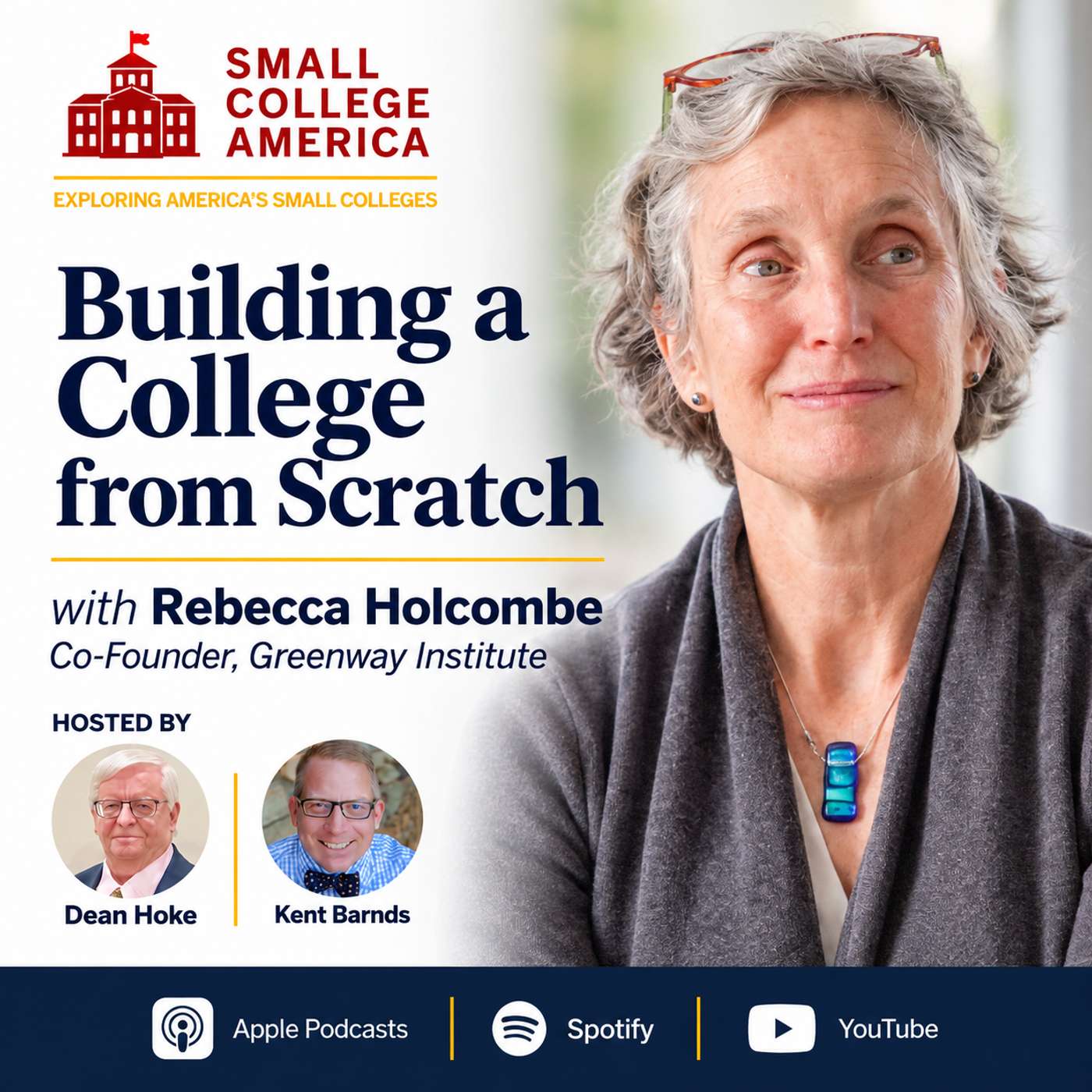
Dean: Today, we’re joined by Rebecca Holcombe, co-founder of the Greenway Institute, a new engineering college being developed in Montpelier, Vermont, with plans to welcome its first students in fall 2027. Rebecca began her career as a teacher and principal, later directed Dartmouth’s Teacher Education Program, and served as Vermont’s Secretary of Education under both Democratic and Republican governors. She was elected to the Vermont legislature in 2022 but chose not to seek reelection to focus on Greenway.
Rebecca, I came across a 2013 article in Seven Days about your rather unusual childhood. You grew up in several countries, including Afghanistan and Pakistan, and your family had to leave Afghanistan during the Soviet invasion in 1979. I also read that at one point your father became your algebra teacher at home. That certainly was an interesting childhood!
Rebecca, welcome to Small College America.
INTERVIEW QUESTIONS
Kent: Rebecca, to begin, tell our listeners a little about the Greenway Institute and what you’re hoping to create in Montpelier. You’ve had a career spanning teaching, school leadership, state education policy, and public office. How did you become involved with Greenway, and what convinced you to devote this stage of your career to establishing a new college? Follow-up: Was creating a college something you had ever envisioned doing, or did this opportunity develop unexpectedly?
Dean: At a time when many small private colleges are struggling financially, merging, or closing, you and your colleagues decided to establish an entirely new institution. Your fellow co-founder Mark Somerville spent much of his career at Olin College of Engineering, which was itself designed to rethink engineering education. What lessons from Olin influenced Greenway, and why start from scratch rather than work through an existing college?
Kent: Greenway proposes a four-year engineering program in which students spend two years on campus and two years working in industry while earning academic credit. You’re also rethinking some traditional college amenities and services. What will a student’s experience look like, and what have you learned from the pilot programs, including your work with Elizabethtown College students?
Dean: Olin benefited from extraordinary financial backing when it was established, with the F. W. Olin Foundation ultimately committing approximately $460 million. Greenway, by comparison, has a fundraising goal of $30 million by 2031. How does that difference affect your approach to building and sustaining a new institution?
Kent: Greenway’s success will depend on industry partners willing to provide meaningful paid work experiences, faculty attracted to a different approach to teaching, and students willing to enroll in a college that hasn’t yet opened. How are you approaching these three challenges, and what kind of response are you receiving?
Dean: Rebecca, let’s close by looking five years into the future. If we’re having this conversation in 2031, what would success look like for Greenway? And what lessons do you hope other small colleges might learn from what you’re attempting to build?
Closing
Kent: Rebecca, thank you for joining us and helping us understand the vision behind the Greenway Institute, the challenges of building a new college, and what your experience may teach other small institutions. We appreciate your perspective and your time.
For those listening or viewing, visit www.smallcollegeamerica.net to learn more about Small College America, find past and upcoming episodes, leave comments, and subscribe. On behalf of our guest Rebecca Holcombe, my co-host Dean Hoke, and me, thank you for joining us.
Disclaimer
This podcast’s information is provided for general reference and was obtained from publicly accessible sources. The Podcast Collaborative neither produces nor verifies the content, accuracy, or suitability of this podcast. Views and opinions belong solely to the podcast creators and guests.
For a complete disclaimer, please see our Full Disclaimer on the archive page. The Podcast Collaborative bears no responsibility for the podcast’s themes, language, or overall content. Listener discretion is advised. Read our Terms of Use and Privacy Policy for more details.